
Sterilization methods and apparatus which employ additive-containing supercritical carbon dioxide sterilant
a carbon dioxide and additive-containing technology, applied in the field of sterilization methods and apparatuses, can solve the problems of inability to implement many new medical advances, compromise mechanical properties, and inability to sterilize steam with thermally or hydrolytically labile polymers, and achieve the effect of linear inactivation
- Summary
- Abstract
- Description
- Claims
- Application Information
AI Technical Summary
Benefits of technology
Problems solved by technology
Method used
Image

Examples
example 1
[0033] The effects of using an additive in accordance with the present invention was compared using the method described by U.S. Pat. No. 6,149,864 to Dillow et al for inactivating B. stearothermophilus spores. Specifically, as noted in Table 1 below, the most extreme sterilizations conditions as disclosed in the Dillow et al '864 patent were employed and resulted in only a 1 log reduction in CFUs / mL for the experiment in which no additive was employed (Ex. A). In contrast, a greater than 6 log reduction was achieved using the method of the present invention (Ex. B). The additive was placed on a cotton ball and inserted in the chamber prior to closure. No further additive was used.
AgitationPressure#Random / TempTimeInitialFinalLogAdditiverange psicyclesDirectional° C.hrsCFU / mlCFU / mlReductionEx. A.Water1500-30003+ / −6022.3 × 1062.1 × 1051.0Ex. BWater + TFA1100-30003+ / +6022.3 × 1060*6.4
*confirmed by turbidity test
example 2
InventionA
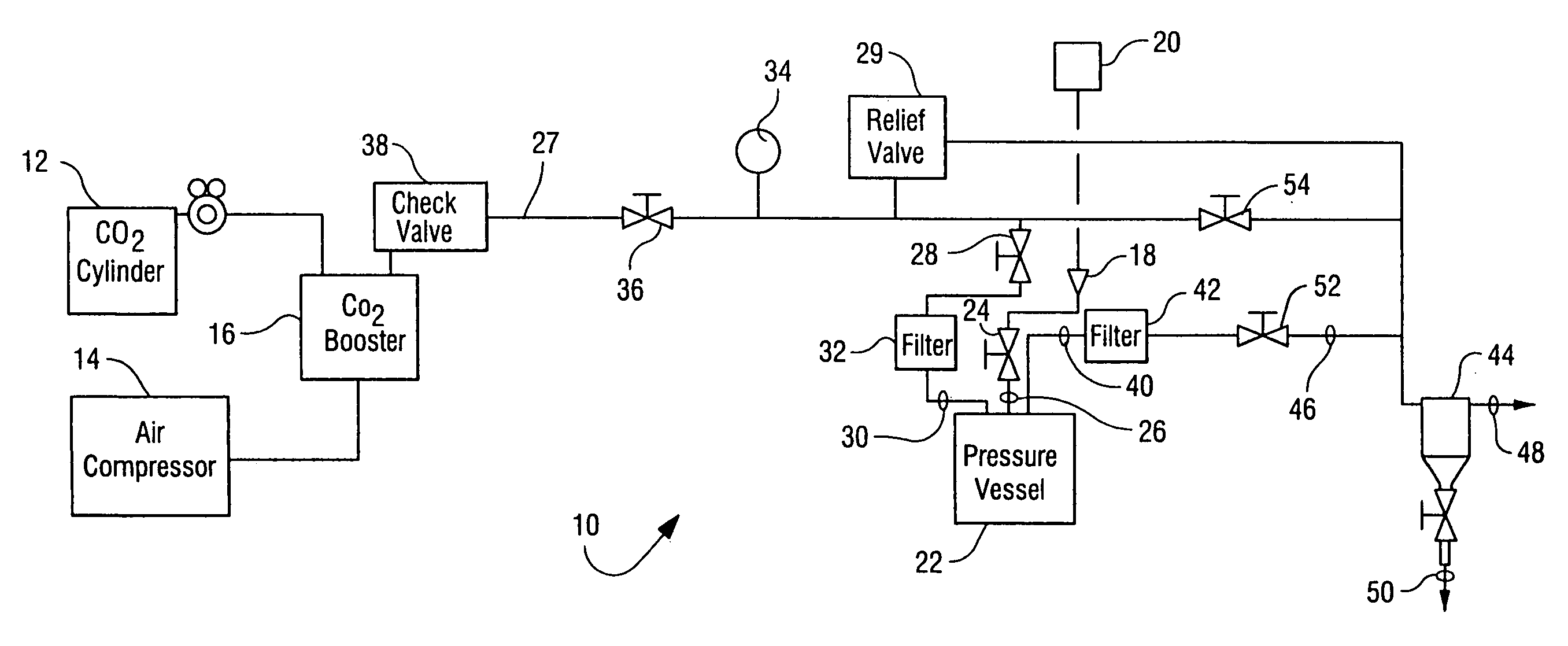
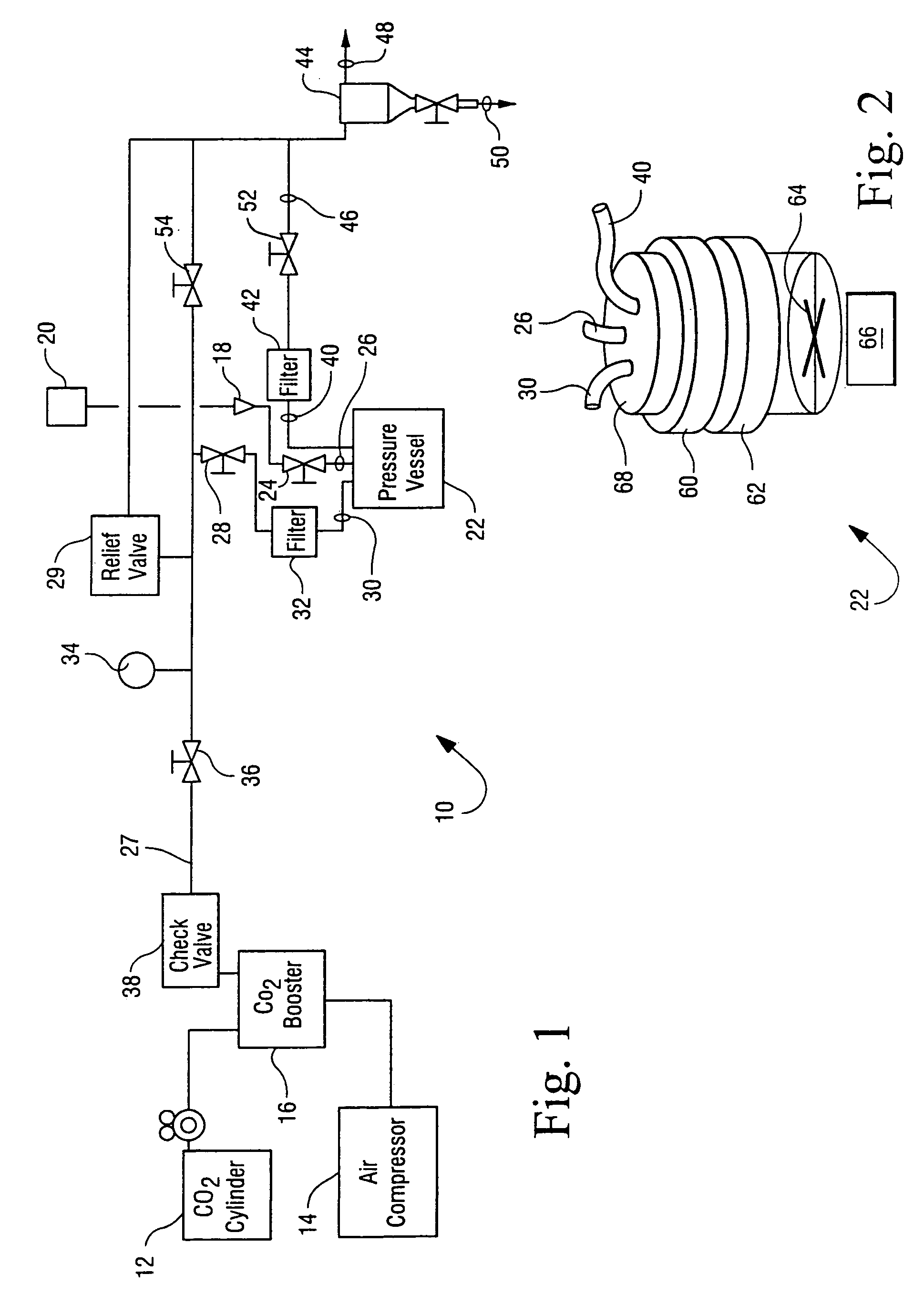
[0034] The apparatus generally depicted in FIGS. 1 and 2 was employed for this Example. A sample of B. stearothermophilus spores (1 mL) of greater than 106 CFU / mL was placed in 16 mm diameter test tubes in a stainless steel basket. Trifluoroacetic acid (4 mL) was transferred by syringe onto the surface of a cotton ball placed in the basket and water (6 mL) was placed at bottom of vessel. The basket was then loaded into the 600 mL reactor vessel. The reactor vessel was heated to 50° C. and equilibrated with CO2 at atmospheric pressure. The stirring and agitation mechanisms were activated and the reactor vessel pressurized to 2000 psi for 40 minutes. The CO2 pressure was then allowed to drop to 1100 psi at a rate of 300 psi / minute. Agitation by means of vibration of the vessel was carried out for 1 minute.
[0035] The pressurization / stirring / agitation / depressurization process was repeated a total of three times. After the third cycle, a series of three flushing cycles to rem...
example 3a
Invention
[0037] The apparatus generally depicted in FIGS. 1 and 2 was employed for this Example. A sample of B. subtilis spore / vegetative preparations (1 mL) of greater than 106 CFU / mL was placed in a 16 mm diameter test tube in a stainless steel basket. Acetic acid (6 mL) was transferred by syringe onto the surface of a cotton ball placed in the basket, which was then loaded into the 600 mL reactor vessel. The reactor vessel was heated to 50° C. and equilibrated with CO2 at atmospheric pressure. The stirring and agitation mechanisms were activated and the reactor vessel pressurized to 3000 psi for 40 minutes. The CO2 pressure was then allowed to drop to 1500 psi at a rate of 300 psi / minute. Agitation was carried out for 1 minute.
[0038] After depressurizing the reactor vessel, more acetic acid (4 mL) was introduced at ambient pressure to the additive loop via port 18 (FIG. 1). The loop was sealed and pressurized to 3000 psi. The reactor vessel was the re-pressurized through the ad...
PUM
| Property | Measurement | Unit |
|---|---|---|
| temperature | aaaaa | aaaaa |
| pressure | aaaaa | aaaaa |
| diameter | aaaaa | aaaaa |
Abstract
Description
Claims
Application Information
 Login to View More