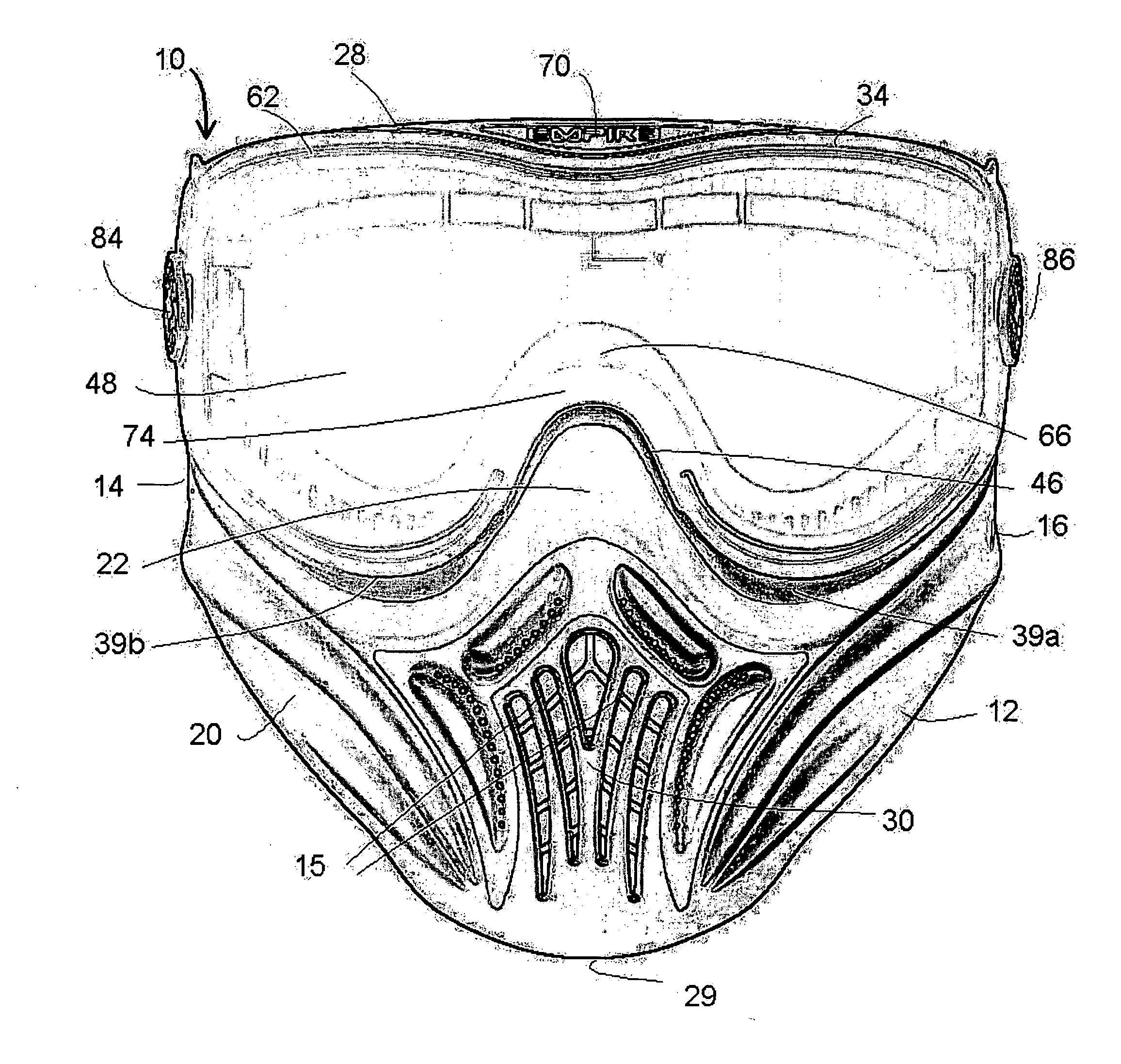
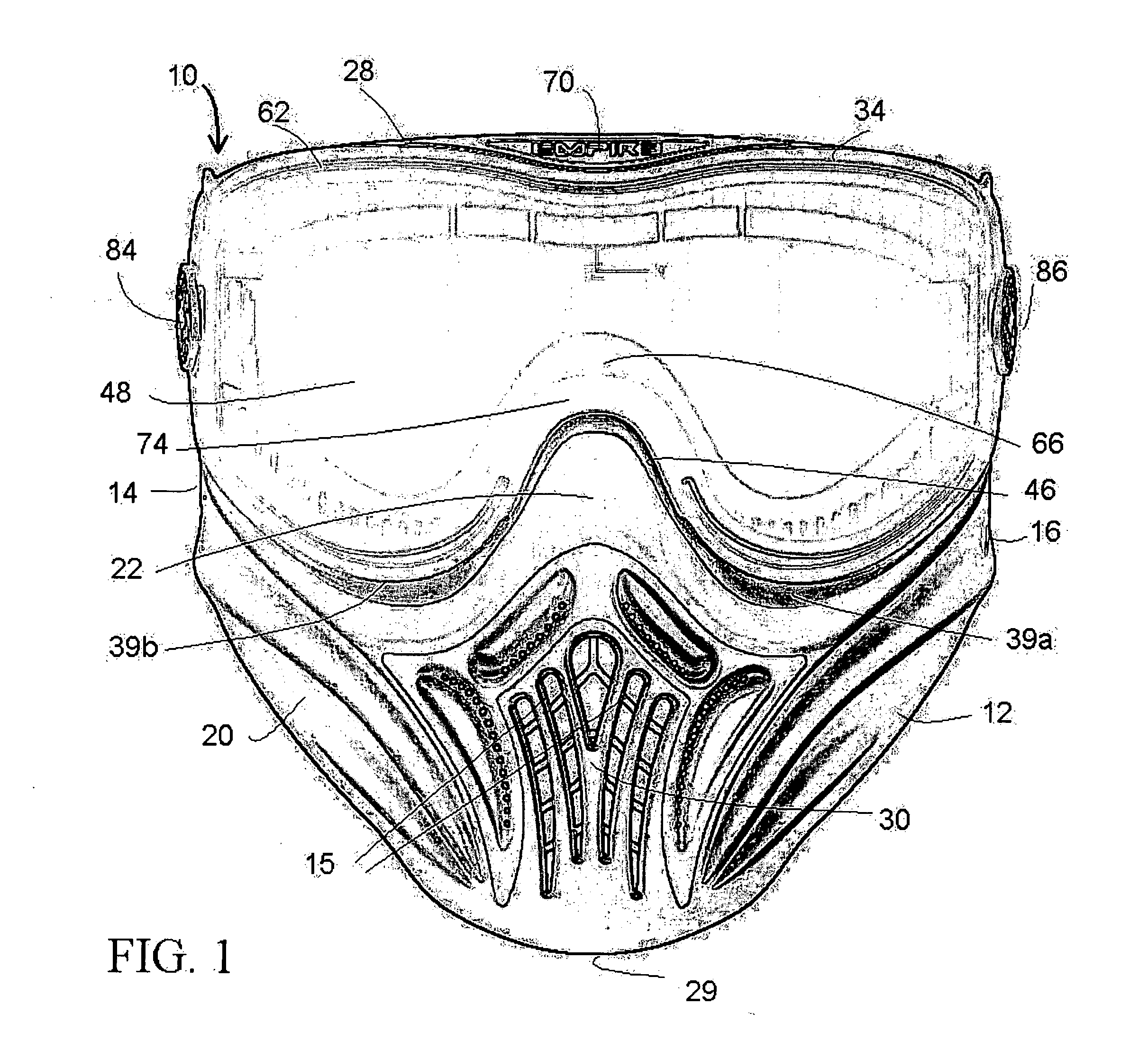
[0055] It is preferable that the width of the central receiving slot 46 is sized (in its non-flexed or non-deformed state) to be about the thickness of the lens 48. When the mask body 12 is flexed such as by moving the opposing sides 14, 16 closer to each other, and the central portion 44 and area adjacent the grooves 38a, 38b is flexed or deformed. With the nose portion 66 of the lens 48 in the receiving slot 46, the flanges 64a, 64b can pass by the surface of the area adjacent the grooves 38a, 38b, such as channel walls 40a and 40b, into the receiving grooves 38a, 38b. Once the flanges 64a, 64b snap into place in the grooves 38a, 38b, the nose portion 22 and nose extensions 68a, 68b can drop further into and be seated in the central receiving slot 46. The nose extensions 68a, 68b are supported at or adjacent to the bottom of the slot 46, as shown in FIG. 10. This provides a firm locking or snapping engagement of the nose portion 22 and flanges 64a, 64b into the mask body 12. Releasing the mask body 12 and allowing it to return to its non-deformed, non-flexed, normal state provides an even tighter engagement of the full length of the flanges 64a, 64b with the receiving grooves 38a, 38b. It is preferred that a user would not be able to remove the lens 48 from its engagement with the mask body without flexing or otherwise deforming the mask body 12.
[0056] This engagement further assists in fixing the lens 48 in place when in use. It is appreciated that, due to the design of the present invention, this arrangement will firmly hold the lens 48 in place on the mask body 12. The face mask system 10 of the present invention comprises even further means for maintaining the lens in place attached to the mask body, as discussed below.
[0057] As shown in FIGS. 1-4, a central portion 70 of the upper portion 28 may extend or otherwise slope downward, and engage a receiving portion 72 in the middle of the upper portion 50 of the lens 48. The upper flange 62 of the lens 48 is received within the upper receiving groove 36. Because the mask body 12 is formed from a flexible material, the upper flange 62 of the lens 48 can additionally snap into the upper receiving groove 36. This provides an additional alignment means for maintaining the lens 48 in the correct position on the mask body 12.
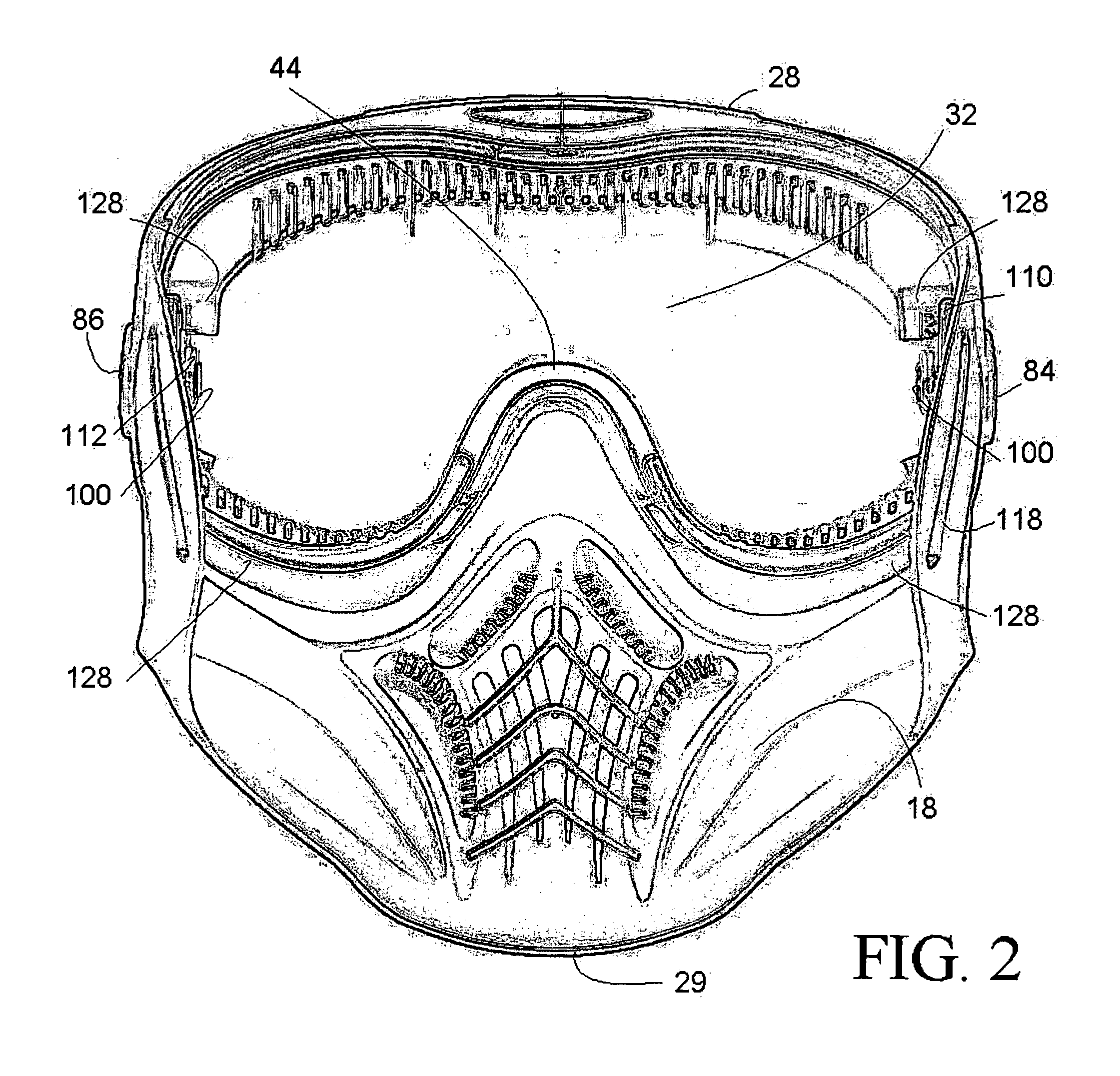
[0058] According to a further feature of the present invention, the central portion 44 of the lens supporting portion 34 is formed so that, in its normal orientation, the central portion 44 is higher than (raised or above) the nose portion 22, as shown in FIGS. 4 and 20. The central portion 44 may be formed having a central support wall 74, which is a generally flat, U-shaped surface against which the nose portion 66 of the lens 48 can rest and / or be supported by from the rear. Thus, the lens 48 is supported from behind by the central portion 44 and central support wall 74 when the lens 48 is attached to the mask body 12, such as when the nose extensions 68a and 68b are engaged with the central receiving slot 46. This provides a novel and effective arrangement that prevents the lens 48 from displacing in relation to the mask body 12 if impacted by a projectile. If, for example, a projectile (such as a paintball) were to impact the lens 48 adjacent the nose portion 22 of the mask body 12 or the nose portion 66 of the lens 48, the mask body 12 and lens 48 will not separate. The lens 48 will be supported from behind by the central support wall 74, and the mask body 12 will not be moved away from the lens 48 or otherwise create a penetrable space or opening. The lens 48 is also supported within the slot 46 at its front by the nose portion 22. The arrangement of the present invention prevents the lens 48 from moving or otherwise being dislodged along its edges, as the nose extensions 68a and 68b are held within the central receiving slot 46, and the upper flange 62 and the lower flanges 64a, 64b engage the respective receiving grooves 36 and 38a, 38b.



 Login to View More
  Login to View More