
Imaging apparatus with resolution adjustability
a technology of resolution adjustment and imaging apparatus, which is applied in the direction of instruments, television systems, and television system scanning details, etc., can solve the problems of increasing the resolution, affecting the accuracy of image resolution, and reducing so as to save the number of sensing assemblies and prevent the error between a sensed image and a to-be-sensed image
- Summary
- Abstract
- Description
- Claims
- Application Information
AI Technical Summary
Benefits of technology
Problems solved by technology
Method used
Image

Examples
first embodiment
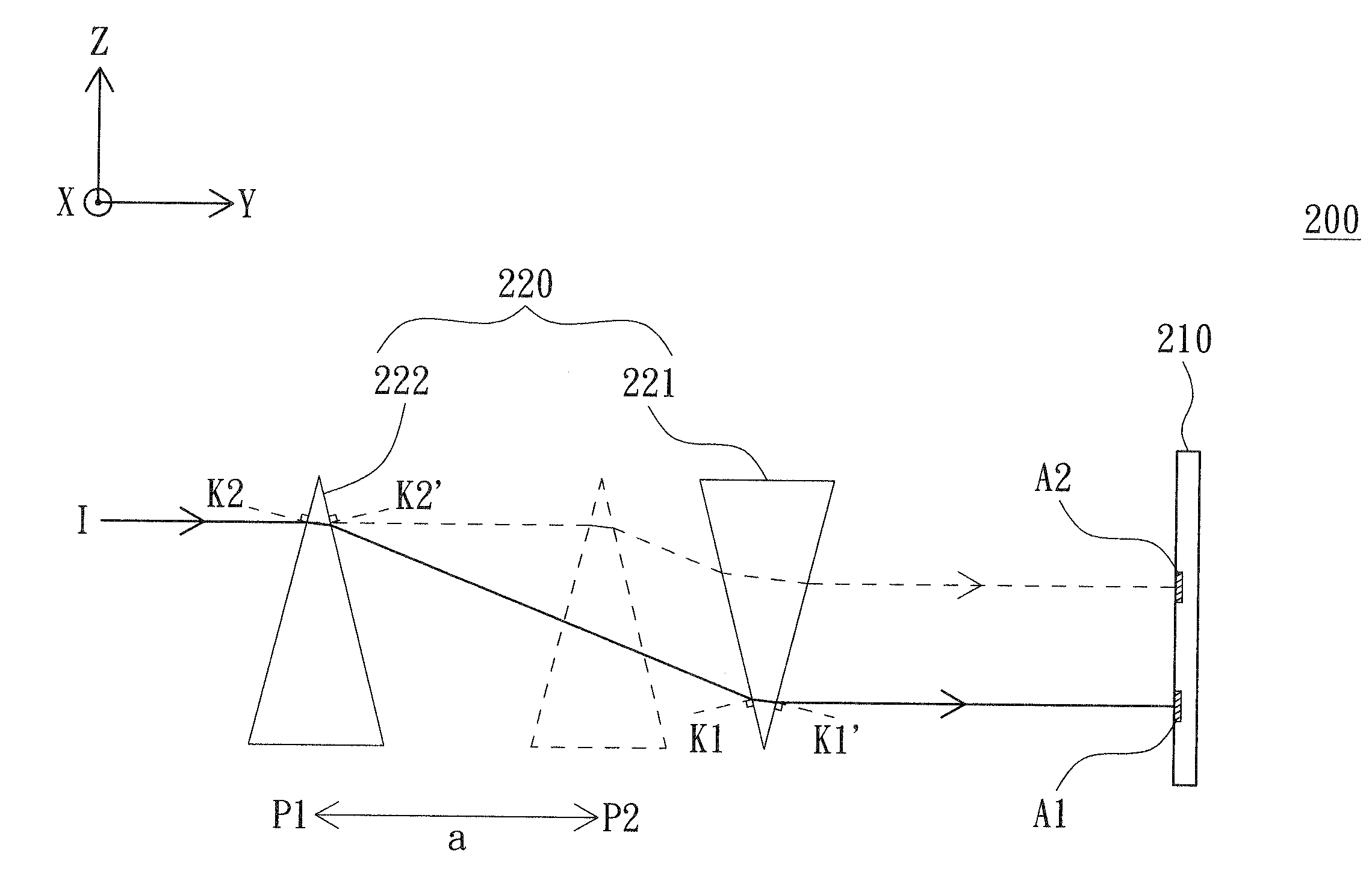
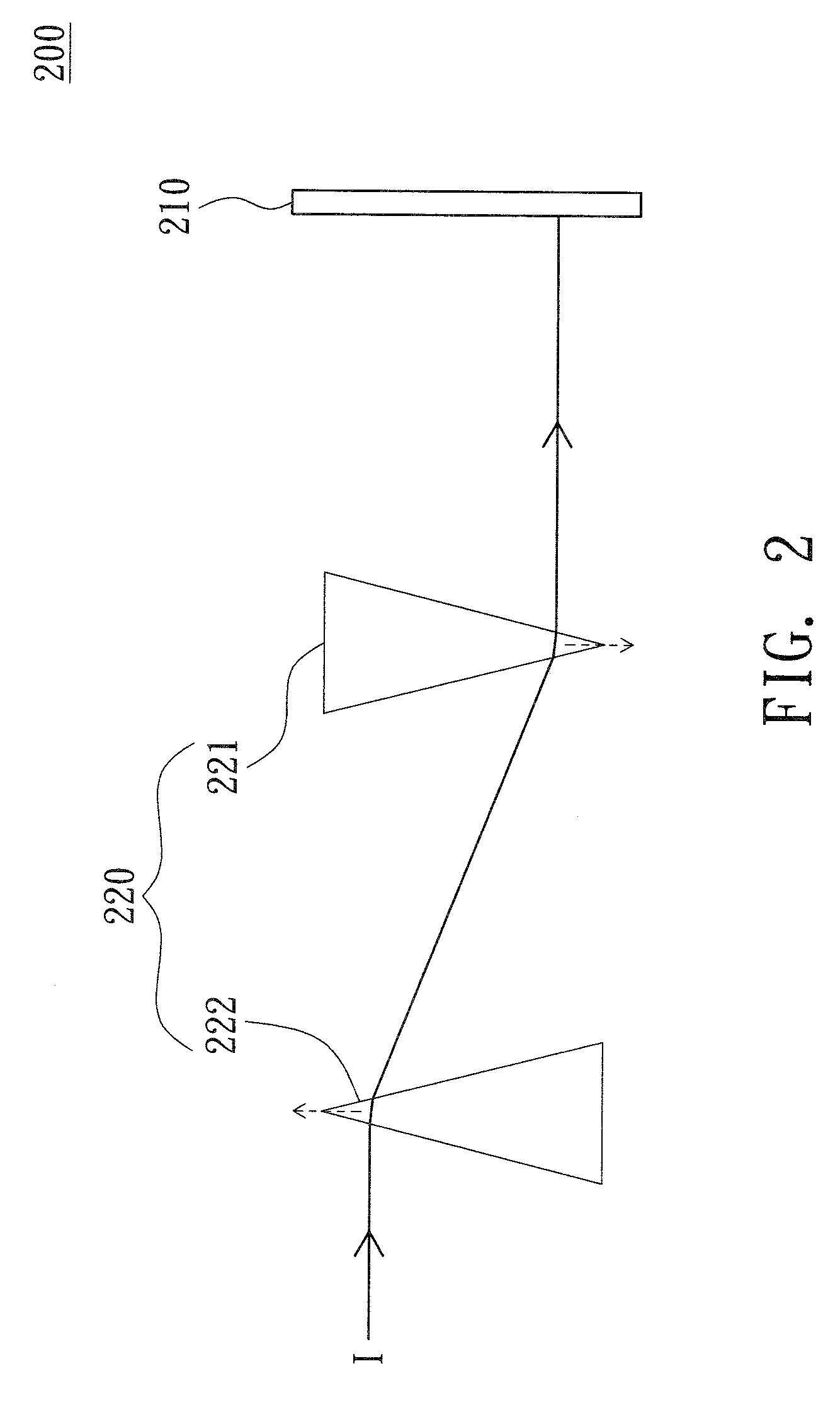
[0025]In the first embodiment, the image sensor 210 is exemplified by a line array sensor. Meanwhile, the imaging apparatus 200 can be used in an ordinary scanner. The imaging apparatus 200 further comprises a lens (such as a lens assembly) for focusing the imaging beam 1. The prism assembly 220 is disposed between the lens and the image sensor 210; or, the lens is disposed between the prism assembly 220 and the image sensor 210. In the first embodiment, the prism assembly 220 is disposed between the lens and the image sensor 210 to guide the imaging beam I focused by passing through the lens.
[0026]Referring to FIG. 3, a diagram showing relative movement between two prisms 221 and 222 according to a first embodiment of the invention is shown. In FIG. 3, the lens is not shown, and the +X axis is in the direction normal to the paper. As indicated in FIG. 3, the image sensor 210 is disposed along the direction of the Z axis, and the sensing area thereof is parallel to the X-Z plane and...
second embodiment
[0033]In the second embodiment, the image sensor 210 is exemplified by a plane array sensor. Meanwhile, the imaging apparatus 200 can be used in an ordinary digital camera comprising a lens (such as a lens assembly) for focusing the imaging beam 1. In the second embodiment, the prism assembly 220 is disposed between the lens and the image sensor 210.
[0034]Referring to FIG. 6, a diagram showing the relative movement between the prisms according to a second embodiment of the invention is shown. In FIG. 6, the directions of the X axis, the Y axis and the Z axis are the same with that in FIG. 3. Meanwhile, the direction of the Z axis is normal to the paper, and the sensing area of the image sensor is parallel to the X-Z plane and toward the direction of the −Y axis. Moreover, FIG. 6 differs from FIG. 3 in that the prism assembly 220 further comprises a third prism 223 and a fourth prism 224 as indicated in FIG. 6. Like the first prism 221 and the second prism 222, the third prism 223 an...
PUM
 Login to View More
 Abstract
Description
Claims
Application Information
 Login to View More