Method and apparatus for configuring logical channels in a network

US20070223512A1Active Publication Date: 2007-09-27ARRIS ENTERPRISES LLC

Patent Information

Authority / Receiving Office
US · United States
Current Assignee / Owner
ARRIS ENTERPRISES LLC
Publication Date
2007-09-27

Smart Images

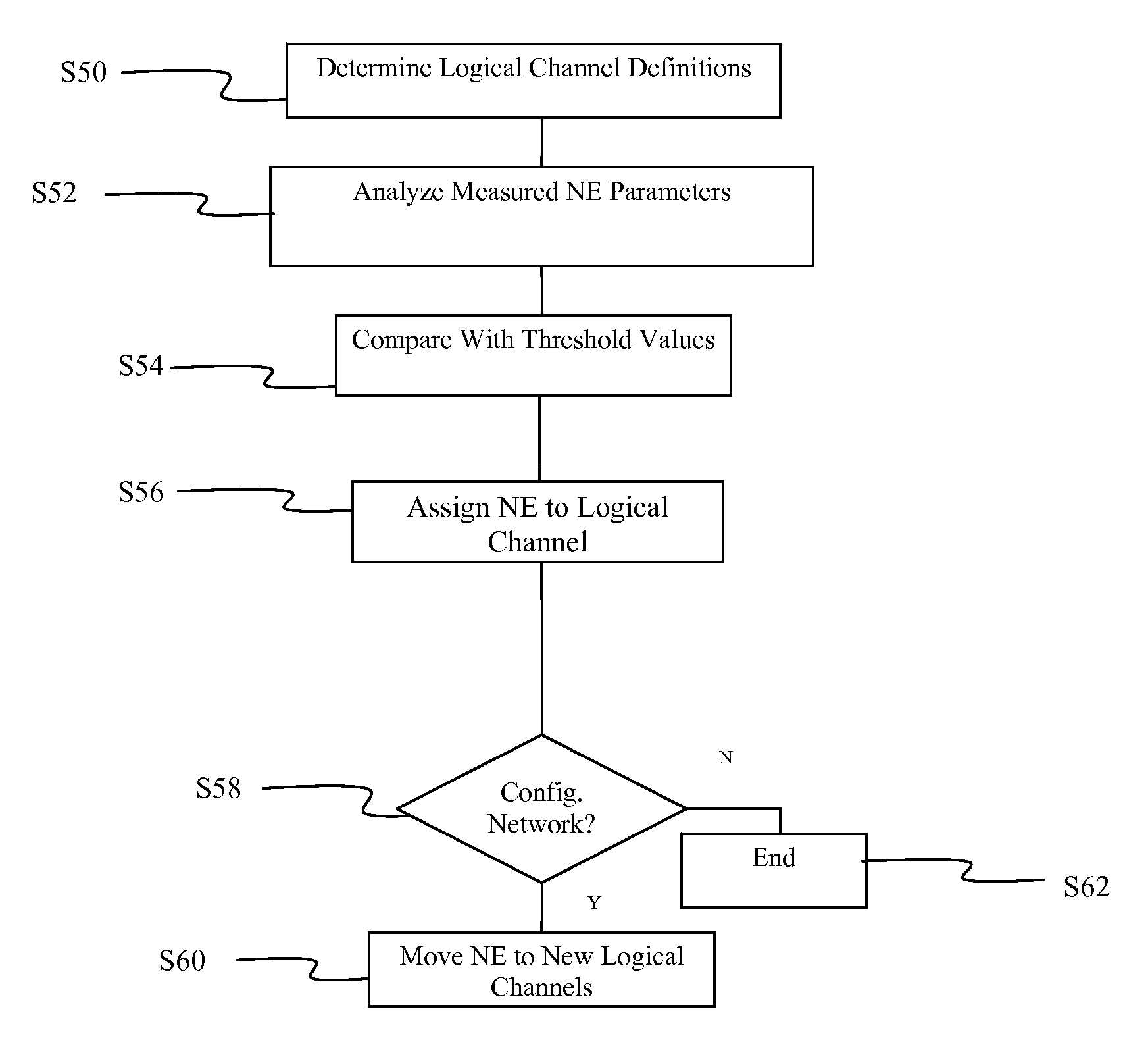
  • Figure 1
    Figure 1
  • Figure 2
    Figure 2
  • Figure 3
    Figure 3
Patent Text Reader

Abstract

Logical channels in a network are automatically be configured by using measured network parameters. The measured network parameters are determined in cooperation with the network elements without interruption of active communication services. The network parameters include upstream or downstream modulation error ratio (MER), upstream or downstream signal to noise ratio (SNR), upstream or downstream microreflections, upstream transmit level, downstream receive power level, cable modem type (DOCSIS 1.0,1.1,2.0), functional capabilities (e.g., VoIP, 256QAM, etc), network element location with in a cable plant (e.g., node location or amplifier cascade depth), network element manufacturer, or type of services provided by the network element (including telephony versus data). An interactive display is provided to an operator which enables analysis of communication parameters, including modulation profiles and channel performance.
Need to check novelty before this filing date? Find Prior Art

Description

[0001] This application claims the benefit of U.S. Provisional Application 60 / 785,647 filed on Mar. 24, 2006, herein incorporated by reference in its entirety.FIELD OF THE INVENTION

[0002] This disclosure is directed toward configuring logical channels in a network. More particularly, this disclosure is directed toward grouping network elements according to certain parameters to configure logical channels in a network. BACKGROUND OF THE INVENTION

[0003] Coaxial cable television systems have been in widespread use for many years and extensive networks have been developed. The extensive and complex networks are often difficult for a cable operator to manage and monitor. A typical cable network generally contains a headend which includes a cable modem termination system (CMTS). The CMTS contains several receivers, each receiver connects to one or more nodes which are connected to network elements (cable modems, MTAs, etc) of many subscribers, e.g., a single receiver may be connected to...

Claims

the structure of the environmentally friendly knitted fabric provided by the present invention; figure 2 Flow chart of the yarn wrapping machine for environmentally friendly knitted fabrics and storage devices; image 3 Is the parameter map of the yarn covering machine
Login to View More