Automated speech recognition using normalized in-vehicle speech

US20080004875A1Inactive Publication Date: 2008-01-03GENERA MOTORS LLC
7 Cites 61 Cited by

Patent Information

Authority / Receiving Office
US · United States
Current Assignee / Owner
Publication Date
2008-01-03
Estimated Expiration
Not applicable · inactive patent

Smart Images

  • Figure 1
    Figure 1
  • Figure 2
    Figure 2
  • Figure 3
    Figure 3
Patent Text Reader

Abstract

A speech recognition method includes the steps of receiving speech in a vehicle, extracting acoustic data from the received speech, and applying a vehicle-specific inverse impulse response function to the extracted acoustic data to produce normalized acoustic data. The speech recognition method may also include one or more of the following steps: pre-processing the normalized acoustic data to extract acoustic feature vectors; decoding the normalized acoustic feature vectors using as input at least one of a plurality of global acoustic models built according to a plurality of Lombard levels of a Lombard speech corpus covering a plurality of vehicles; calculating the Lombard level of vehicle noise; and / or selecting the at least one of the plurality of global acoustic models that corresponds to the calculated Lombard level for application during the decoding step.
Need to check novelty before this filing date? Find Prior Art

Description

TECHNICAL FIELD

[0001] This invention relates to speech signal processing and, more particularly, to automated speech recognition (ASR).BACKGROUND OF THE INVENTION

[0002] ASR technology enables microphone-equipped computing devices to interpret speech and thereby provide an alternative to conventional human-to-computer input devices such as keyboards or keypads. For example, vehicle telecommunications devices are equipped with voice dialing features enabled by an ASR system. Typically, ASR users significantly vary the way they articulate their speech in response to changes in background noise of a vehicle. Vehicle background noise is influenced by several external and internal noises, such as the type of road the vehicle is traversing, the speed the vehicle travels, wind noise, noise external to the vehicle, air conditioning settings, and other factors. As vehicle background noise varies in intensity, ASR users tend to vary the volume and the pitch of their utterances. Such variation in...

Examples

Embodiment Construction

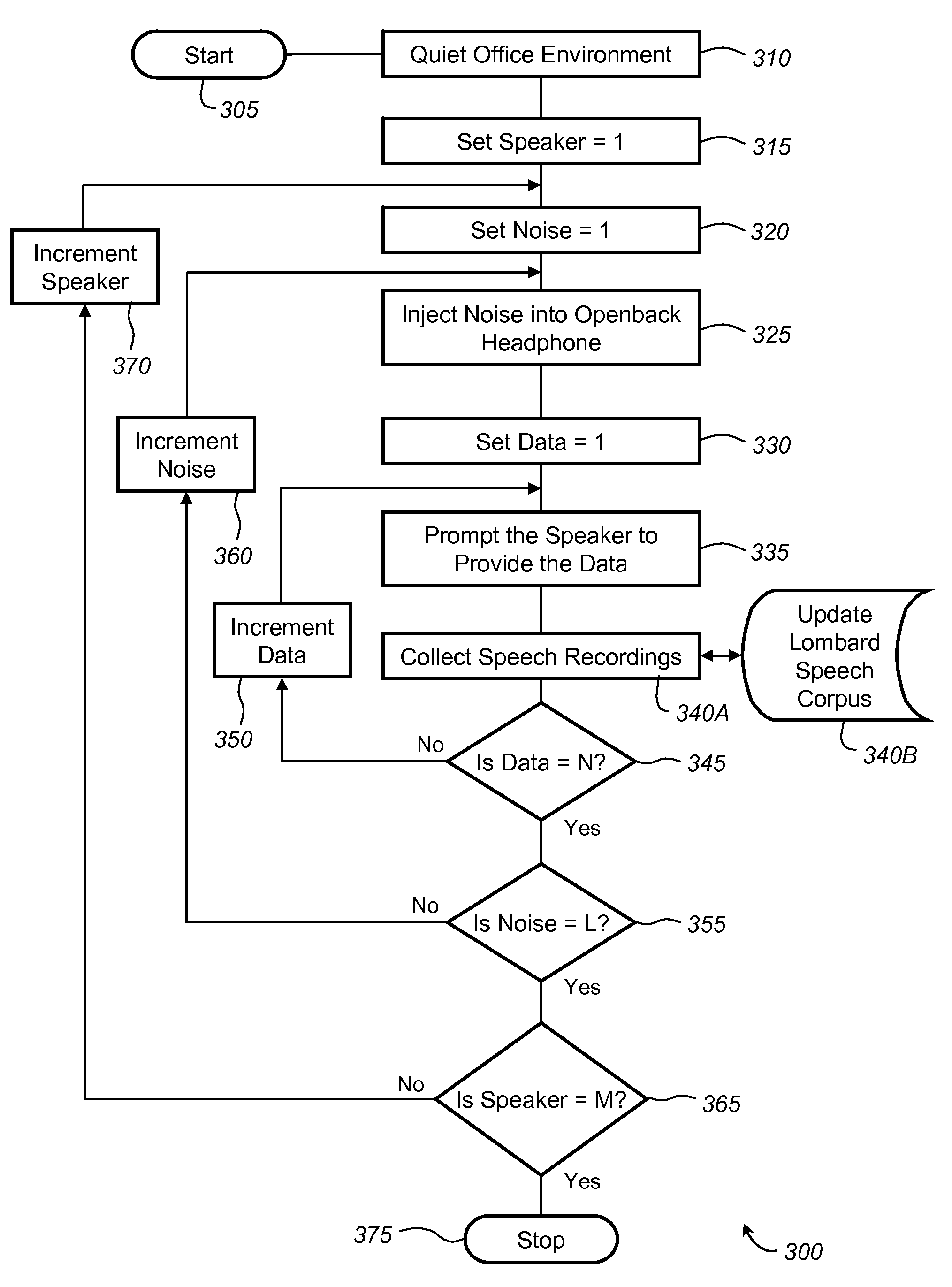
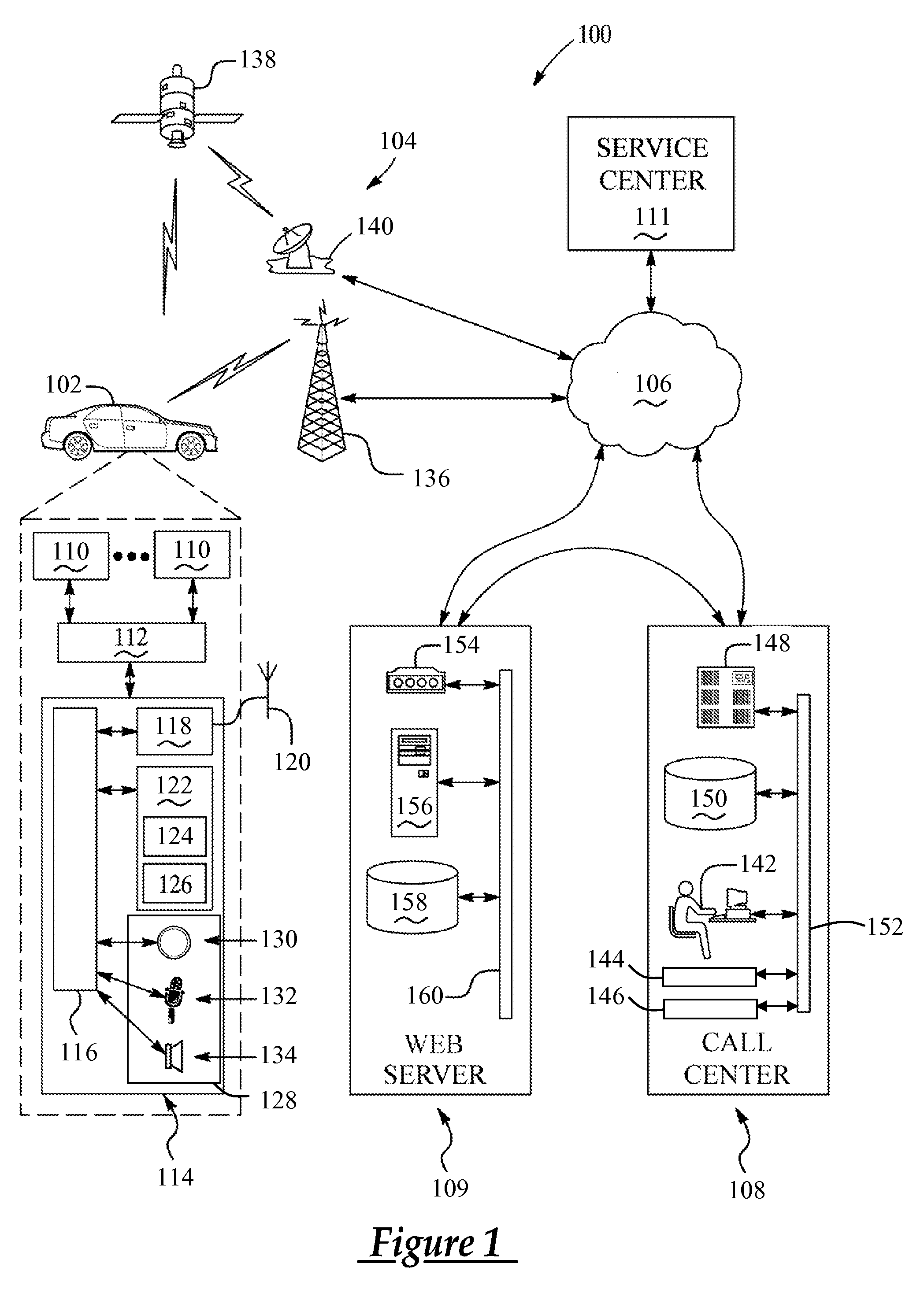
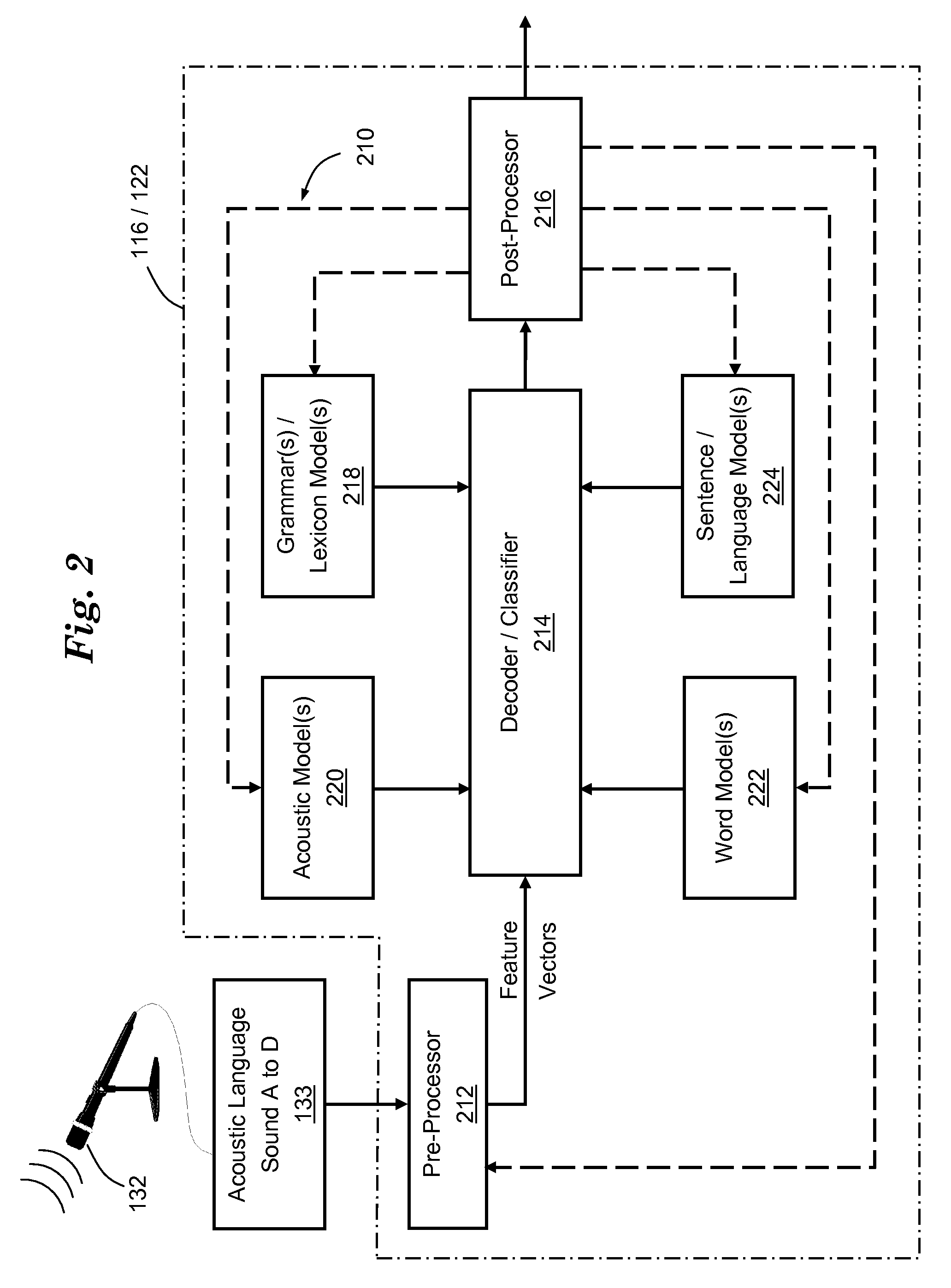
[0021]An exemplary operating environment enabled with automated speech recognition (ASR) is illustrated in FIGS. 1 and 2, and can be used to implement the illustrated embodiments speech recognition methods. These methods can be particularly useful for voice dialing applications, voice activated web browsing applications, or the like. The methods can include speech recognition generally and improved applications of speech recognition, and are discussed in detail further below in conjunction with FIGS. 3 through 7.

[0022]The methods can be carried out using any suitable ASR-enabled system. Preferably, however, the methods are carried out in conjunction with an ASR-enabled telematics system such as the illustrated system 100, which can include a motor vehicle 102 carrying one or more occupants or users, a wireless communication system 104 for wirelessly communicating with the vehicle 102 and a second communications system 106 that, in turn, communicates with a call center 108 that provi...