This helps you quickly interpret patents by identifying the three key elements:
Problems solved by technology
Method used
Benefits of technology
Benefits of technology
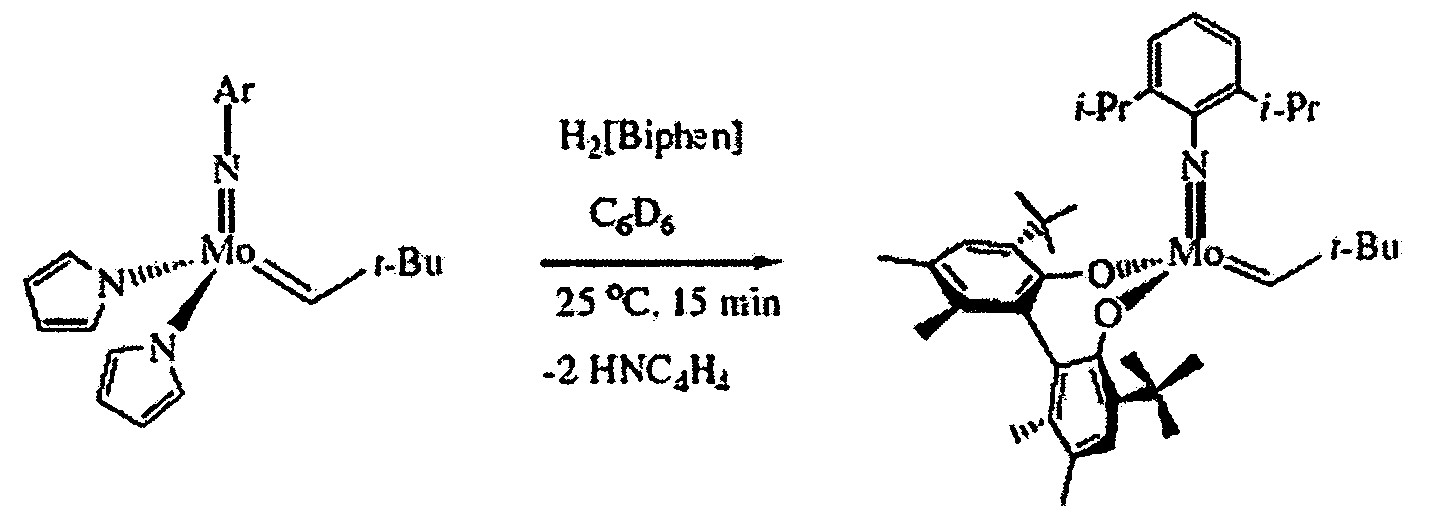
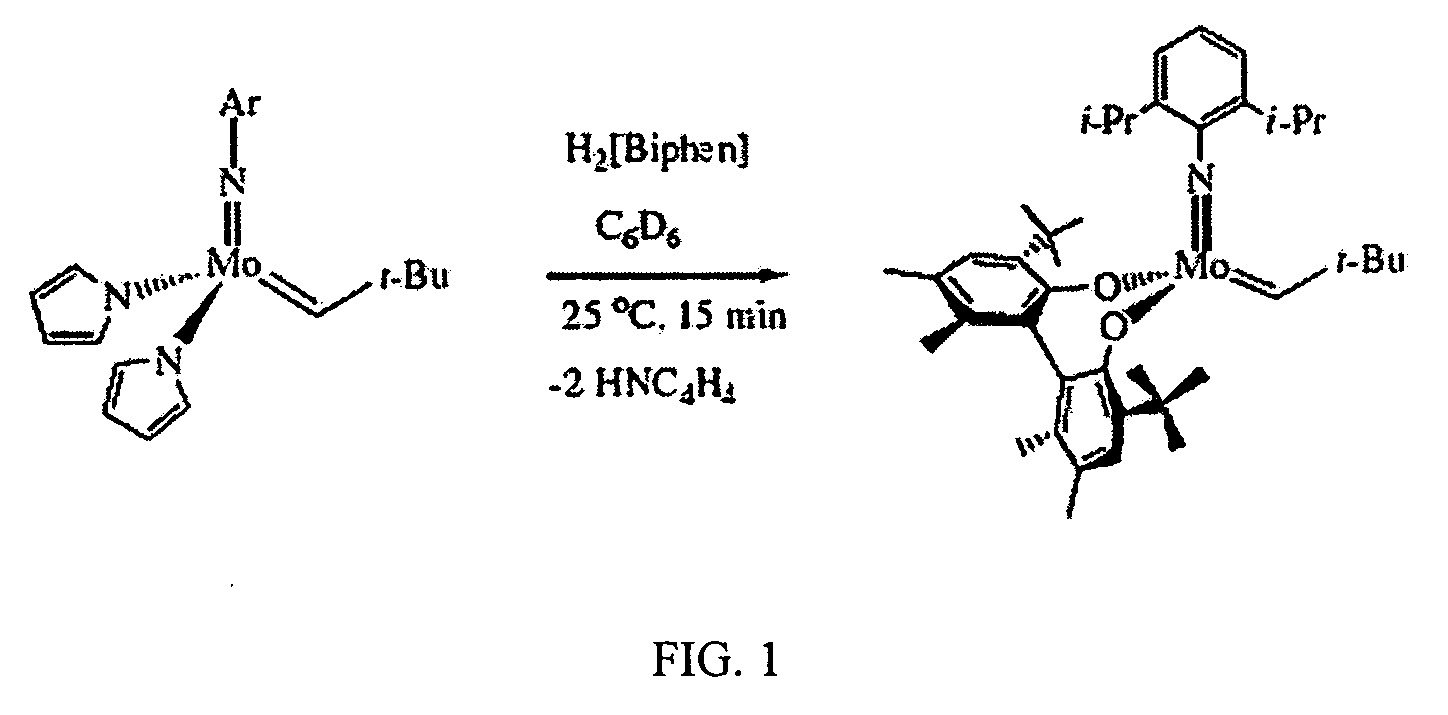
[0007]The present invention also provides methods for forming and using a catalyst comprising providing a catalyst precursor comprising an organometallic composition including a first nitrogen-containing ligand in a reaction vessel; replacing the first, nitrogen-containing ligand with a second,
Problems solved by technology
In some applications, variation of the substituents and / or ligands of the catalyst may greatly affect the performance of the catalyst.
However, using methods currently known in the art, the synthesis and isolation of many different catalyst compositions may be impractical.
In some cases, the substitution or replacement of ligands bound to an organometallic catalyst may occur slowly and / or incompletely, or not all.
In other cases, the synthesis of organometallic catalysts may occur with poor yield due to the occurrence of side reactions.
For example, the syntheses of metal alkylidene complexes for olefin metathesis may often result in low yields due to competitive side reactions including deprotonation of the alkylidene.
Method used
the structure of the environmentally friendly knitted fabric provided by the present invention; figure 2 Flow chart of the yarn wrapping machine for environmentally friendly knitted fabrics and storage devices; image 3 Is the parameter map of the yarn covering machine
View more
Image
Smart Image Click on the blue labels to locate them in the text.
Viewing Examples
Smart Image
Click on the blue label to locate the original text in one second.
Reading with bidirectional positioning of images and text.
Smart Image
Examples
Experimental program
Comparison scheme
Effect test
example 1
[0053]All complexes were handled using standard Schlenk techniques or in a Vacuum Atmospheres glove box under an argon or dinitrogen atmosphere. All solvents were dried, degassed, and stored over activated molecular sieves in a dinitrogen-filled glovebox. Pyrrole was distilled from CaH2 in an inertatmosphere and lithium pyrrolide was prepared using published procedures. Mo(N-2,6-i-Pr2C6H3)(CHCMe2Ph)(OTf)2DME, Mo(NAd)(CHR)(OTf)2(DME), and Mo(N-2,6-Br2-4-MeC6H2)(CHCMe3)(OTf)2(DME) were synthesized by published procedures. Elemental analyses were performed by Desert Analytics, Tucson, Ariz. Little or no competitive deprotonation of the alkylidene to give an alkylidyne complex was observed. The compounds were sensitive to air and moisture and could be recrystallized readily from toluene or mixtures of pentane and ether.
example 2
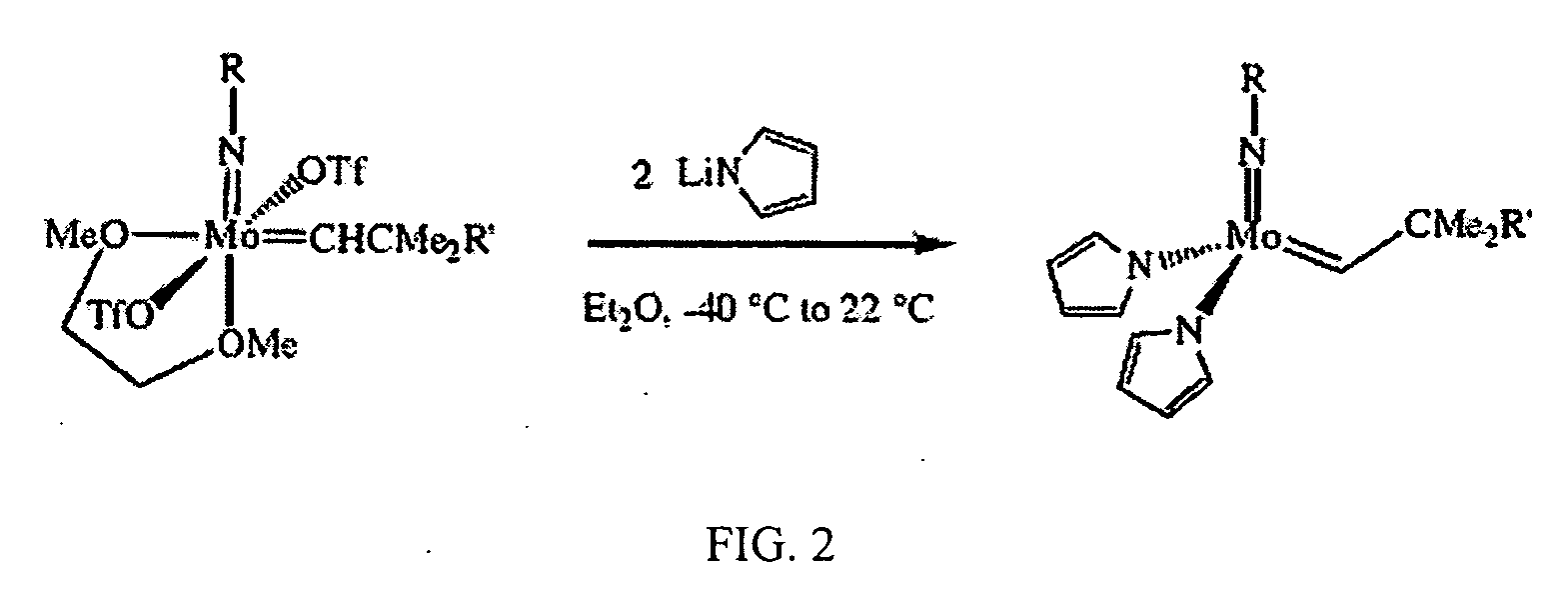
Synthesis of Mo(N-2,6-i-Pr2C6H3)(CHCMe3)(NC4H4)2
[0054]The following procedure was used to prepare the title compound. To a −35° C. solution of 0.193 g (0.27 mmol) Mo(NAr)(CHCMe3)(OTf)2(DME) in 4 mL diethyl ether was added 38.6 mg (0.53 mmol) of LiNC4H4 as a solid in one portion. The mixture was stirred at room temperature for 1 hour, then all volatiles were removed in vacuo. The resulting brown powder was extracted with 5 mL of toluene and the solution was filtered through celite. The celite was washed with toluene (1 mL) and the resulting solution was taken to dryness in vacuo. The product was recrystallized from mixtures of pentane / toluene or pure toluene at −35° C. as a toluene solvate. 1H NMR (300 MHz, toluene-d8) δ 13.5 (br s, 1H, MoCHR), 7-6.2 (v br s, overlapping, 11H, Ar—H and NC4H4), 3.8-2.9 (br s, 2H, i-Pr), 1.3 (br s, 6H, CMe3), 1.1 (br s, 12H, i-Pr).
Example 3
Synthesis of Mo(N-2,6-i-Pr2C6H3)(CHCMe2Ph)(NC4H4)2
[0055]The following procedure was used to prepare the title co...
example 3
Synthesis of Mo(NAd)(CHCMe2Ph)(NC4H4)2
[0056]The following procedure was used to prepare the title compound. LiNC4H4 (169 mg, 2.32 mmol) was added as a solid in small portions to a −35° C. solution of 0.890 g (1.16 mmol) Mo(NAd)(CHCMe2Ph)(OTf)2(DME) in 50 mL of diethyl ether. The mixture was stirred at room temperature for 1.5 h, then all volatiles were removed in vacuo. The resulting brown powder was extracted with toluene and the solution was filtered through celite. The celite was washed with toluene and the combined filtrates were taken to dryness in vacuo. The off-white solid may be recrystallized from toluene at −35° C.; yield 420 mg (2 crops, 71%): 1H NMR (C6D6, 500 MHz, 293 K) δ 13.6 (br s, 1H, MoCHR), 12.8 (br s, 1H, MoCHR), 7.5, (br s, 4H, MoCHCMe2Ph), 7.0-4.7 (2 overlapping br s, MoCHCMe2Ph and NC4H4), 1.8-1.6 (br multiplet, 15H, MoNAd), 1.3 (br s, 6H, MoCHCMe2Ph). 13C (CD2Cl2 126 MHz, 223K): 316.1 (JCH 118.2 Hz), 295.5 (JCH 111.3 Hz). Analysis calcd. For C28H35MoN3 (foun...
the structure of the environmentally friendly knitted fabric provided by the present invention; figure 2 Flow chart of the yarn wrapping machine for environmentally friendly knitted fabrics and storage devices; image 3 Is the parameter map of the yarn covering machine
Login to View More
PUM
Property
Measurement
Unit
Temperature
aaaaa
aaaaa
Temperature
aaaaa
aaaaa
Temperature
aaaaa
aaaaa
Login to View More
Abstract
The present invention provides methods for the synthesis of catalysts and precursors thereof. Methods of the invention may comprise combining a catalyst precursor and at least one ligand to generate a catalytically active species, often under mild conditions and in high yields. In some cases, a wide variety of catalysts may be synthesized from a single catalyst precursor. Methods of the invention may also include the preparation of catalysts which, under reaction conditions known in the art, may have been difficult or impossible to prepare and / or isolate due to, for example, steric crowding at the metal center. The present invention also provides catalyst compositions, and precursors thereof, which may be useful in various chemical reactions including olefin metathesis. In some cases, methods of the invention may reduce the number of synthetic and purification steps required to produce catalysts and / or other reaction products, as well as reducing time, cost, and waste production.
Description
FIELD OF THE INVENTION[0001]The present invention generally relates to compositions useful as organometallic catalysts, and related methods.BACKGROUND OF THE INVENTION[0002]Transition metal-catalyzed reactions which form carbon-carbon bonds have become an important tool in synthetic organic chemistry. One example is transition metal-catalyzed olefin metathesis, which has been shown to be useful in the synthesis of high molecular weight polymers, pharmaceuticals, and other materials. Olefin metathesis may be defined conceptually as a mutual exchange of alkylidene units between two olefins involving both the formation and cleavage of carbon-carbon double bonds, i.e., via [2+2] cycloadditions between an M=C center and a carbon-carbon double bond. Metal alkylidene complexes including ruthenium and molybdenum alkylidene complexes have been shown to perform olefin metathesis in the presence of a variety of functional groups. However, in many cases, multi-step syntheses are required to gen...
Claims
the structure of the environmentally friendly knitted fabric provided by the present invention; figure 2 Flow chart of the yarn wrapping machine for environmentally friendly knitted fabrics and storage devices; image 3 Is the parameter map of the yarn covering machine
Login to View More
Application Information
Patent Timeline
Application Date:The date an application was filed.
Publication Date:The date a patent or application was officially published.
First Publication Date:The earliest publication date of a patent with the same application number.
Issue Date:Publication date of the patent grant document.
PCT Entry Date:The Entry date of PCT National Phase.
Estimated Expiry Date:The statutory expiry date of a patent right according to the Patent Law, and it is the longest term of protection that the patent right can achieve without the termination of the patent right due to other reasons(Term extension factor has been taken into account ).
Invalid Date:Actual expiry date is based on effective date or publication date of legal transaction data of invalid patent.


 Login to View More