Check patentability & draft patents in minutes with Patsnap Eureka AI!

Systems and methods for synchronous generic framing protocol mapping

Active Publication Date: 2009-12-31
CIENA
View PDF16 Cites 19 Cited by
  • Summary
  • Abstract
  • Description
  • Claims
  • Application Information

AI Technical Summary

Benefits of technology

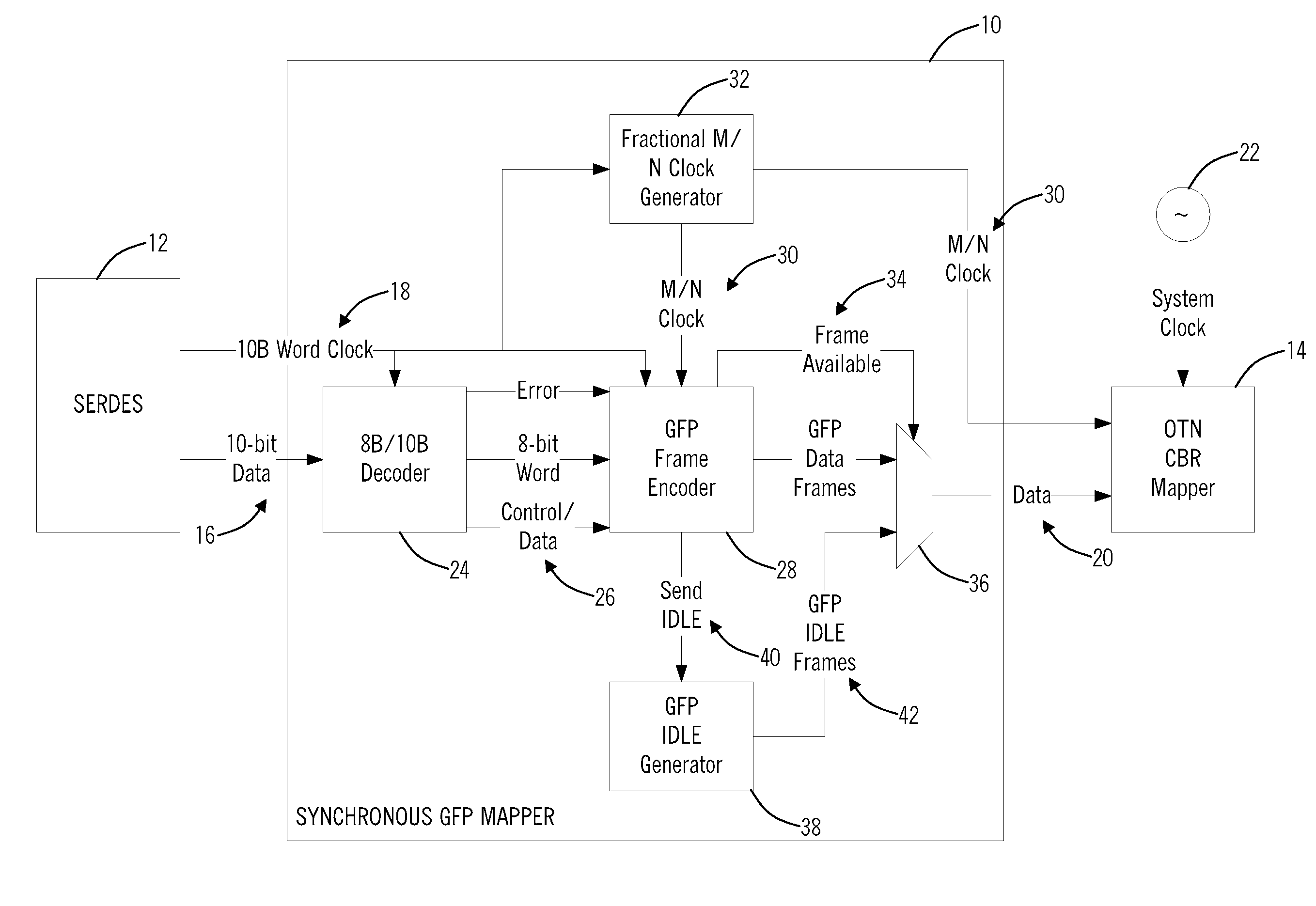
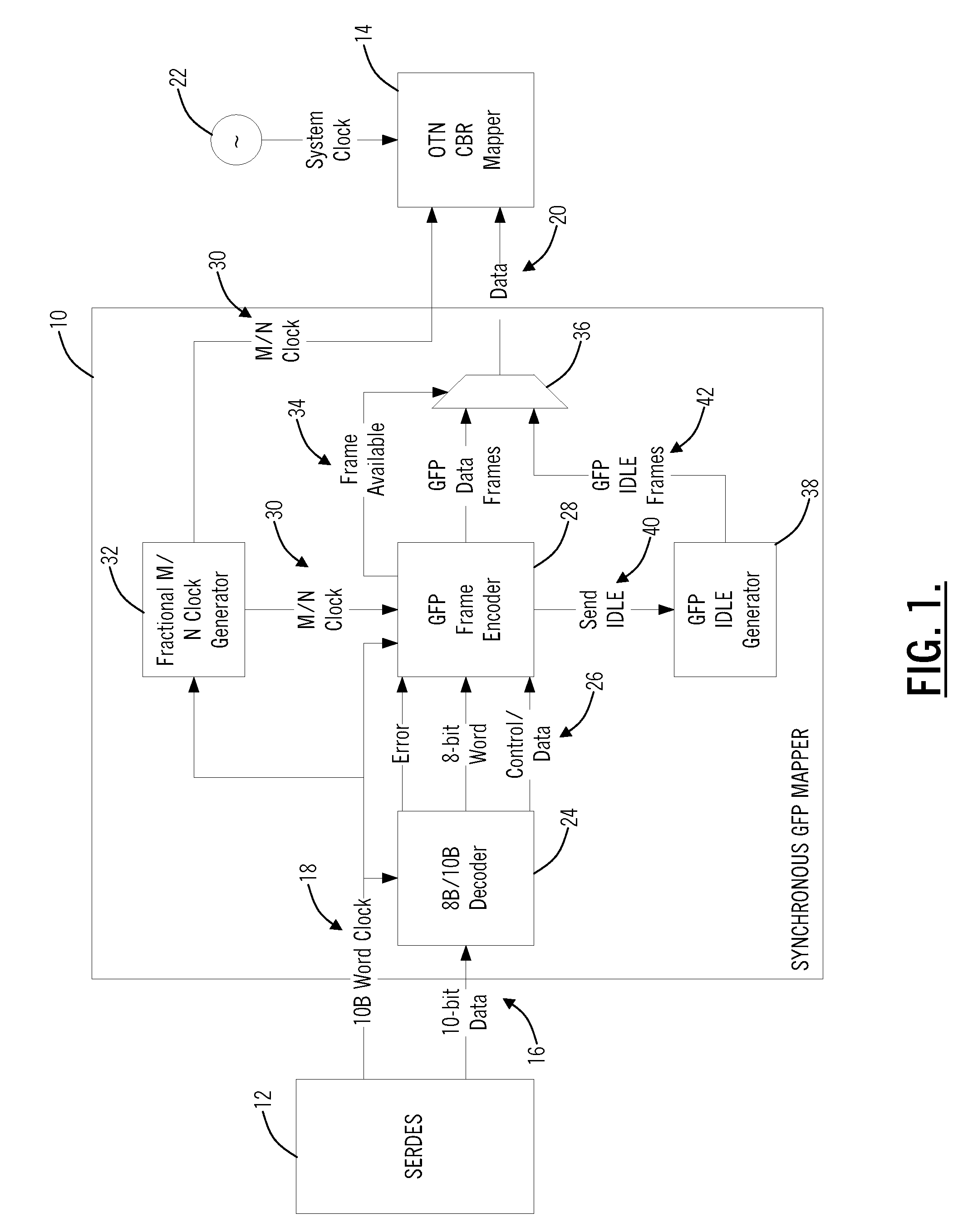
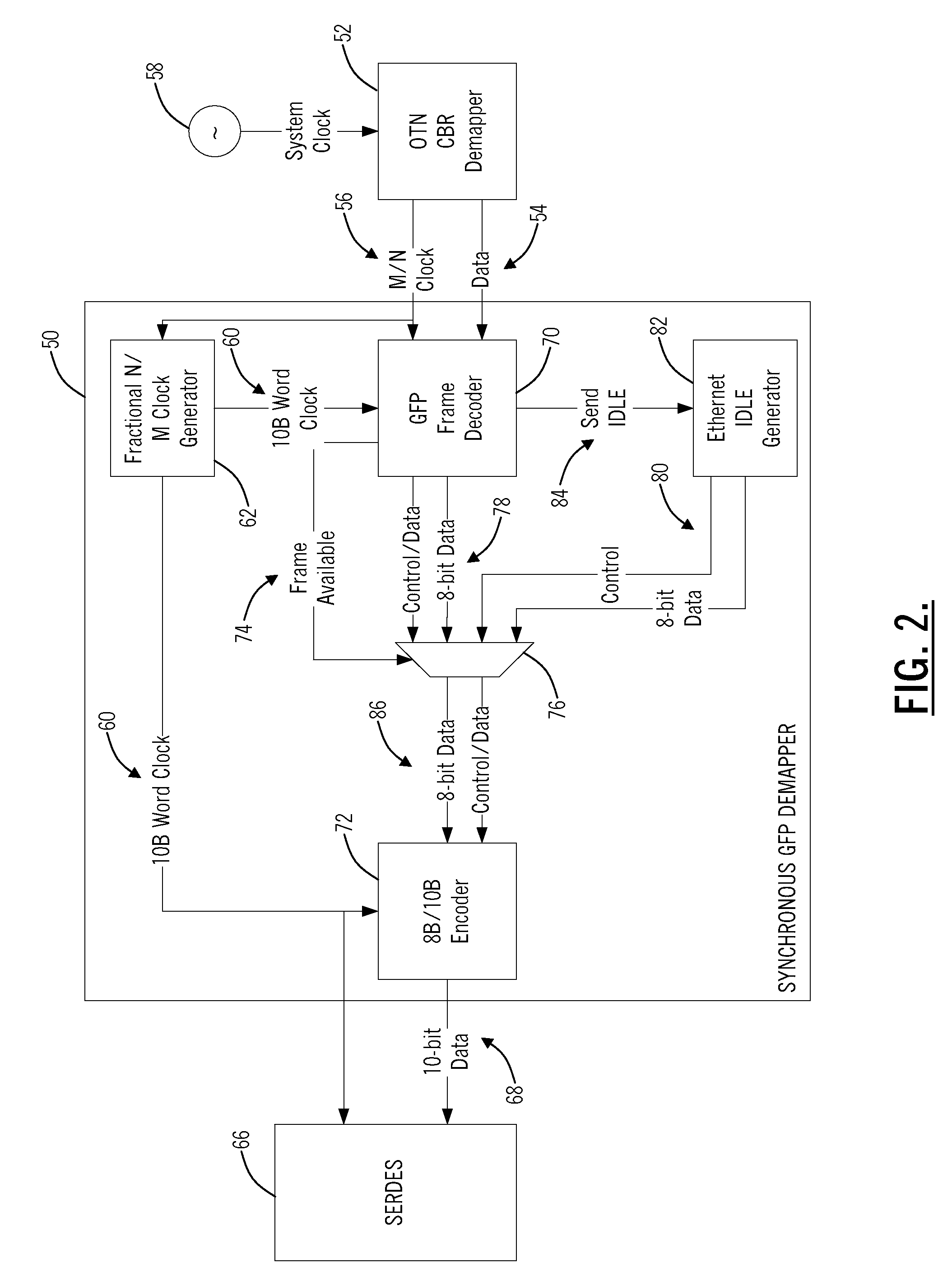
[0008]In various exemplary embodiments, the present invention provides systems and methods for mapping synchronous input signals, such as synchronous Ethernet, into Generic Framing Protocol frames for using GFP directly on Optical Transport Network (OTN) while preserving the synchronous timing of the input signals. The present invention defines a mapping technique for GFP-based encapsulation that preserves timing information of an incoming client signal. The mapping technique makes use of the concept that a timing signal can be fractionally multiplied in frequency using factors that are ratios of integers without creating significant timing impairments.

Problems solved by technology

However, given that Ethernet is inherently an asynchronous technology, transport of timing information via Ethernet has been an issue.
However, the GFP mapping techniques do not preserve the timing integrity of a synchronous Ethernet link due to the removal of characters or the encoding process.
Therefore there is no external timing or line timing mechanism available to transport synchronous Ethernet timing information.
The only standards-based mechanism for mapping Ethernet signals into OTN uses the GFP mapping technique described above, but this method does not preserve the timing integrity of the client signal.
The problem with the current state of the art is that the presence of a SDH / SONET layer is required to provide the transport of synchronous Ethernet signals along across an OTN-based DWDM network and preserve their timing integrity.
This is problematic since OTN-based DWDM networks are defined to operate asynchronously and there is currently no standardized mapping defined for Ethernet signals into OTN that would preserve the timing information of synchronous Ethernet line interfaces.
The only standards-based OTN client signal mapping technique that will support the preservation of timing information is a constant bit-rate (CBR) mapping mechanism, which could be applied to synchronous Ethernet client signals, but does not have the bandwidth efficiency provided by the standard GFP mapping technique.

Method used

the structure of the environmentally friendly knitted fabric provided by the present invention; figure 2 Flow chart of the yarn wrapping machine for environmentally friendly knitted fabrics and storage devices; image 3 Is the parameter map of the yarn covering machine
View more

Image

Smart Image Click on the blue labels to locate them in the text.
Viewing Examples
Smart Image
  • Systems and methods for synchronous generic framing protocol mapping
  • Systems and methods for synchronous generic framing protocol mapping
  • Systems and methods for synchronous generic framing protocol mapping

Examples

Experimental program
Comparison scheme
Effect test

Embodiment Construction

[0021]In various exemplary embodiments, the present invention provides systems and methods for synchronous GFP mapping. The present invention makes it possible to efficiently transport synchronous Ethernet client signals as well as other synchronous client signals that are mapped using GFP directly over OTN networks while preserving timing integrity. Advantageously, the present invention removes the requirement for intermediate layers, such as SONET / SDH, to transport synchronous Ethernet client signals and the like providing improvements in bandwidth efficiency and cost.

[0022]The present invention defines a mapping technique for GFP-based encapsulation that preserves timing information of an incoming client signal. In an exemplary embodiment, the present invention specifically addresses synchronous Ethernet applications using Gigabit Ethernet (GbE) links, but the present invention can be applied to any client signal encapsulated using GFP where preservation of timing information is ...

the structure of the environmentally friendly knitted fabric provided by the present invention; figure 2 Flow chart of the yarn wrapping machine for environmentally friendly knitted fabrics and storage devices; image 3 Is the parameter map of the yarn covering machine
Login to View More

PUM

No PUM Login to View More

Abstract

The present invention provides systems and methods for mapping synchronous input signals, such as synchronous Ethernet, into Generic Framing Protocol (GFP) frames for using GFP directly on Optical Transport Network (OTN) while preserving the synchronous timing of the input signals. The present invention defines a mapping technique for GFP-based encapsulation that preserves timing information of an incoming client signal. The mapping technique makes use of the concept that a timing signal can be fractionally multiplied in frequency using factors that are ratios of integers without creating significant timing impairments.

Description

FIELD OF THE INVENTION[0001]The present invention relates generally to telecommunications and datacommunications. More particularly, the present invention provides systems and methods for mapping synchronous input signals, such as synchronous Ethernet, into Generic Framing Protocol (GFP) frames for using GFP directly on Optical Transport Network (OTN) while preserving the synchronous timing of the input signals.BACKGROUND OF THE INVENTION[0002]The growth of packet data services to support the transport of the Internet Protocol (IP) has now made packet data transmission the dominant application in telecommunication networks. This is stimulating an evolution of traditional voice centric telecommunications network designs toward more data centric designs. These data centric designs are converging toward a single packet transport technology based on Ethernet which is well suited for carrying IP traffic. Ethernet networks are now capable of supporting transport of not only packet based s...

Claims

the structure of the environmentally friendly knitted fabric provided by the present invention; figure 2 Flow chart of the yarn wrapping machine for environmentally friendly knitted fabrics and storage devices; image 3 Is the parameter map of the yarn covering machine
Login to View More

Application Information

Patent Timeline
no application Login to View More
IPC IPC(8): H04J3/06
CPCH04J3/1658H04J3/0685
Inventor SUREK, STEVEN ARVO
Owner CIENA
Features
  • R&D
  • Intellectual Property
  • Life Sciences
  • Materials
  • Tech Scout
Why Patsnap Eureka
  • Unparalleled Data Quality
  • Higher Quality Content
  • 60% Fewer Hallucinations
Social media
Patsnap Eureka Blog
Learn More