
Method for producing substrate for making microarray
a microarray and substrate technology, applied in the field of biomolecule testing technique, can solve the problems of variable substrate amount, fluctuation in detection, and variation in immobilization spot amount, and achieve the effect of high precision, easy and convenient acquisition, and sufficient delamination resistan
- Summary
- Abstract
- Description
- Claims
- Application Information
AI Technical Summary
Benefits of technology
Problems solved by technology
Method used
Image

Examples
production example 1
Production of 11,12-Epoxydodecyl Trimethoxy Silane
[0078]The compound was produced according to the method described in Japanese Patent Application Laid-Open (kokai) No. H4-182491.
[0079]Measurement results of IR (liquid film), 13C-NMR, and 1H-NMR of 11,12-epoxydodecyl trimethoxy silane thereby produced are shown below.
[0080]IR (liquid film) νmax: 3041, 2925, 2854, 2840, 1727, 1465, 1911, 1089, and 916 cm−1.
[0081]13C-NMR (150 MHz, CDCl3) δ: 9.10, 22.54, 25.92, 29.18, 29.39, 29.40, 29.42, 29.48, 32.45, 33.08, 47.07, 50.42, and 52.35 ppm.
[0082]1H-NMR (600 MHz, CDCl3) δ: 0.59 to 0.62 (2H, m), 1.20 to 1.51 (20H, m), 2.421 (1H, dd, J=3.5 Hz), 2.70 (1H, t-like, J=5 Hz), and 2.85 to 2.88 (1H, m) ppm.
example 1
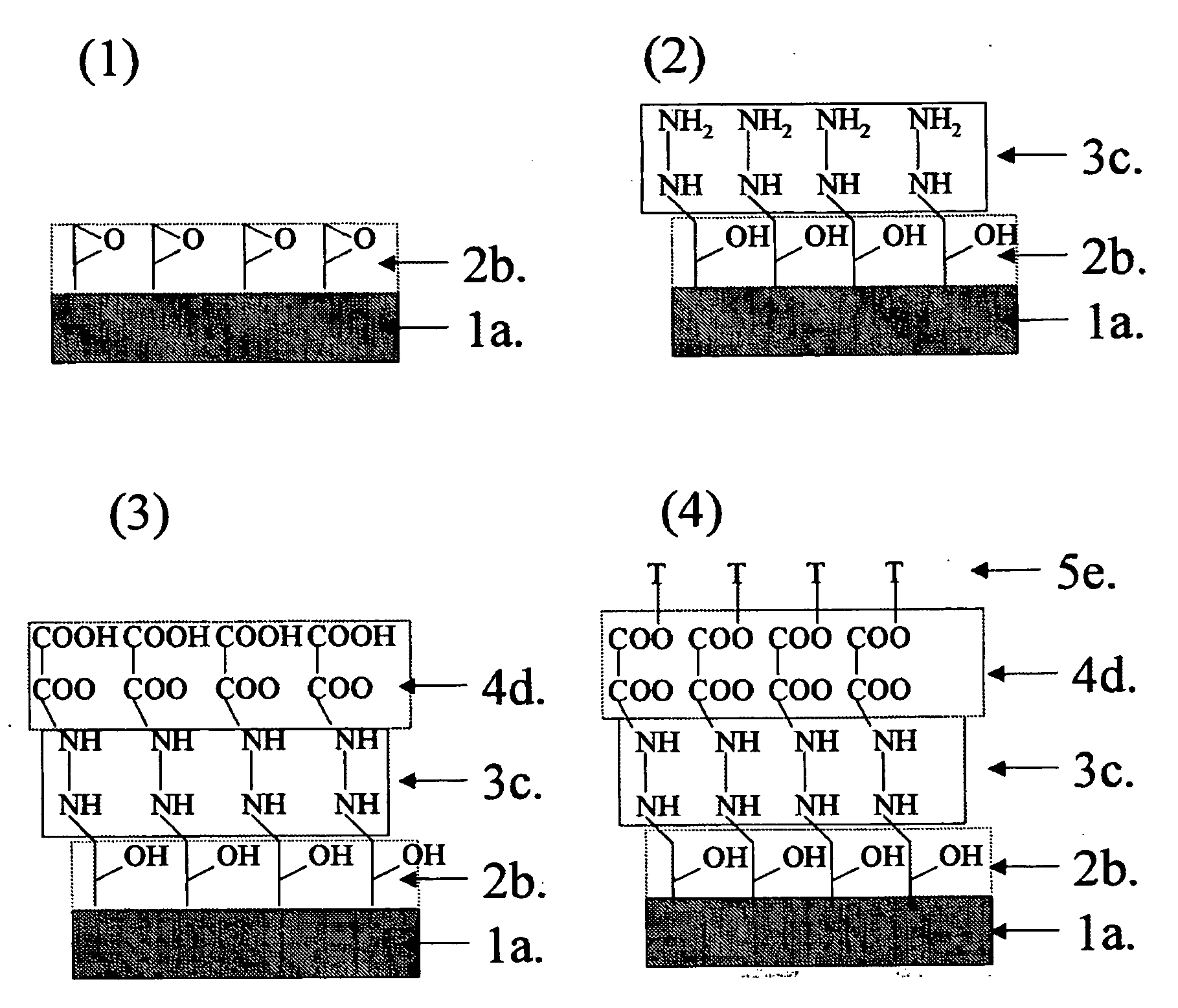
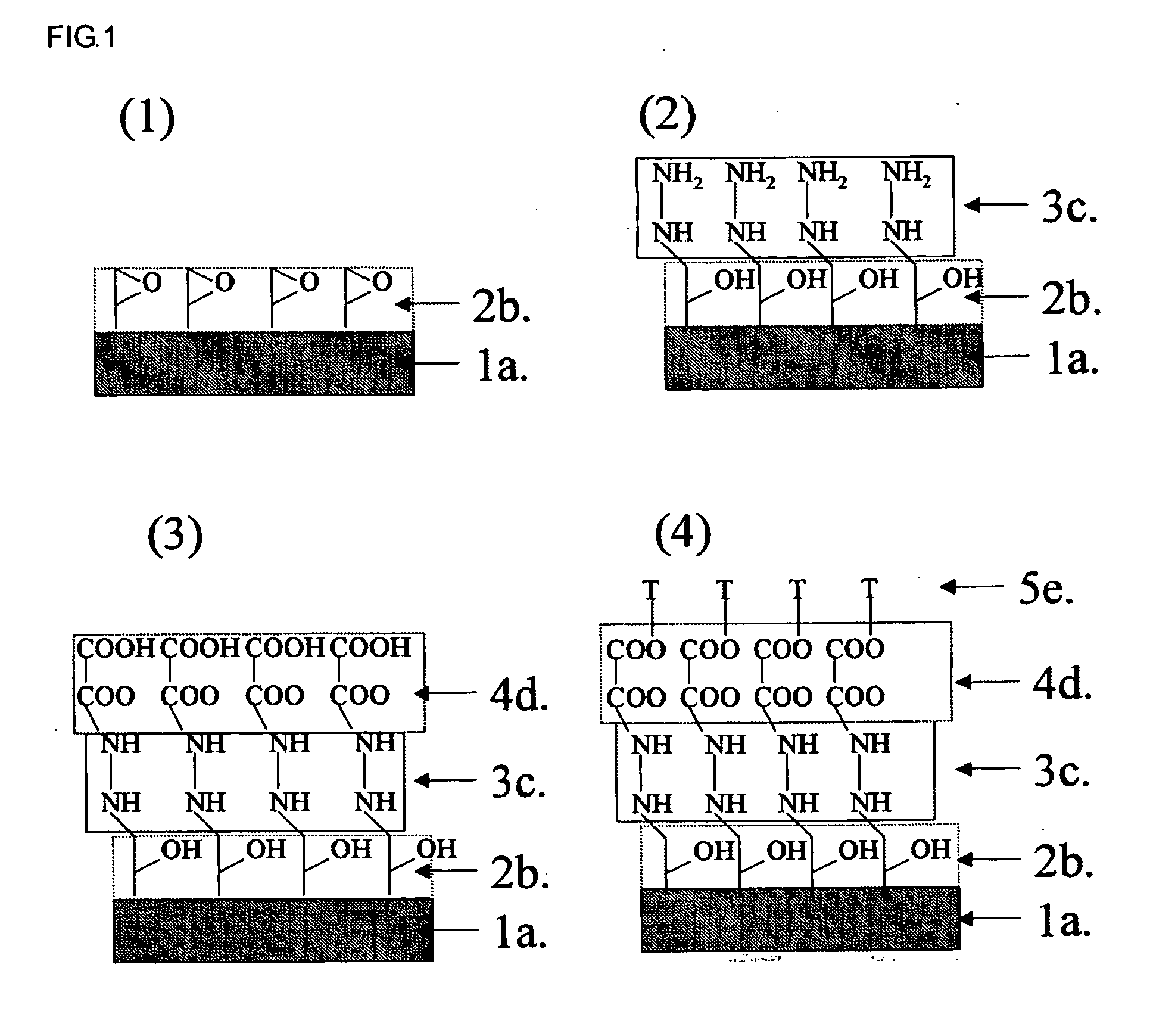
[0083]A substrate 1a having a silicon oxide layer on its surface was washed under an ultrasonic wave by soaking in chloroform and then in acetone. The substrate was further soaked in a piranha solution for 15 minutes, in water for one hour, and then in a toluene solution containing 0.02 mol / L of 11,12-epoxydodecyl trimethoxy silane prepared as mentioned above and 0.02 mol / L of piperidine for 12 hours to form a monomolecular film 2b having orientated oxysilanyl groups toward an outmost surface on the substrate (FIG. 1(1)). The substrate was washed under an ultrasonic wave by soaking in chloroform, acetone, and then water for 5 minutes each.
[0084]The substrate 1a thus treated was soaked in a methanol solution containing 0.01 mol / L of 1,8-diamino octane for 8 hours to form a monomolecular film 3c having orientated amino groups toward an outmost surface on the substrate (FIG. 1(2)). The substrate was washed under an ultrasonic wave by soaking in chloroform, acetone, and then water for 5...
example 2
[0086]A substrate having a silicon oxide layer on its surface was washed under an ultrasonic wave by soaking in chloroform and then in acetone. The substrate was further soaked in a piranha solution for 15 minutes, in water for one hour, and then in a toluene solution containing 0.02 mol / L of the above-mentioned 11,12-epoxydodecyl trimethoxy silane and 0.02 mol / L of piperidine for 12 hours to form a monomolecular film having orientated oxysilanyl groups toward an outmost surface on the substrate. The substrate was washed under an ultrasonic wave by soaking in chloroform, acetone, and then water for 5 minutes each.
[0087]The substrate thus treated was soaked in a methanol solution containing 0.01 mol / L of 2,5-diamino toluene for 8 hours to form a monomolecular film having orientated amino groups toward an outmost surface on the substrate. The substrate was washed under an ultrasonic wave by soaking in chloroform, acetone, and then water for 5 minutes each.
[0088]The substrate thus trea...
PUM
 Login to View More
 Abstract
Description
Claims
Application Information
 Login to View More