
Anti-tumoral compositions methods
- Summary
- Abstract
- Description
- Claims
- Application Information
AI Technical Summary
Benefits of technology
Problems solved by technology
Method used
Image

Examples
example 1
Cloning of APRT
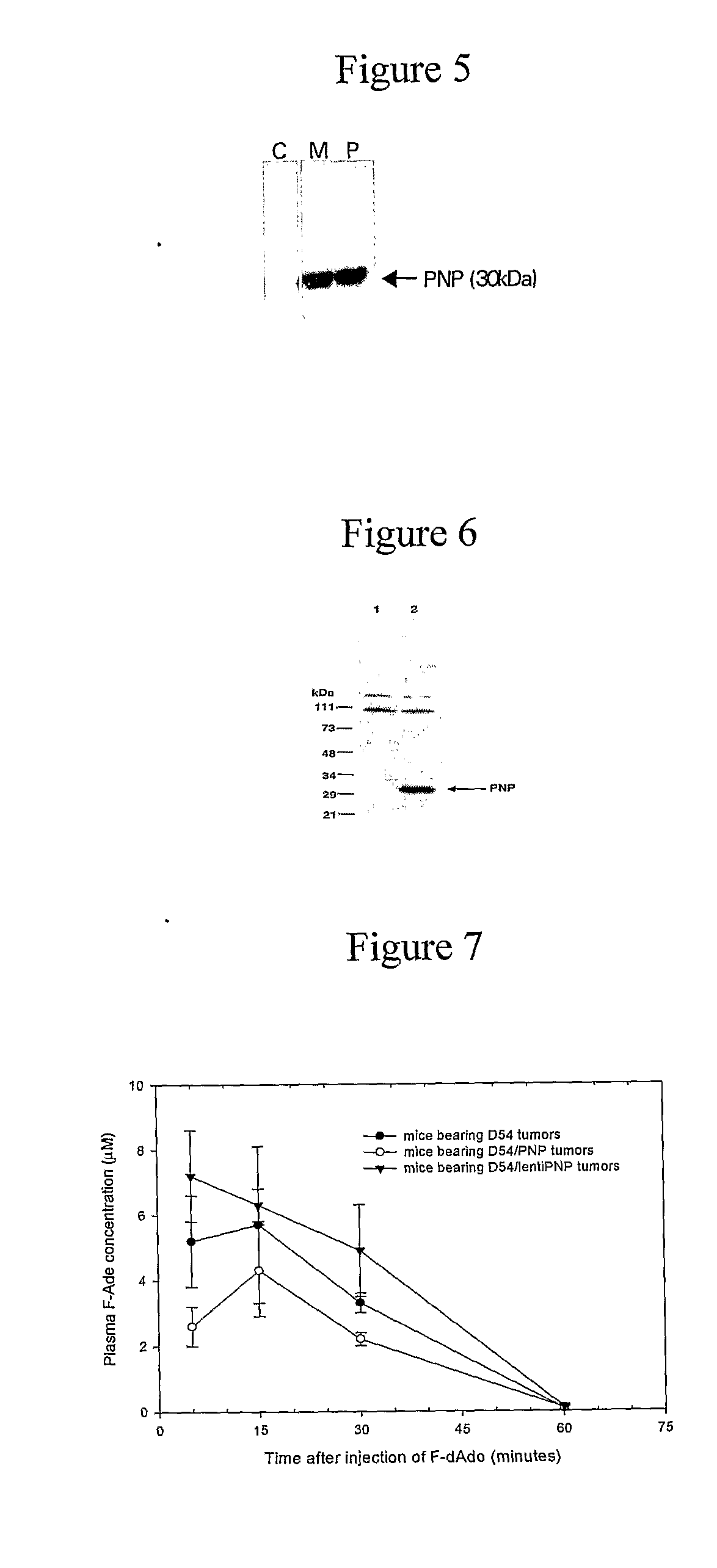
[0105]A cDNA encoding full length human APRT is isolated, the cDNA encoding the APRT protein of SEQ ID NO 1. In this example, cDNAs are synthesized from HeLa total RNA using an RNeasy kit from Qiagen and used in a PCR reaction to amplify APRT cDNA. FIG. 3 shows a 543 by band on a gel which is a PCR product encoding full length human APRT. The PCR products are cloned into a pCR4-Blunt Topo vector, available commercially from Invitrogen. The resulting clone is verified by DNA sequencing.
[0106]This 543 by APRT coding sequence may be amplified with primers to introduce restriction sites, such as NcoI and XhoI, into the product suitable for cloning into an expression vector. FIG. 4 shows an example of an expression vector according to the present invention containing a DNA sequence encoding human APRT.
example 2
Cloning of E. coli PNP
[0107]A bacterial PNP-encoding sequence is inserted into an expression vector. In one example, E. coli (strain, JM101) chromosomal DNA template is obtained using the method described in N. J. Gay, J. Bacteriol., 158:820-825 (1984). Two PCR primers GATCGCGGCCGCATGGCTACCCCACACATTAATGCAG and GTACGCGGCCGCTTACTCTTTATCGCCCAGCAGAACGGA-TTCCAG are used to define the full length coding sequence of the E. coli DeoD gene and to incorporate NotI sites at both 5′ and 3′ ends of the desired product. After 30 cycles of amplification (94° C.×1 minute denaturation, 50° C.×2 minute annealing, and 72° C.×3 minute elongation using 1 ng template, 100 microliters of each primer in a 100 microliter reaction mixture containing 2.5 units taq polymerase, 200 micromolar each dNTP, 50 mM KCl, 10 mM Tris Cl (pH 8.3), 1.5 mM MgCl2 and 0.01% gelatin (weight / vol)), a single PCR product of the predicted size is obtained. This product is extracted with phenol / chloroform, precipitated with ethano...
example 3
Generation of Herpesvirus Expression Vectors
[0109]HSV vectors exhibit tumor specificity in vivo by selectively targeting the proliferating cells in a growing tumor mass. Certain HSV vectors have been used previously in the clinic to examine glioma therapy (for micrometastatic disease) and by regional administration to liver for treatment of metastatic colon cancer Shah, A. C., et al., 2003, J. Neuro-Oncol. 65: 203-226; Markert, J. M., et al., 2000, Gene Therapy 7: 867-874; and Rampling, R., et al., 2000, Gene Therapy 7: 859-866.
[0110]Sequences encoding PNP and / or APRT are inserted into an HSV targeting plasmid. The targeting plasmids are separately co-transfected into rabbit skin cells (RSC) with C101 viral DNA that is isolated and digested with the restriction enzyme PacI (which removes a GFP expression cassette from the virus). After co-transfection, the viral genome is reconstituted by homologous recombination and viral plaques selected, propagated, and subjected to two additiona...
PUM
| Property | Measurement | Unit |
|---|---|---|
| Fraction | aaaaa | aaaaa |
| Fraction | aaaaa | aaaaa |
| Cytotoxicity | aaaaa | aaaaa |
Abstract
Description
Claims
Application Information
 Login to View More