
Method for producing metal-supported carbon, method for producing crystals consisting of fullerene molecules and fullerene nanowhisker/nanofiber nanotubes, and apparatus for producing the same
a technology of supporting metal particles and crystals, which is applied in the direction of physical/chemical process catalysts, cell components, separation processes, etc., can solve the problems of large supported metal particles that are not uniform, deficient or uneven amounts of supporting catalysts, and the effect of increasing the size of the apparatus and facilitating the regulation of electrical and electron characteristics
- Summary
- Abstract
- Description
- Claims
- Application Information
AI Technical Summary
Benefits of technology
Problems solved by technology
Method used
Image

Examples
example 1
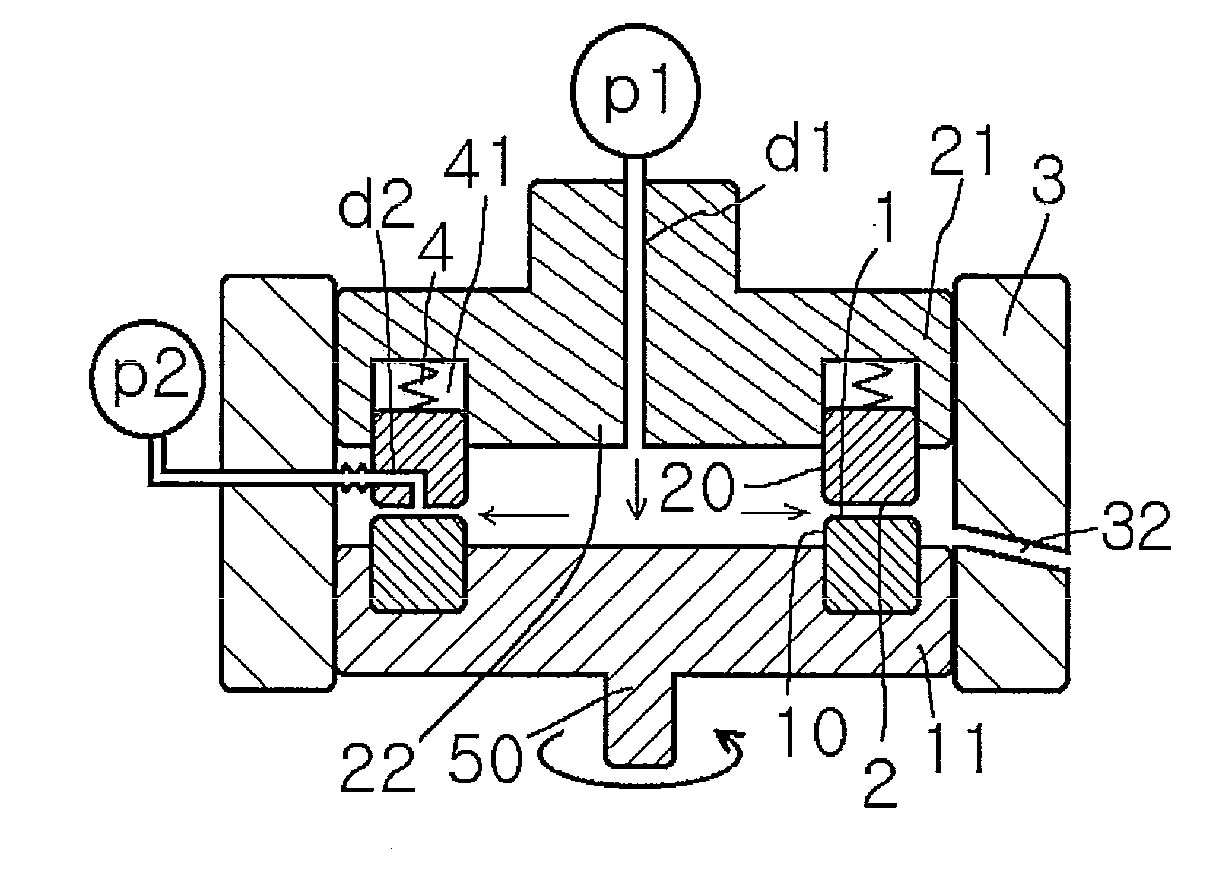
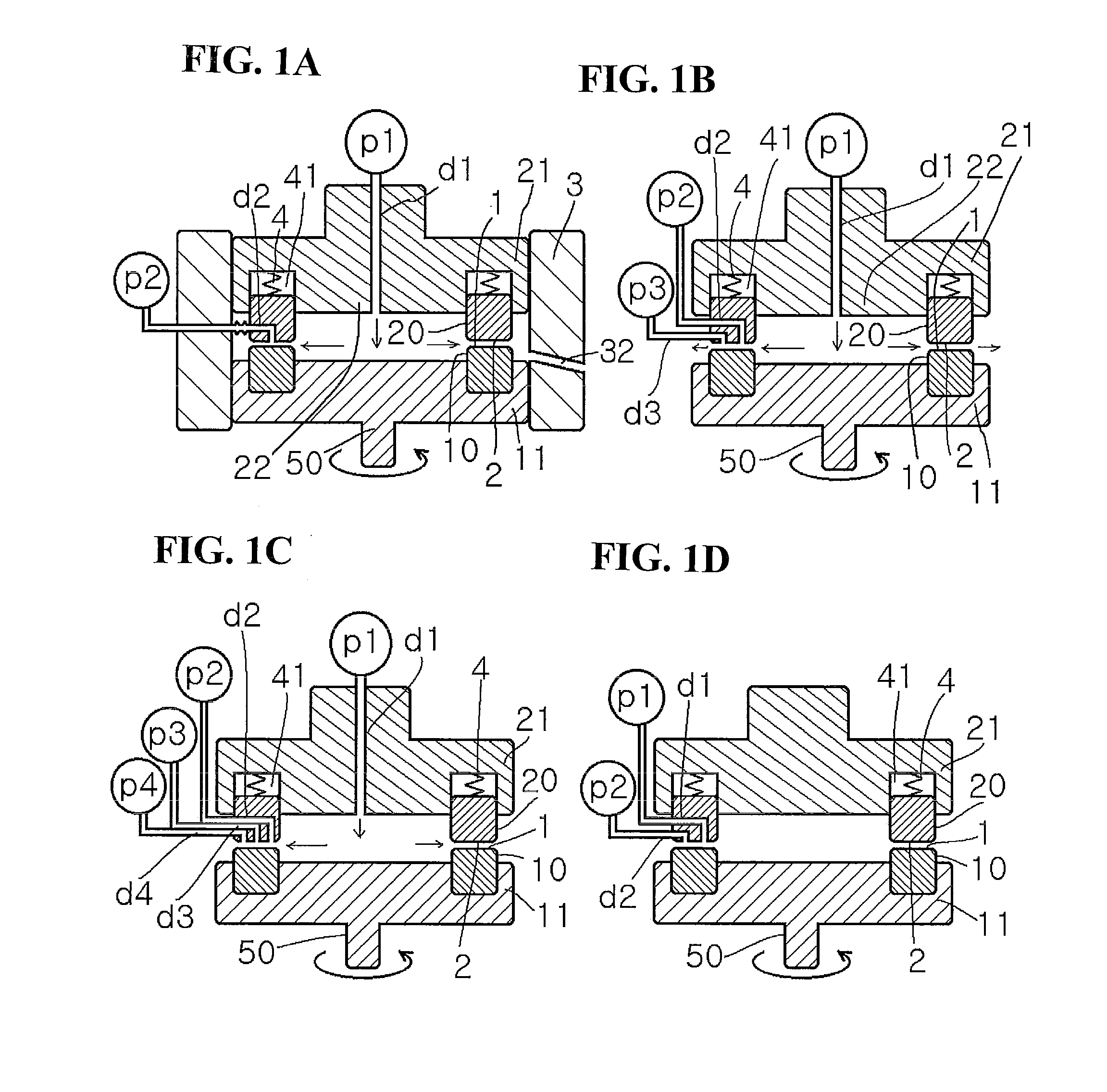
[0410]As shown in FIG. 1(A), an aqueous solution in which fructose is dissolved as a reducing agent and carbon black is dispersed was allowed to flow into an aqueous solution containing a metal compound in a thin film fluid formed between the processing surfaces 1 and 2 arranged to be opposite to each other so as to be able to approach to and separate from each other, at least one of which rotates relative to the other, in use of a uniformly stirring and mixing reaction apparatus as shown in FIG. 1(A), thereby mixing them uniformly in the thin film and simultaneously supporting metal microparticles by a liquid-phase reduction method.
[0411]While an aqueous solution of 2% carbon black (Ketjen Black EC manufactured by Lion Corporation) / ethanol / fructose was sent as a first fluid from the center at a supply pressure / back pressure of 0.30 MPa / 0.01 MPa, at a revolution number of 1000 rpm and at a solution sending temperature of 80° C., a 5% dinitrodiamine platinum nitrate solution was intr...
example 2
[0413]While an aqueous solution of 2% carbon black (Ketjen Black EC manufactured by Lion Corporation) / ethanol / fructose was sent as a first fluid from the center at a supply pressure / back pressure of 0.20 MPa / 0.01 MPa, at a revolution number of 1000 rpm and at a solution sending temperature of 80° C., a 5% dinitrodiamine platinum nitrate solution was introduced at a rate of 10 ml / min. as a second fluid into the space between the processing surfaces. A dispersion of platinum microparticles supported on the surface of carbon black was discharged from the processing surfaces.
[0414]By observation with TEM, it was confirmed that highly dispersed platinum microparticles having a particle size of about 1 nm were supported on carbon particles. The amount of supported platinum was 44%.
example 3
[0415]While an aqueous solution of 2% carbon black (Ketjen Black EC manufactured by Lion Corporation) / ethanol / fructose was sent as a first fluid from the center at a supply pressure / back pressure of 0.20 MPa / 0.01 MPa, at a revolution number of 2000 rpm and at a solution sending temperature of 80° C., a 5% dinitrodiamine platinum nitrate solution was introduced at a rate of 10 ml / min. as a second fluid into the space between the processing surfaces. A dispersion of platinum microparticles supported on the surface of carbon black was discharged from the processing surfaces.
[0416]By observation with TEM, it was confirmed that highly dispersed platinum microparticles having a particle size of about 1 nm were supported on carbon particles. The amount of supported platinum was 40%.
PUM
| Property | Measurement | Unit |
|---|---|---|
| diameter | aaaaa | aaaaa |
| diameter | aaaaa | aaaaa |
| pressure | aaaaa | aaaaa |
Abstract
Description
Claims
Application Information
 Login to View More