
Wheel structure
a technology of wheels and wheels, applied in the field of wheels, can solve the problems of increasing the cost of manufacture and assembly, difficulty in controlling the turning movement, and carts (a) still may encounter the possibility of overturning, so as to save assembly time, reduce manufacturing costs, and stable riders
- Summary
- Abstract
- Description
- Claims
- Application Information
AI Technical Summary
Benefits of technology
Problems solved by technology
Method used
Image

Examples
first embodiment
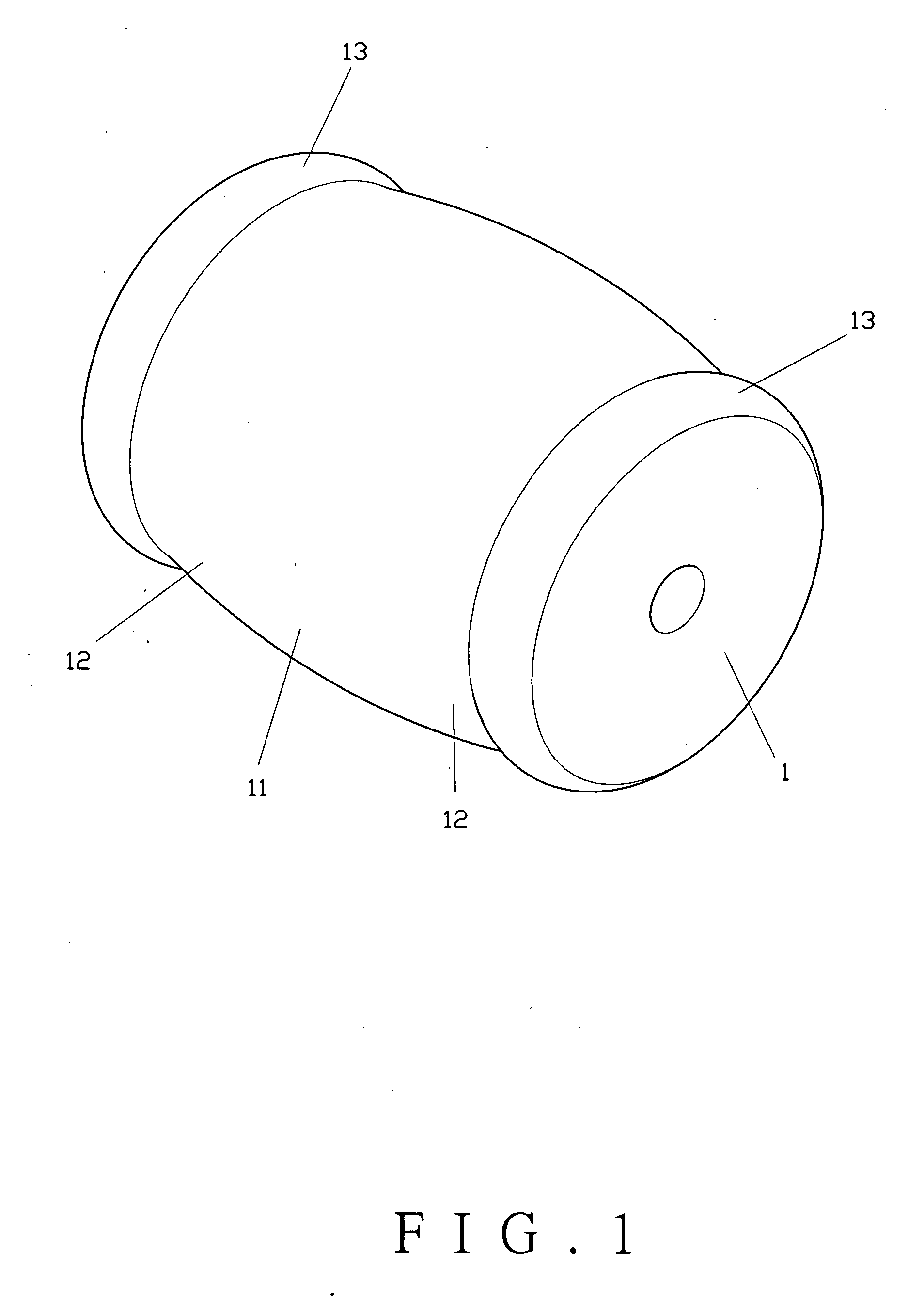
[0021] As shown in FIG. 1, the present invention comprises a wheel (1) having a main wheel body (11) at the center portion for direct contact with the ground. The main wheel body (11) has its two sides extending to form a pair of extension sections (12) to get in touch with the ground when making turns. Each extension section (12) extends outwardly to form an auxiliary section (13). The main wheel body (11) of the wheel (1) has a larger outer diameter than the outer diameters of the auxiliary sections (13) to increase the contact surfaces with the ground when making turns. The auxiliary sections (13) are integral to the main wheel body (11).
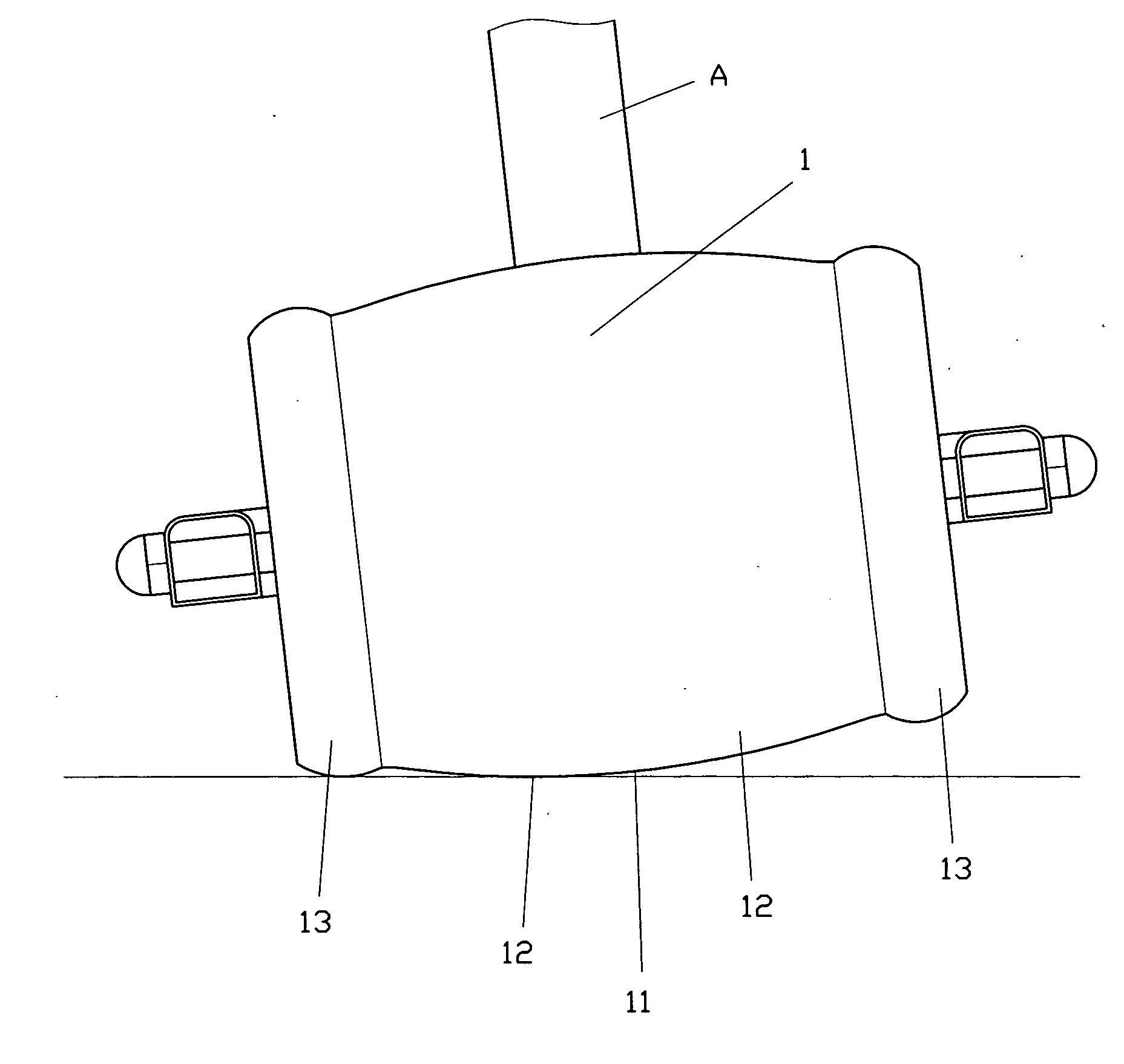
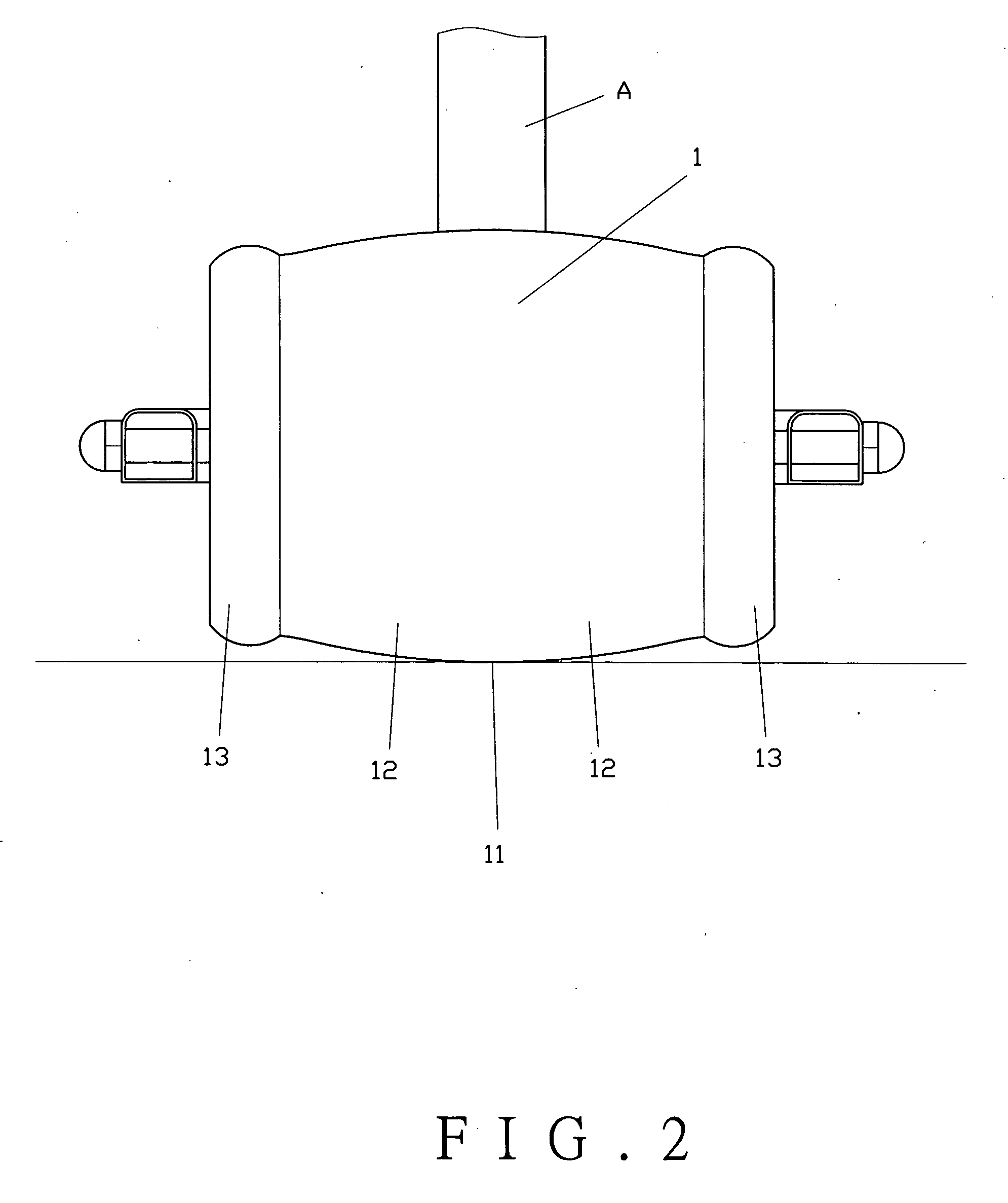
[0022] To operate the present invention, as shown in FIGS. 2 and 3, the wheel (1) is pivotally connected to a cart (A). When the cart (A) is rolling in a straight direction, the main wheel body (11) of the wheel (1) remains contact with the ground. When the cart (A) makes a turn, due to the centrifugal force, the wheel (1) will incline with the c...
second embodiment
[0023] the present invention comprises a wheel (1A) as shown in FIG. 4. The wheel (1A) has a main wheel body (11A) at the center portion, a pair of extension sections (12A) extending from respective sides of the main wheel body (11A), and a pair of auxiliary sections (13A) coaxially extending from the extension sections (12A), respectively. The main wheel body (11A) of the wheel (1A) has a larger outer diameter than the outer diameters of the auxiliary sections (13A). The extension sections (12A) are spaced from the auxiliary sections (13A).
third embodiment
[0024] the present invention comprises a wheel (1B), as shown in FIG. 5. The wheel (1B) comprises a main wheel body (11B) at the center portion to be in touch with the ground when the cart is rolling. The main wheel body (11B) has its two sides extending outwardly to form a pair of extension sections (12B) and a pair of auxiliary sections (13B) coaxially extending from the extension sections (12B), respectively. The main wheel body (11B) of the wheel (1B) has a larger outer diameter than the outer diameters of the auxiliary sections (13B). The extension sections (12B) are spaced from the auxiliary sections (13B).
PUM
 Login to View More
 Abstract
Description
Claims
Application Information
 Login to View More