
Novel Anti-inflammatory compounds
a technology of anti-inflammatory compounds and compounds, applied in the field of new anti-inflammatory compounds, can solve the problems of increased risk of cardiac disease, increased risk of cardiovascular disease, and progression of inflammatory tissue damage, and achieve the effect of suppressing infiltration into tissues and little side effects in administration
- Summary
- Abstract
- Description
- Claims
- Application Information
AI Technical Summary
Problems solved by technology
Method used
Image

Examples
example 1
Analysis Regarding Metabolites of 18-HEPE and 20-HDoHE: Establishment of Highly Sensitive Method of Analyzing PUFA Metabolites
[0292]In the present Example, in order to make it possible to also analyze a novel compound, first, establishment of a system capable of quantitatively analyzing many kinds of PUFA metabolites at once and at high sensitivity was tried. In the present Example, at once quantitative analysis system of polyvalent unsaturated fatty acid (PUFA) metabolites by Multiple Reaction Monitoring (MRM) using high performance liquid chromatography-tandem mass spectrometry (HPLC-MS / MS) was established.
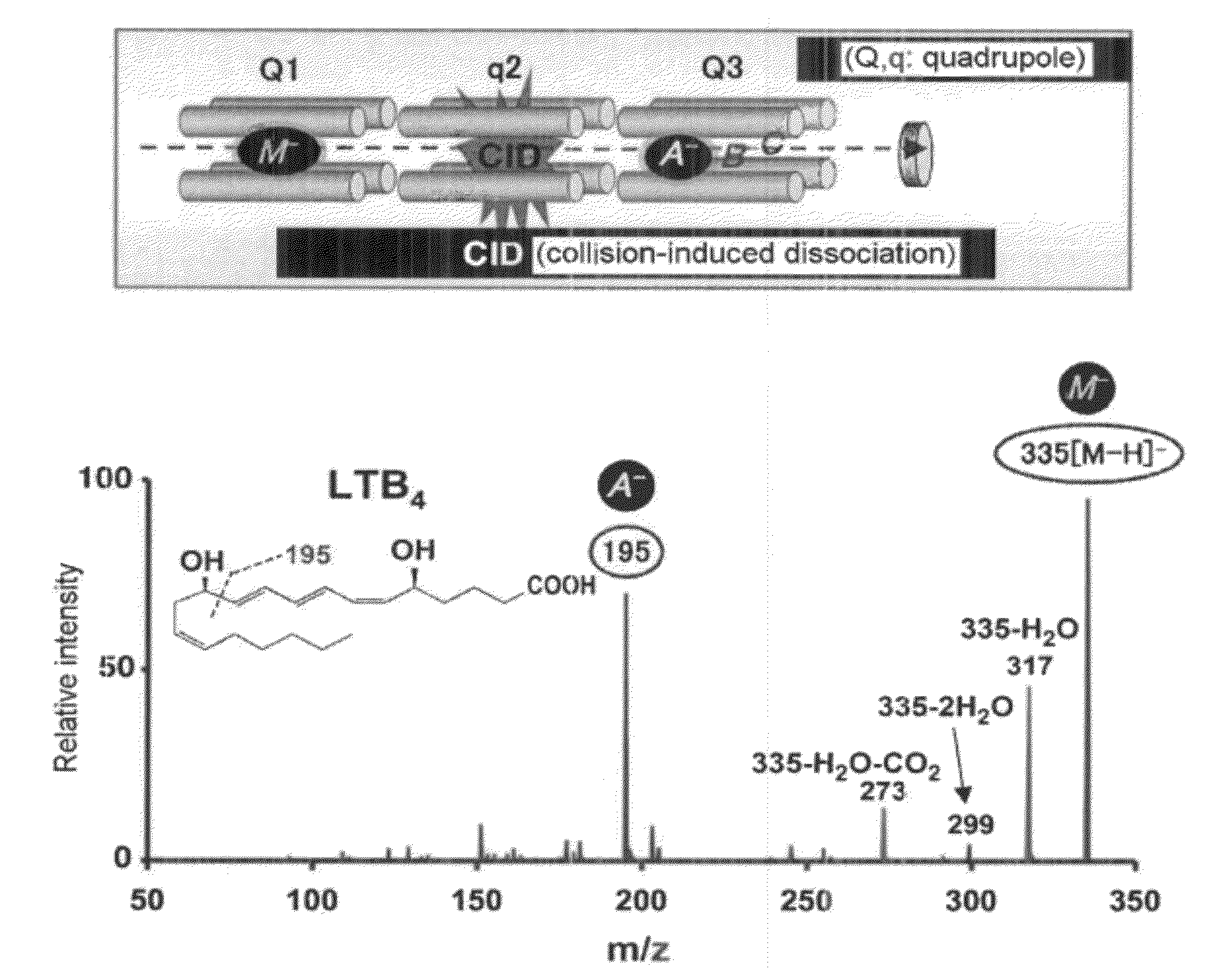
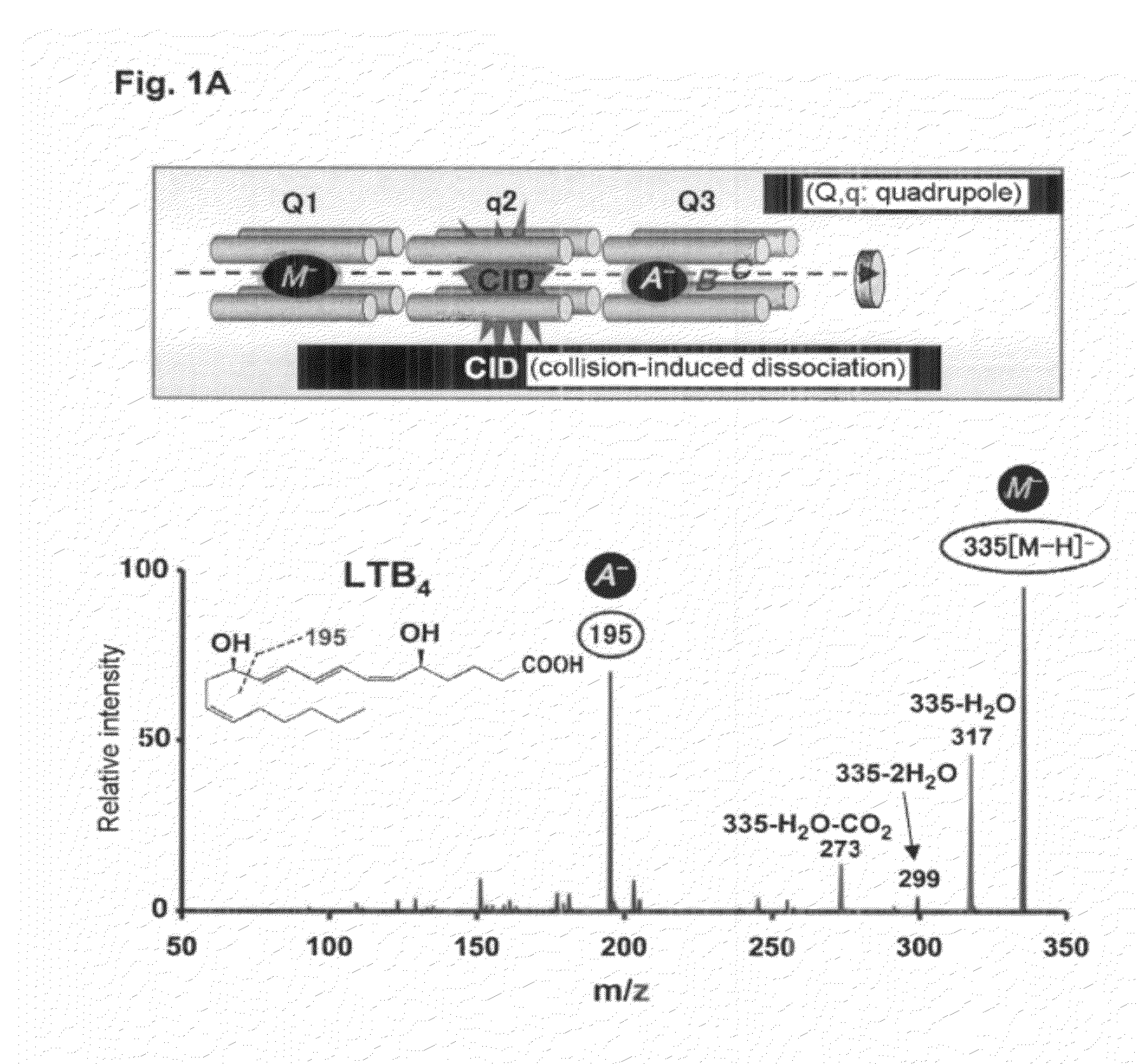
[0293]MRM is a procedure which can analyze an objective metabolite selectively and at a high sensitivity using MS / MS (FIG. 1A). When MS / MS of a metabolite of PUFA is measured, for example, an oxide causes fragmentation at a carbon-carbon bond before and after its hydroxyl group. Then, a MS / MS value characteristic in a structure of the metabolite is detected. Then, a procedure of...
example 2
Analysis of Metabolism Route and Certification of Presence of Novel Compound
[0311]In the present Example, an 18-series EPA metabolism pathway was analyzed. Therein, it was found out that a novel compound which has not previously been found out in a living body is present.
[0312]Then, for the purpose of grasping what a metabolite is generated from 18-HEPE at inflammation, by amplification, incubation of 18-HEPE with lymphocyte which is infiltrating at an inflammation site was performed. A zymosan peritonitis model was used, in which many lymphocytes infiltrated at an inflammation site as PEC (Peritoneal Exudate Cells) and its recovery was easy. When peritonitis is elicited by zymosan administration, a pattern characteristic in acute inflammation is shown, in which first neutrophil infiltrates and, thereafter, this time monocyte • macrophage infiltrate with decrease in neutrophil. This time, using PEC after 4 hours from zymosan administration as an initial stage of inflammation, and af...
example 3
Synthesis of 18-HEPE-Derived Metabolites
[0328]In the present invention, it was demonstrated that novel compounds corresponding to novel metabolites derived from 18-HEPE and 20-HDoPE can be synthesized. It was found out that these are produced by 12 / 15-LOX or soybean LOX (sLOX), as a result of intensive study. Then, in order to assess activity of these metabolites, those metabolites were tried to synthesize using an enzymatic reaction therefor. In the present Example, an enzymatic reaction was performed using sLOX for the purpose of subjecting to general use, in place of mouse 12 / 15-LOX. In addition, whether produced metabolites were constituent with those produced by a living body was examined by a spike experiment.
(Material)
(1. Preparation of Dihydroxy Body of DHA by Enzymatic Reaction)
[0329]Enzymatic reaction using soybean lipoxygenase (sLOX) Borate buffer (pH 9.0): Boric acid and potassium chloride (both Wako Pure Chemical Industries, Ltd.) were dissolved in milliQ. A 1N potassiu...
PUM
| Property | Measurement | Unit |
|---|---|---|
| weight | aaaaa | aaaaa |
| weight | aaaaa | aaaaa |
| weight | aaaaa | aaaaa |
Abstract
Description
Claims
Application Information
 Login to View More