
Fibronectin Binding Domains with Reduced Immunogenicity
a technology of fibronectin and binding domain, which is applied in the field of fibronectin binding domain with reduced immunogenicity, can solve the problems of potentially harmful immune responses in patients and the efficacy reduction of protein therapeutics, and achieve the effect of improving target binding and reducing immunogenicity
- Summary
- Abstract
- Description
- Claims
- Application Information
AI Technical Summary
Benefits of technology
Problems solved by technology
Method used
Image

Examples
example 1
Expression and Purification of Fibronectin Based Scaffold Proteins
[0246]Selected binders were cloned into a PET9d vector and transformed into E. coli BL21 DE3 plysS cells. Transformed cells were inoculated in 5 ml LB medium containing 50 μg / mL kanamycin and 34 μg / ml chloromphenicol in a 24-well format and grown at 37° C. overnight (inoculums culture). Production cultures were established by aspirating 200 μl of the inoculum culture into 5 ml (in a 24-well format) of TB-Overnight Expression Media (auto induction) containing 50 μg / ml Kanamycin and 34 μg / ml chloromphenicol. The cultures were grown at 37° C. for 4 hours at which time the temperature was lowered to 18° C. and grown for 20 hours. Cultures were harvested by centrifugation for 10 minutes at 2750 g at 4° C.
[0247]Cell pellets (in 24-well format) were lysed by resuspension in 450 μl of Lysis buffer (50 mM NaH2PO4, 0.5 M NaCl, 1× Complete™ Protease Inhibitor Cocktail-EDTA free (Roche), 1 mM PMSF, 10 mM CHAPS, 40 mM Imidazole, 1...
example 2
Characterization of the Immunogenicity of 10Fn3 Domain Polypeptides
[0248]The adaptive immune response is initiated by the processing and digestion of an internalized protein by an antigen-presenting cell (APC), such as a dendritic cell. The APC clips the internalized protein into short peptides and then displays the peptides on its surface MHC Class II molecules. The peptide binding site of the MHC Class II molecule is long and narrow, like a hot-dog bun, and holds its peptide in an extended format, with room for nine amino acids in the primary binding site (and generally allows for short tails on either side of the peptide). Certain pockets in the MHC binding site are dominant in determining peptide binding. These pockets correspond to amino acid positions 1, 4, 6, and 9 in the anchored portion of the 9-mer peptide. A peptide that has favorable side chains at each of these four positions will in general bind to HLA (an MHC Class II molecule) well.
[0249]Position 1 is thought to be t...
example 3
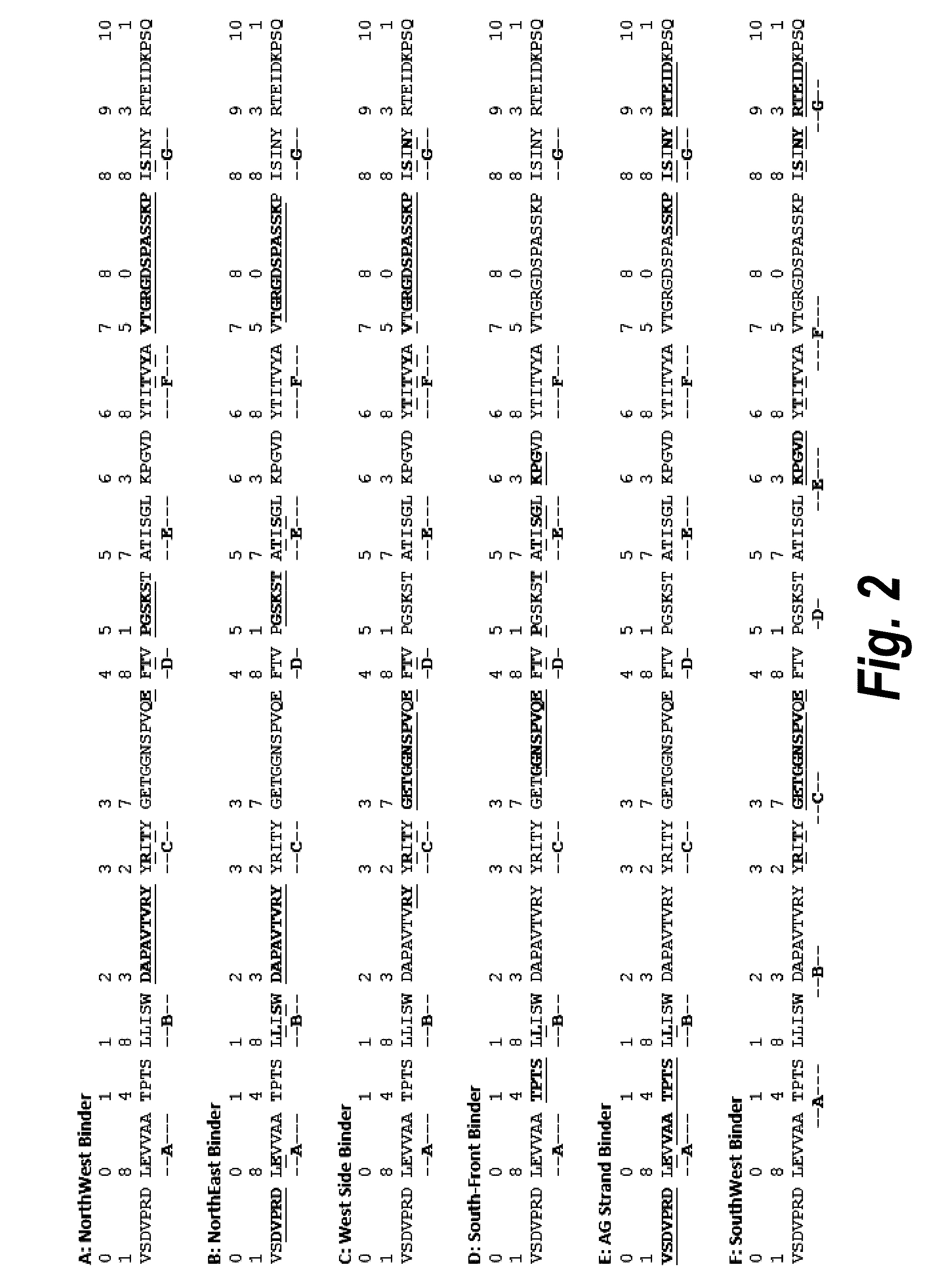
Generation of West Side Binders
[0261]Libraries of West Side (“WS”) binder polypeptides comprising a modified 10Fn3 domain were screened using mRNA display (Xu et al Chem. Biol. 2002 August; 9(8):933-42) for binding to murine IL-17, murine DLL4 or human PXR as targets. The WS binders were designed such that the BC loop sequence was left as wildtype. The WS 1 library design (see FIG. 9A) was used to identify binders to the target human PXR and the WS-LI1 library design (see FIG. 9A) was used to identify binders to the targets murine IL-17 or murine DLL4. Target binding was monitored by qPCR and populations were cloned and expressed in E. coli when a specific binding signal was observed.
PUM
| Property | Measurement | Unit |
|---|---|---|
| concentration | aaaaa | aaaaa |
| molecular mass | aaaaa | aaaaa |
| total molecular mass | aaaaa | aaaaa |
Abstract
Description
Claims
Application Information
 Login to View More