However, it is difficult to arrange the cylindrical batteries in a stacked structure due to the external shape of the cylindrical batteries.
Generally, the secondary battery pack is repeatedly charged and discharged during the use of the secondary battery pack, and the secondary battery pack uses
lithium secondary battery, which exhibits low safety in abnormal conditions, such as external
impact, dropping, penetration of a needle-shaped body,
overcharge,
overcurrent, etc., as a unit
cell.
Consequently, when the connection state of the corresponding region is variable, for example, the resistance value of the terminal connection region changes due to vibration, the detected information is inaccurate, and therefore, the safety element cannot perform the desired process.
However, the
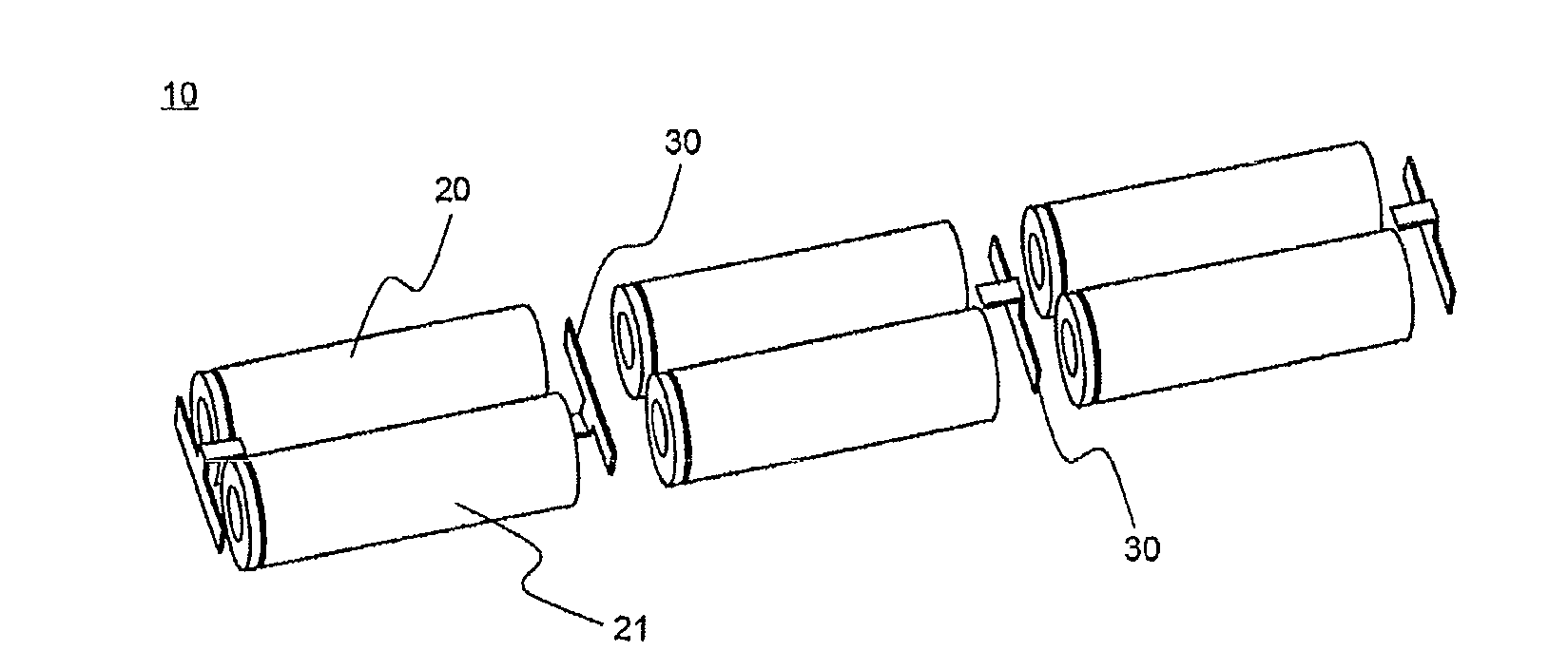
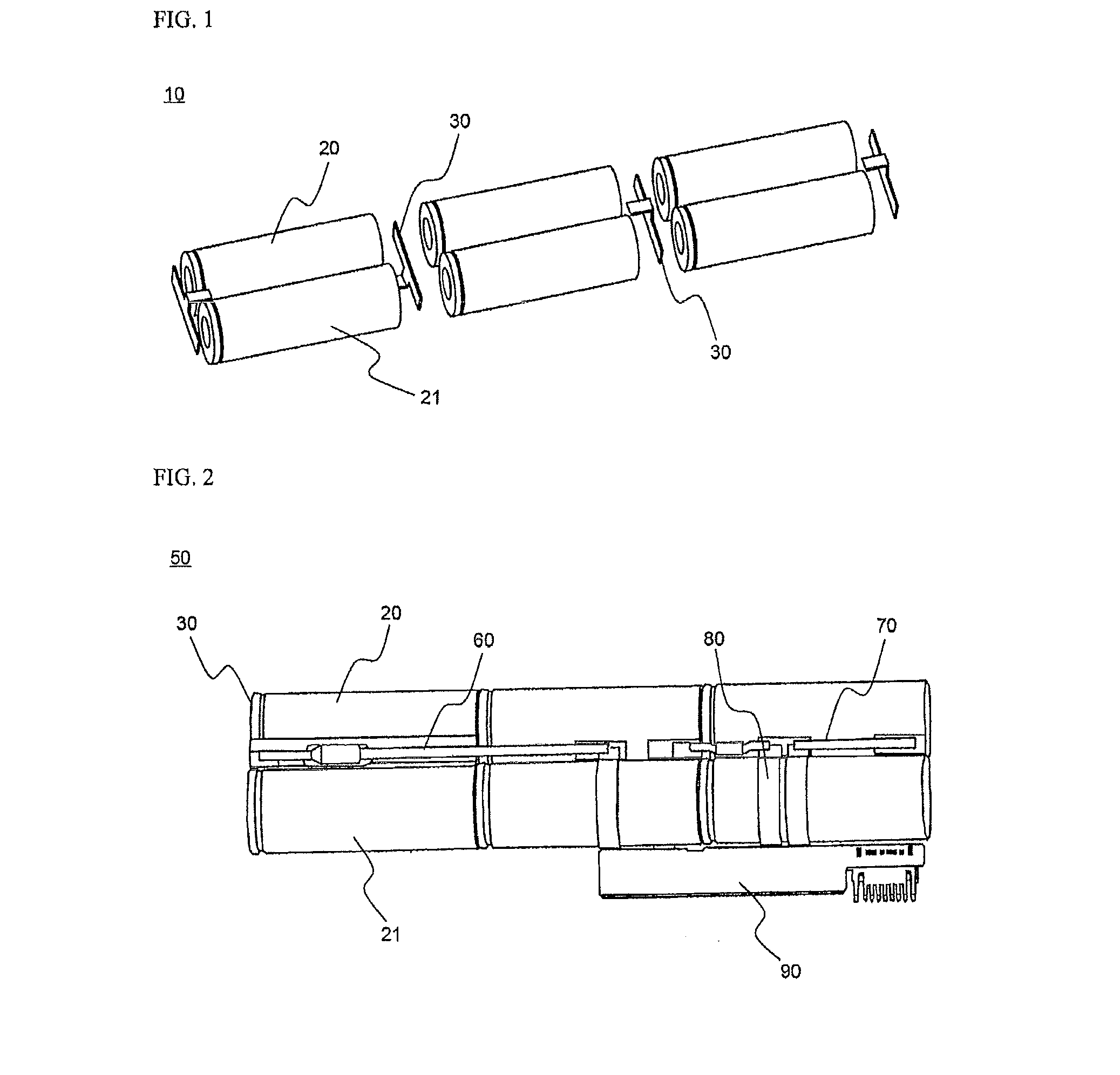
welding or
soldering process between the battery cells has the following problems.
As a result, the production process is complicated, and the production costs increase, whereby the production efficiency lowers.
Also, a
short circuit may occur at the welded region, due to the vibration generated from the battery pack or external
impact applied to the battery pack, at the time of directly
welding or
soldering the battery cells.
In addition, electrical or
thermal damage may be caused between the battery cells and the connection members, whereby the safety of the batteries is threatened, and the defective product rate increases.
Furthermore, when some of the battery cells become defective, during the manufacturing or use of the battery cells, all the battery cells constituting the battery pack must be discarded.
Consequently, there is a high necessity for a technology that is capable of substituting for the connection method based on such
welding or
soldering, which threatens the safety of the batteries and requires a complicated working process, and, at the same time, reusing the remaining battery cells, although some of the battery cells are defective, while stably securing the connection structure between the battery cells.
However, the above-mentioned technologies have a problem in that it is required for connection members to exhibit elasticity enough to fix the battery cells and stably connect
electrode terminals to one another, and therefore, connection members exhibiting low elasticity are limited in use.
Especially, the technology using the conduction coils has problems in that the sectional area of a wire constituting each coil is small, and the connection length of the wire is relatively large, whereby the electrical resistance increases.
The increase of the electrical resistance causes
power loss and increases the amount of heat generated, whereby the stable connection between the batteries may be obstructed.
On the other hand, for the technology using the
metal plates that are bent to have elasticity, the
metal plates may lose their elasticity or break when an excessive force is applied to the
metal plates at the time of inserting the battery cells into the pack case, or when the metal plates are repeatedly used, with the result that, when external
impact is applied to the battery cells, the battery cells may be separated from the pack case or the
electrical connection between the battery cells may be
cut off.
Furthermore, the above-mentioned connection member is limited to apply to the previously described secondary battery pack due to the variable connection state at the corresponding region.
However, the provision of the partitions increases the size of the battery pack, which is far from the latest tendency to pursue the reduction in size, weight, and thickness.
In this method, however, a material, such as
polymer resin, for the pack case is slowly deformed by stress during the use of the pack case for a long period of time, which is called a
creep phenomenon.
Consequently, excessively high elastic pressing force of the connection members causes the occurrence of stress at the pack case, which leads to the
creep phenomenon.
As a result, the distance between the battery cells gradually increases, and therefore, the
electrical connection between the battery cells is unstable.
This phenomenon may be serious especially for a device of which the long-term use is required.
Consequently, the connection method based on the primary batteries cannot be applied to a battery pack, based on secondary batteries, of which the long-term use is required through repeated
charge and discharge, without any modification.
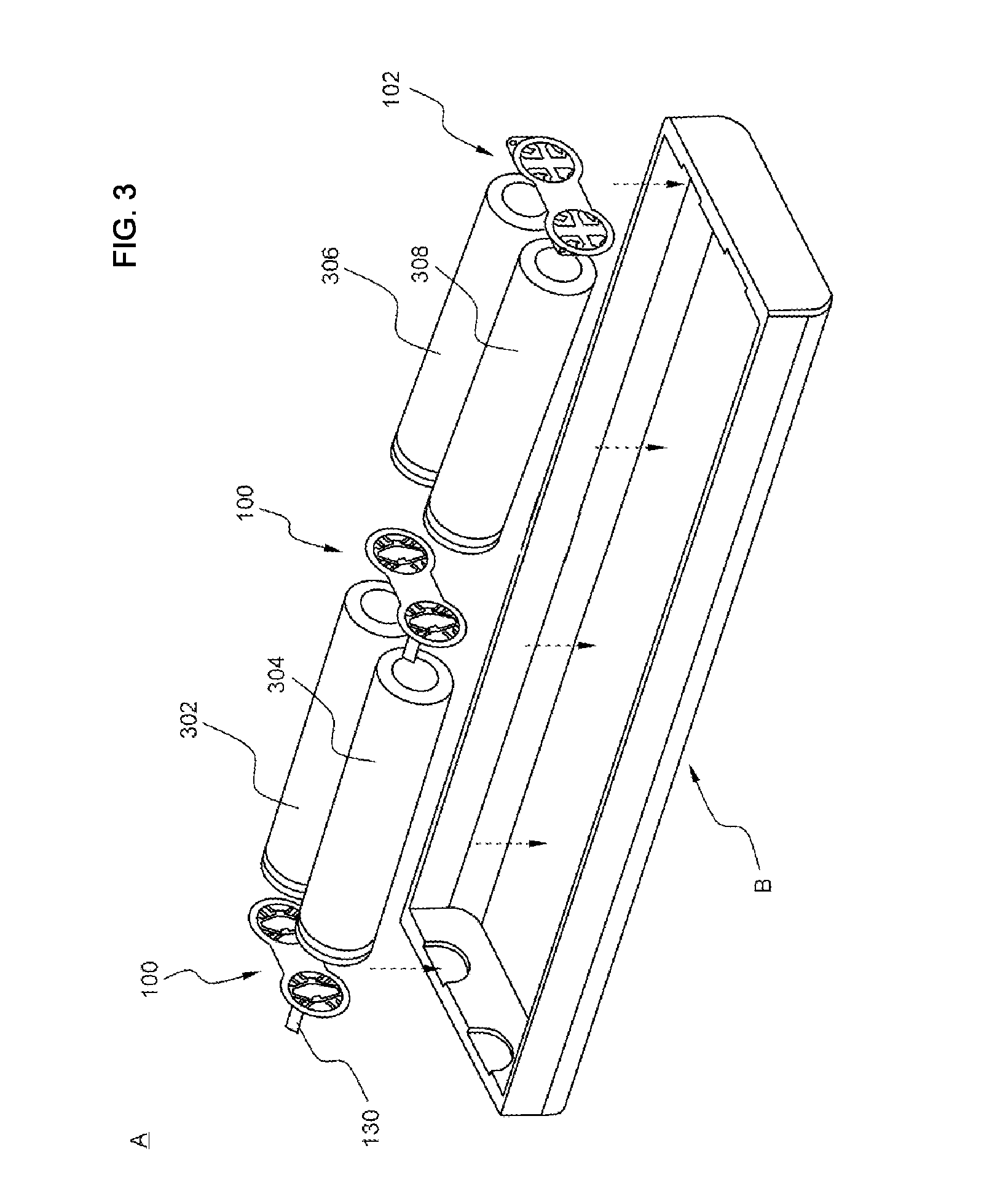
Consequently, there is a high necessity for a battery pack that is capable of substituting for the connection method based on such welding or soldering, which threatens the safety of the batteries and requires a complicated working process, not causing the increase in size of the battery pack, and stably securing the connection structure between the battery cells.


 Login to View More