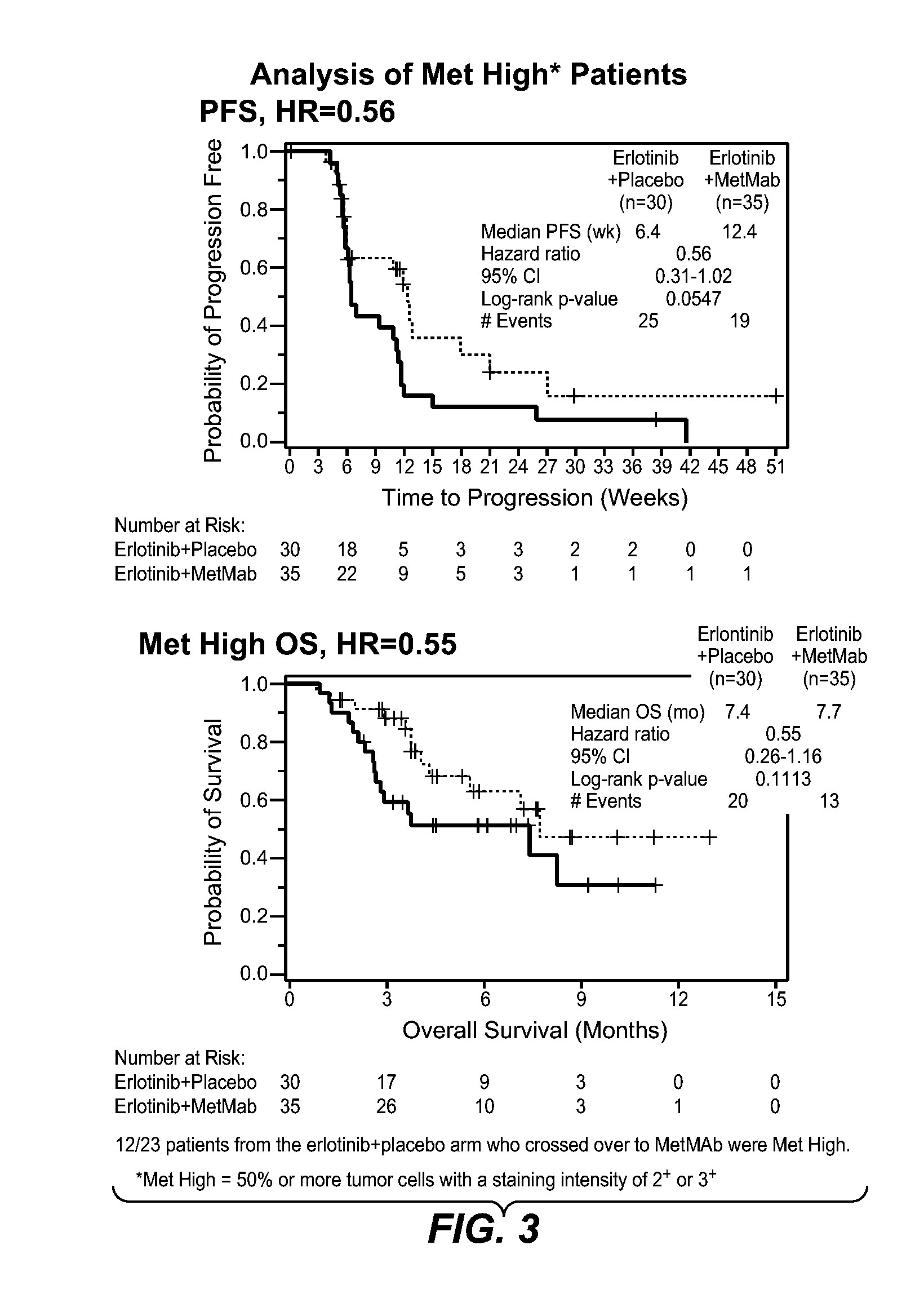
[0007]Uses of a c-met antagonist for effectively treating cancer patients are provided. This application also provides better methods for diagnosing disease for use in treating the disease optionally with c-met antagonist. In particular, the invention provides data from a randomized phase II clinical trial of anti-c-met antibody MetMAb (onartuzumab) in combination with erlotinib (TARCEVA®) in subjects with second- and third-line non-small cell lung cancer (NSCLC). C-met biomarker was used to identify a patient population in which MetMAb plus erlotinib treatment provided clinically meaningful benefit, evaluated by progression-free survival and overall survival, and a patient population in which MetMAb plus erlotinib treatment significantly increased the risk of cancer progression and death (compared to treatment with erlotinib alone). This worse outcome underscores the need to select patients who will benefit from treatment with c-met antagonist (e.g., in combination with EGFR antagonist).
[0008]In the clinical trial, treatment with MetMAb and erlotinib provided a clinically meaningful benefit to patients with NSCLC that expressed high levels of c-met biomarker. The results showed that the efficacy, as evaluated by progression free survival (PFS) and overall survival (OS), was positive especially when compared to PFS and OS data for erlotinib treatment alone. The difference was statistically significant, and the addition of MetMAb to erlotinib nearly doubled the progression free and overall survival in patients with NSCLC that expressed high levels of c-met biomarker. The clinical trial data also showed that treatment with MetMAb in combination with erlotinib increased the risk of progression and death in patients with NSCLC that expressed low levels of c-met biomarker, relative to risk of progression and death in such patients treated with erlotinib alone. The results showed that the efficacy, as evaluated by PFS and OS, was worse in the MetMAb and erlotinib treated patients when compared with PFS and OS data for erlotinib treatment alone. The difference was statistically significant.
[0023]In some aspects, the invention features methods of instructing a patient with cancer (such as NSCLC) expressing high levels of c-met biomarker by providing instructions to receive treatment with a c-met antagonist (for example, an anti-c-met antibody), and in some embodiments, treatment with a second medicament (such as EGFR antagonist, e.g. erlotinib), for example, to increase survival of the patient, to decrease the patient's risk of cancer recurrence and / or to increase the patient's likelihood of survival. In some embodiments, the treatment comprises administering to the NSCLC patient an anti-c-met antibody (e.g., MetMAb) administered in combination with an EGFR antagonist, such as erlotinib. In some embodiments the method further comprises providing instructions to receive treatment with at least one chemotherapeutic agent. In certain embodiments the patient is treated as instructed by the method of instructing. In some embodiments, the package insert indicates that the c-met antagonist is to be used to treat the patient if the patient's cancer sample expressed high c-met biomarker. In some embodiments, the instructions indicate that the c-met antagonist is not to be used to treat the patient if the patient's cancer sample expresses low c-met biomarker, wherein low c-met biomarker means decreased PFS and OS when the patient is treated with the c-met antagonist (or in some embodiments, treated with c-met antagonist in combination with EGFR antagonist). In some embodiments, the PFS and / or OS is decreased relative to a patient who is not treated with the c-met antagonist (or in some embodiments, treated with c-met antagonist in combination with EGFR antagonist).
[0024]The invention also provides business methods, comprising marketing an c-met antagonist (e.g., anti-c-met antibody) for treatment of cancer (e.g., NSCLC) in a human patient, wherein the patient's cancer expressed high (elevated) c-met biomarker expression, for example, to increase survival, decrease the patient's likelihood of cancer recurrence, and / or increase the patient's likelihood of survival. In some embodiments, the treatment comprises administering to a cancer patient an anti-c-met antibody (e.g., MetMAb), and in some embodiment, a second medicament (e.g., an EGFR antagonist, such as erlotinib). In some embodiments, the marketing is followed by the treatment of the patient with the c-met antagonist (such as anti-c-met antibody) and in some embodiments, treatment with anti-c-met antibody and / or EGFR antagonist. In some aspects, the invention features a method of instructing a patient with cancer (such as NSCLC) expressing low (i.e., low or substantially undetectable) levels of c-met biomarker by providing instructions to receive treatment with a cancer medicament other than a c-met antagonist. In certain embodiments the patient is treated as instructed by the method of instructing.


 Login to View More