Unlock instant, AI-driven research and patent intelligence for your innovation.

Dental apparatus for treating malocclusion

a technology for dental devices and malocclusions, applied in dentistry, medical science, dental tools, etc., can solve the problems of limiting the opening of the mouth,

Inactive Publication Date: 2014-09-04
REMOX
View PDF13 Cites 3 Cited by
  • Summary
  • Abstract
  • Description
  • Claims
  • Application Information

AI Technical Summary

Benefits of technology

The patent is about a dental apparatus that can be adjusted to the person's jaw configuration. It uses a third pivoting joint to connect the rear ends of rods, allowing the device to move from an open position to a closed position and follow the jaws' movement. This results in a more precise fit and better dental treatment.

Problems solved by technology

Thus, certain activators are difficult to wear because they are relatively large and are visible, having parts located outside the oral cavity, and, moreover, they limit the opening of the mouth.
They all have the disadvantage of limiting the opening of the mouth or of not enabling it at all.
In some cases, when forces are applied anteriorly, they can cause buccoversion of the lower incisors.
While this admittedly enables greater opening of the oral cavity than the devices described above, this device nevertheless has the disadvantage of using a posterior anchoring, in particular on the upper and lower molars, which anchoring, combined with a rotation action of the two arms around the central hinge, causes tensile force to be applied on the two arches, which reduces the efficacy of the treatment.
Moreover, the closing of the device around a hinge freely suspended between the two arches carries the risk of causing it to move in the internal membrane of the cheeks, and, therefore, of being irritating during use.
While it admittedly ensures better positioning of each rigid arm, and therefore of the application of force with respect to the dental arches, this device has the disadvantage of holding the mouth in the open position, which is uncomfortable, while being ineffective, because it is known that optimal efficacy is achieved when the oral cavity is in the closed position.

Method used

the structure of the environmentally friendly knitted fabric provided by the present invention; figure 2 Flow chart of the yarn wrapping machine for environmentally friendly knitted fabrics and storage devices; image 3 Is the parameter map of the yarn covering machine
View more

Image

Smart Image Click on the blue labels to locate them in the text.
Viewing Examples
Smart Image
  • Dental apparatus for treating malocclusion
  • Dental apparatus for treating malocclusion
  • Dental apparatus for treating malocclusion

Examples

Experimental program
Comparison scheme
Effect test

first embodiment

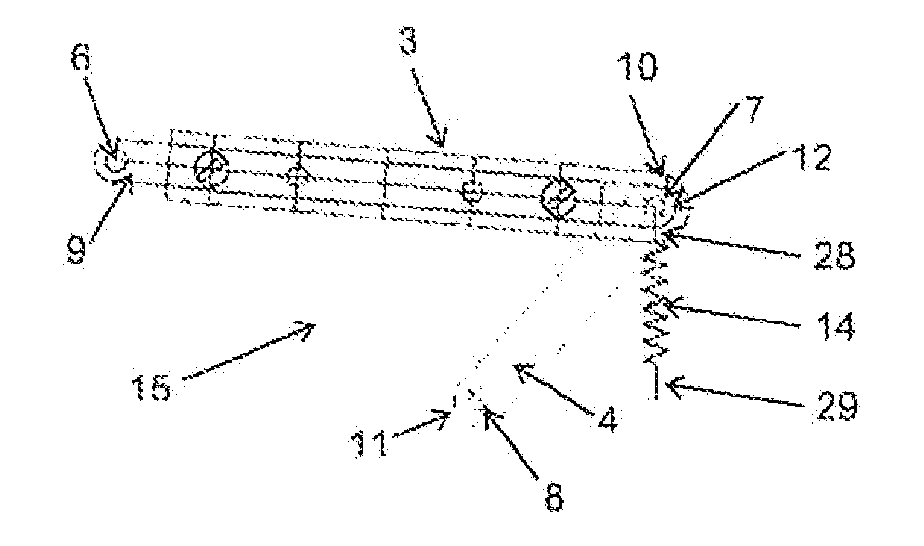
[0056]In a first embodiment, as can better be seen in FIGS. 3a and 3b, the elastic means can be a tension spring 14 connecting the central joint pin 7 and attachment means located at the dental arch or the tray. The first rod 3 is advantageously longer than the second rod 4. The tension spring 14 comprises a first end 28 connected to the central joint pin 7 and a second end 29 that is intended to be connected behind the first molar, for example consisting of an anchoring located at the second molar.

second embodiment

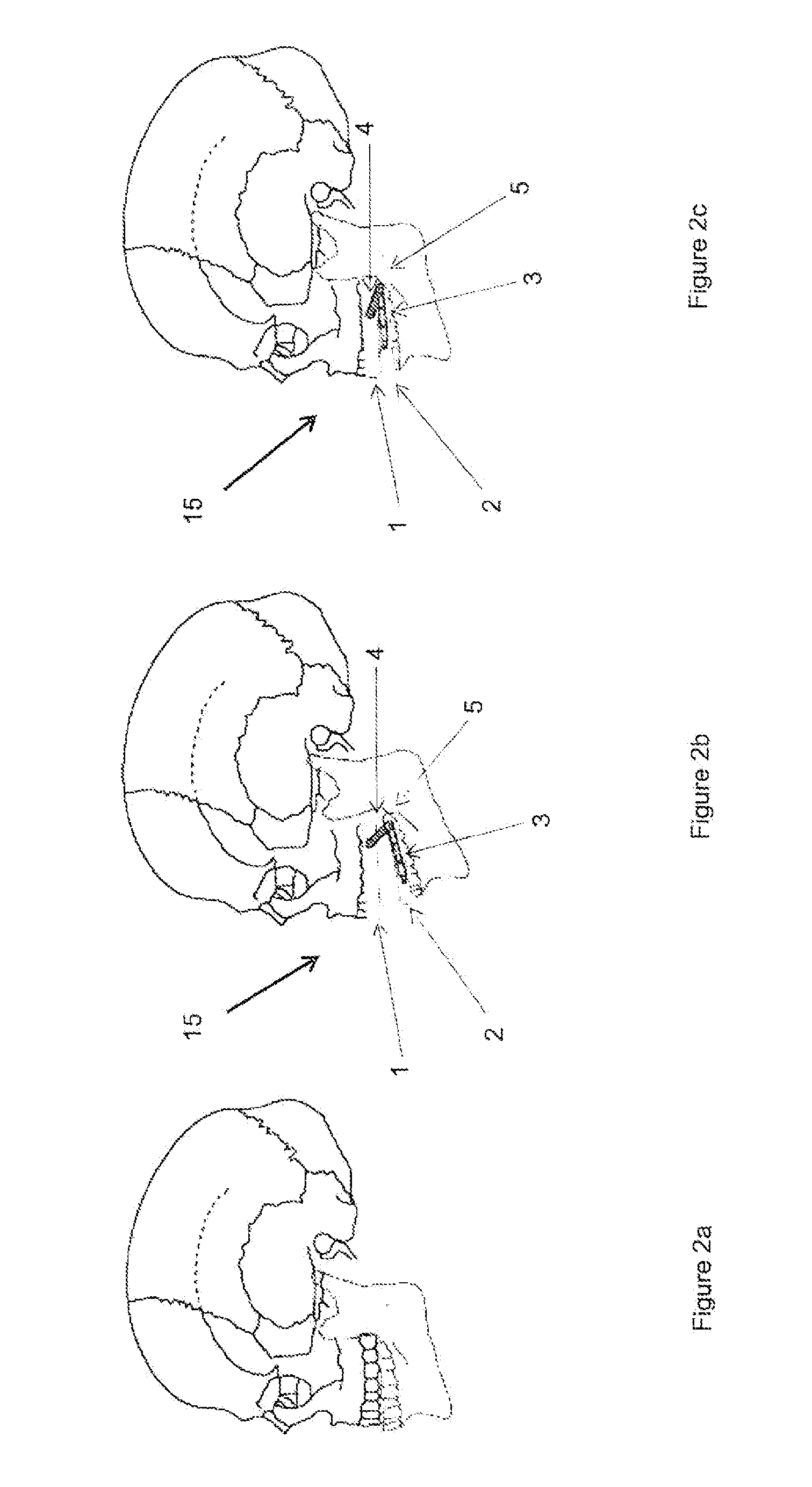
[0057]In a second embodiment, as can better be seen in FIGS. 4a and 4b, the elastic means 5 can be a tension spring 14 arranged along the second rod 4, which spring connects the central joint pin 7 and the end of the slide 17 of the rod 4 as will be explained below.

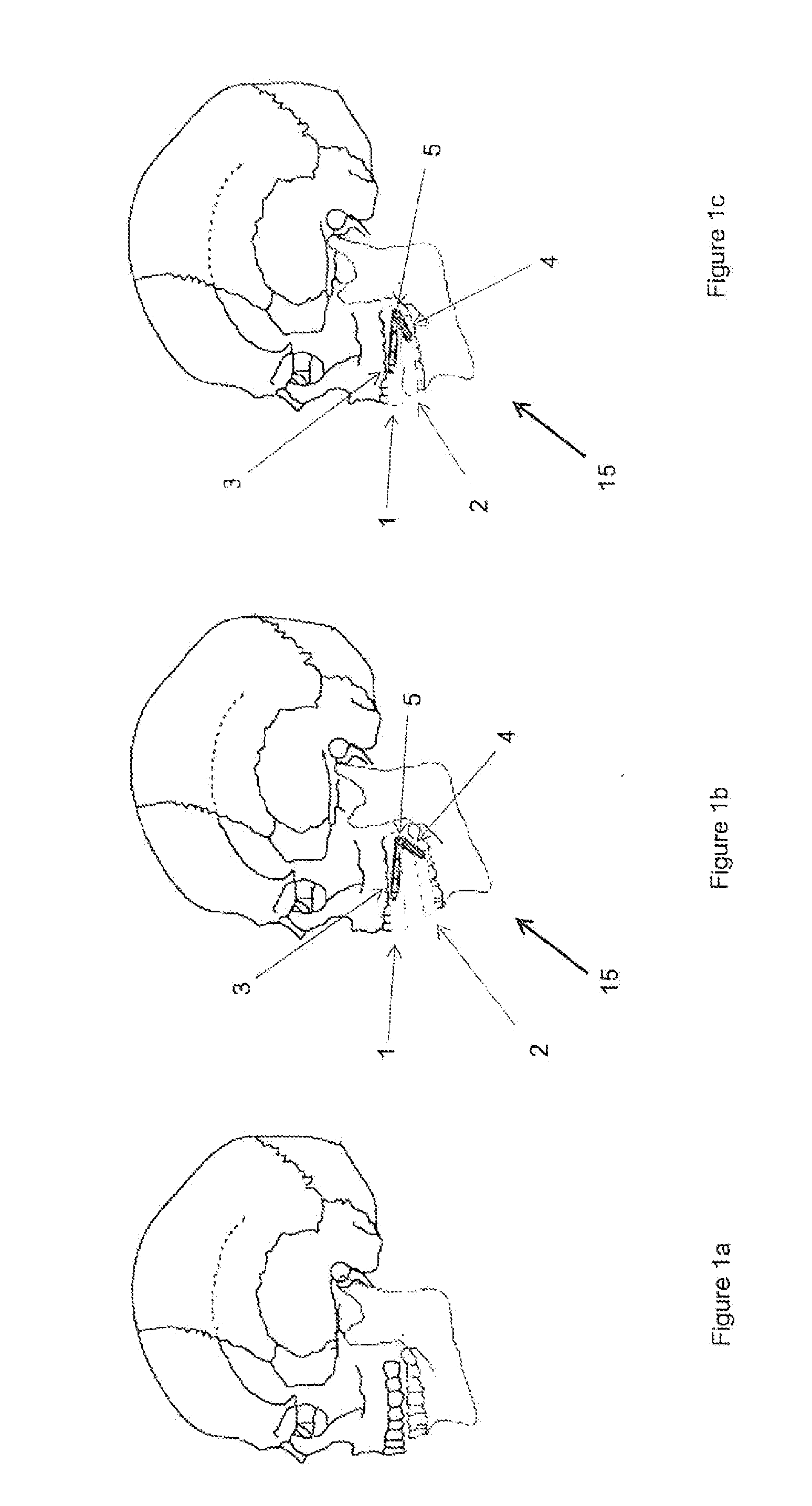
[0058]In a first embodiment of the device 15 of the invention, and as shown in FIGS. 3a and 4a, the device of the invention is used to correct class II Angle defects or to cause nocturnal mandibular advancement in the context of sleep apnea. As can better be seen in FIGS. 1 and 2, the hinges 6, 7, 8 are attached close to the respective ends 9, 10, 11, 12 of the rods 3, 4. The second hinge 8 is located close to the end of the second tray 1, i.e. at the first molar when said tray is placed on the mandibular teeth. The first hinge 6 is advantageously located at the cuspids when said tray is placed on the maxillary teeth. In the closed position of the jaws, the device produces a forced anterior-posterior movement of the mandi...

third embodiment

[0067]In a third embodiment, the trays are provided in a standard size, but are specifically adapted to the patient. As can better be seen in FIGS. 7a to 7c, the maxillary tray 1 is filled with a liquid, semi-liquid or gelatinous product, such as a polymer gel 31, and comprises, in its upper portion, a thermoformed sheet 30 and, in its lower portion, at least one vent hole 32 (or slot) through which said product can flow. In this embodiment, the maxillary tray, which has been placed on the patient's maxillary teeth, is adapted to the patient's morphology. Thus, in use, the sheet 30 (FIG. 7a) is first removed before use, then the tray is inserted around the teeth of the dental arch (FIG. 7b) so that the excess liquid, semi-liquid or gelatinous polymer product, such as gel 31, can flow through said vent hole 32. Said polymer product is then solidified by a suitable technique, for example by cooling to body temperature, or by polymerization, said polymerization being capable of being i...

the structure of the environmentally friendly knitted fabric provided by the present invention; figure 2 Flow chart of the yarn wrapping machine for environmentally friendly knitted fabrics and storage devices; image 3 Is the parameter map of the yarn covering machine
Login to View More

PUM

No PUM Login to View More

Abstract

Device for activating mandibular growth, maxillary growth and mandibular advancement, the device having a first rod with a front end and a rear end; a second rod with a front end and a rear end; the first and second rods having mutually different lengths; a first pivoting articulation for connecting the front end of the first rod to a first dental arch of a person; a second pivoting articulation for connecting the front end of the second rod to the second dental arch of the person; a third pivoting articulation interconnecting the rear ends of the rods, the third pivoting articulation being connected to the dental arch carrying the shortest rod with the aid of elastic means returning the device to the closed position.

Description

TECHNICAL FIELD OF THE INVENTION[0001]The invention relates to the field of corrective devices for dentofacial misalignments, and relates more specifically to a device used in an orthodontic treatment for repositioning of the mandibular arch with respect to the maxillary arch in order to correct Class II and Class III defects for children and adolescents and thus improve dental occlusion. A corrective device according to the invention is intended to enable the activation of mandibular growth, the activation of maxillary growth, as well as nocturnal mandibular advancement to provide protection against sleep apnea.PRIOR ART[0002]Childhood maxillofacial growth dysmorphosia can lead to maxillary or mandibular prognathism or retrognathism. This dysmorphia can be corrected by the use of apparatuses or devices called growth activators, which exert controlled stress on the mandible and which the child wears for at least some of the day, during the maxillofacial growth phase.[0003]More speci...

Claims

the structure of the environmentally friendly knitted fabric provided by the present invention; figure 2 Flow chart of the yarn wrapping machine for environmentally friendly knitted fabrics and storage devices; image 3 Is the parameter map of the yarn covering machine
Login to View More

Application Information

Patent Timeline
no application Login to View More
Patent Type & Authority Applications(United States)
IPC IPC(8): A61C7/36
CPCA61C7/36A61C7/00
Inventor DESOUCHES, RENAUD
Owner REMOX