Unlock instant, AI-driven research and patent intelligence for your innovation.

System and Method for Implementing Constrained Data-Driven Parallelism

a data-driven parallelism and data-driven technology, applied in the field of parallel programming, can solve the problems of high cumbersome mutual exclusion approach, difficult parallel programming, restricted to an elite group of programming experts,

Active Publication Date: 2014-09-18
ORACLE INT CORP
View PDF8 Cites 19 Cited by
  • Summary
  • Abstract
  • Description
  • Claims
  • Application Information

AI Technical Summary

Benefits of technology

The patent describes a system and methods for implementing a form of data-driven parallelism called constrained data-driven parallelism. This system can allow programmers to impose ordering constraints on tasks and decide whether to schedule or defer the execution of tasks based on their priorities. The system can also create task groups to organize tasks and determine which ones to execute based on their relative priorities. Additionally, the system can use a pool of tasks to execute and defer the execution of tasks based on their priorities. The technical effects of this system include improved performance and efficiency in parallel computing, improved programmability, and better resource utilization.

Problems solved by technology

However, experience over several decades has shown that parallel programming is difficult.
Thus far, it has been restricted to an elite group of programming experts.
A particularly thorny issue encountered in parallel programming is the issue of how to implement efficient and correct data sharing between concurrent computations.
The traditional lock based mutual exclusion approach is highly cumbersome and error prone.
However, atomic blocks do not help express parallelism in applications, which is another challenge that programmers face.
Nonetheless, data-driven parallelism can be problematic.

Method used

the structure of the environmentally friendly knitted fabric provided by the present invention; figure 2 Flow chart of the yarn wrapping machine for environmentally friendly knitted fabrics and storage devices; image 3 Is the parameter map of the yarn covering machine
View more

Image

Smart Image Click on the blue labels to locate them in the text.
Viewing Examples
Smart Image
  • System and Method for Implementing Constrained Data-Driven Parallelism
  • System and Method for Implementing Constrained Data-Driven Parallelism
  • System and Method for Implementing Constrained Data-Driven Parallelism

Examples

Experimental program
Comparison scheme
Effect test

Embodiment Construction

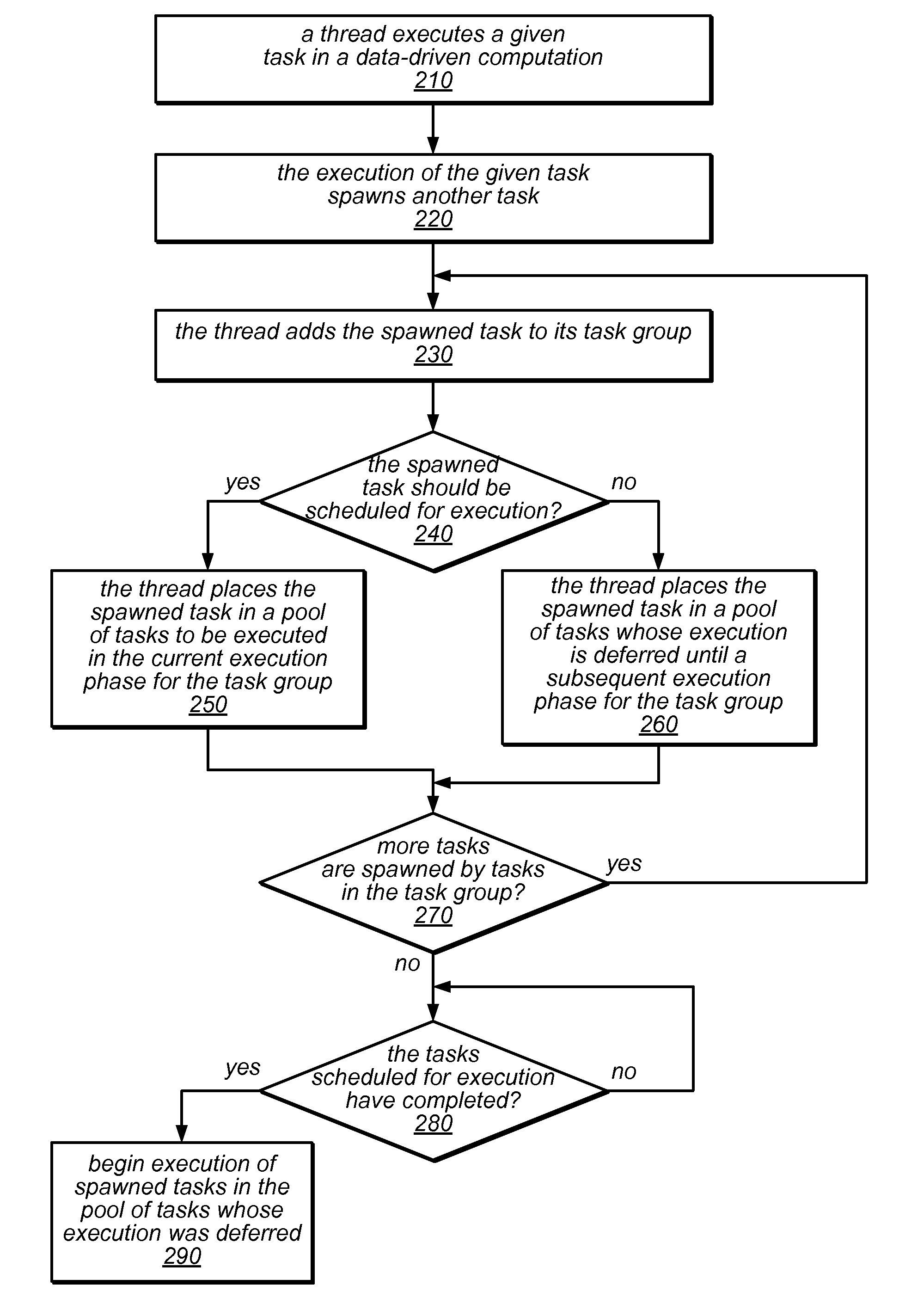
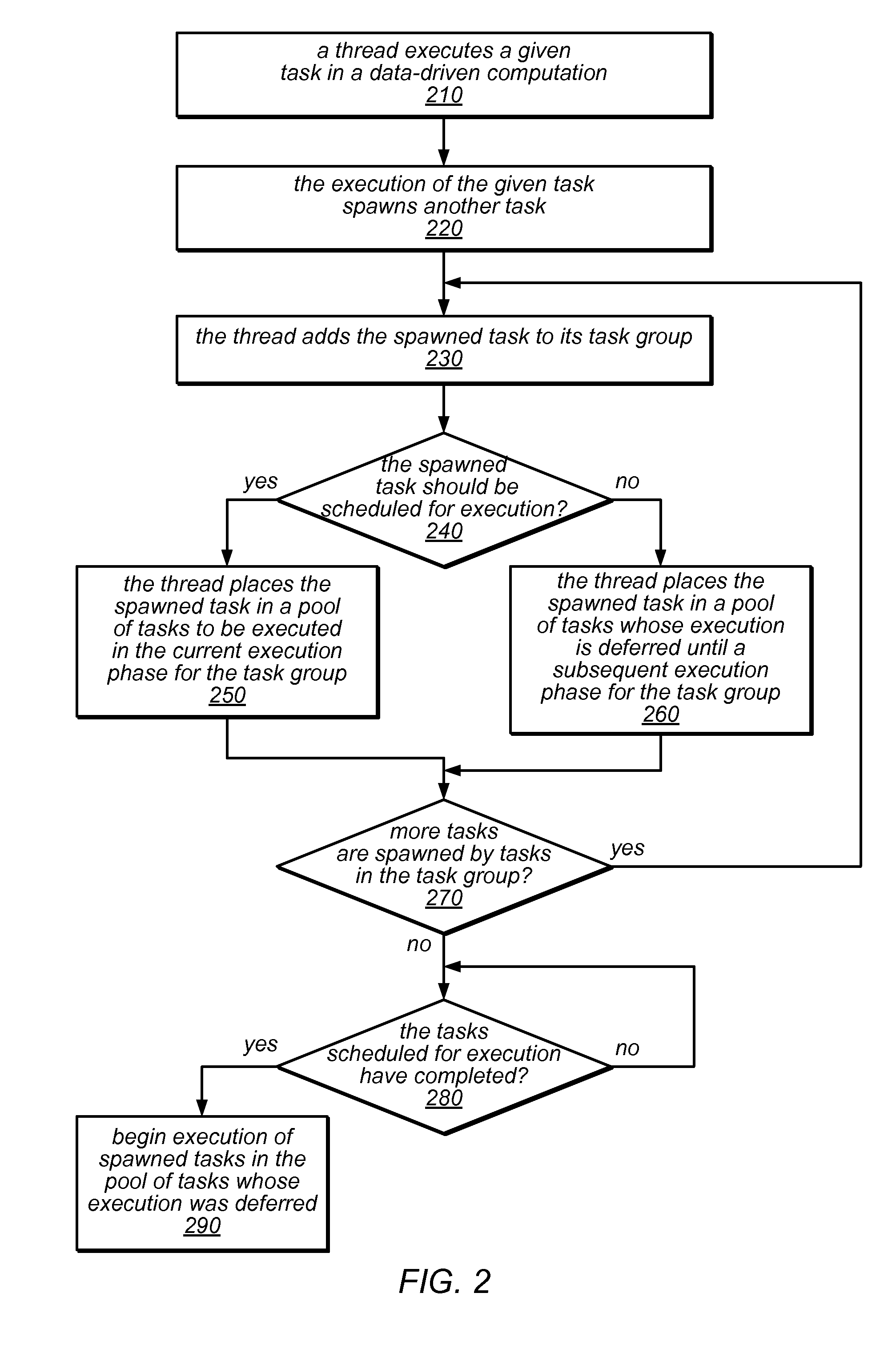
[0024]The system and methods described herein may in some embodiments be used to implement constrained data-driven parallelism, in which programmers can impose ordering constraints on tasks. In particular, new abstractions may be used to define groups of tasks and to constrain the execution order of tasks within each group. For example, as illustrated in many of the examples herein, the execution order of tasks within each task group may be constrained by designating tasks for execution in different execution phases. In other embodiments, other mechanisms may be provided for controlling the execution order and / or interleaving of tasks within the same task group and / or in different task groups (including, but not limited to, task queues of different types, such as LIFOs, FIFOs, or deques). Several example embodiments are described herein. Preliminary performance results (presented below) suggest that this approach may enable new efficient data-driven implementations of a variety of g...

the structure of the environmentally friendly knitted fabric provided by the present invention; figure 2 Flow chart of the yarn wrapping machine for environmentally friendly knitted fabrics and storage devices; image 3 Is the parameter map of the yarn covering machine
Login to View More

PUM

No PUM Login to View More

Abstract

Systems and methods for implementing constrained data-driven parallelism may provide programmers with mechanisms for controlling the execution order and / or interleaving of tasks spawned during execution. For example, a programmer may define a task group that includes a single task, and the single task may define a direct or indirect trigger that causes another task to be spawned (e.g., in response to a modification of data specified in the trigger). Tasks spawned by a given task may be added to the same task group as the given task. A deferred keyword may control whether a spawned task is to be executed in the current execution phase or its execution is to be deferred to a subsequent execution phase for the task group. Execution of all tasks executing in the current execution phase may need to be complete before the execution of tasks in the next phase can begin.

Description

[0001]This application claims benefit of priority of U.S. Provisional Application Ser. No. 61 / 794,321 entitled “System and Method for Implementing Constrained Data-Driven Parallelism,” filed Mar. 15, 2013, the content of which is incorporated by reference herein in its entirety.BACKGROUND[0002]1. Field of the Disclosure[0003]This disclosure relates generally to parallel programming, and more particularly to systems and methods for implementing constrained data-driven parallelism.[0004]2. Description of the Related Art[0005]The ongoing proliferation of multicore systems in the mainstream computing industry is making parallel programming more commonplace. However, experience over several decades has shown that parallel programming is difficult. Thus far, it has been restricted to an elite group of programming experts.[0006]A particularly thorny issue encountered in parallel programming is the issue of how to implement efficient and correct data sharing between concurrent computations....

Claims

the structure of the environmentally friendly knitted fabric provided by the present invention; figure 2 Flow chart of the yarn wrapping machine for environmentally friendly knitted fabrics and storage devices; image 3 Is the parameter map of the yarn covering machine
Login to View More

Application Information

Patent Timeline
no application Login to View More
IPC IPC(8): G06F9/48
CPCG06F9/4843G06F9/4881
Inventor MARATHE, VIRENDRA J.LEV, YOSEFLUCHANGCO, VICTOR M.
Owner ORACLE INT CORP