
Economic optimization for product search relevancy
a product search and economic optimization technology, applied in the field of business rule algorithms, can solve the problems of many hours being spent, the time spent by the designer of the web page to add or remove a web page, an object, or a widget contained on the web page can be very costly financially to the party paying for the services of the designer, and the cost of e-commerce site valuable tim
- Summary
- Abstract
- Description
- Claims
- Application Information
AI Technical Summary
Benefits of technology
Problems solved by technology
Method used
Image

Examples
Embodiment Construction
[0032]In the following description, for purposes of explanation, numerous specific details are set forth to provide a thorough understanding of example embodiments. It may be evident, however, to one skilled in the art, that the present invention may be practiced without these specific details.
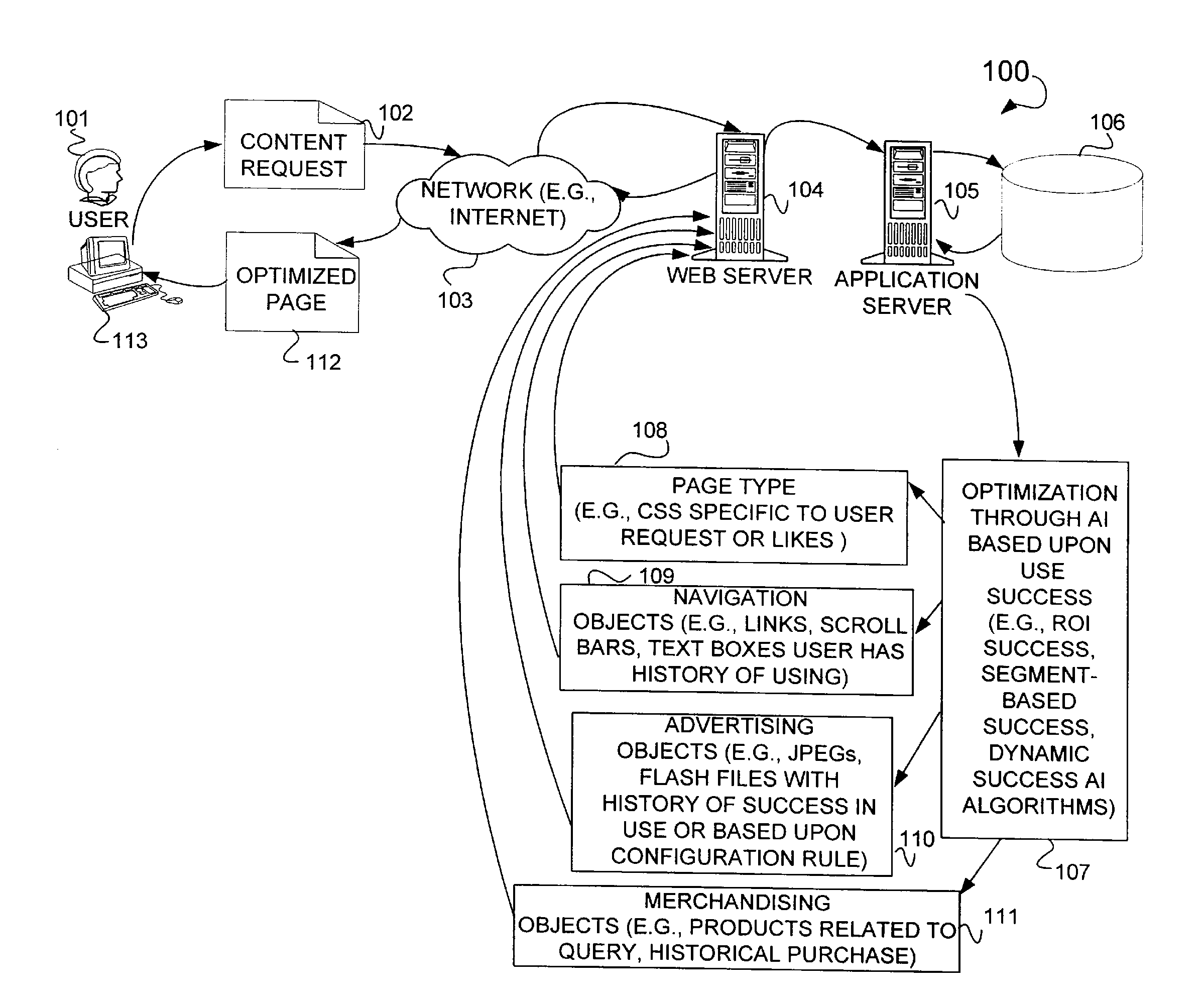
[0033]In one embodiment, the method and system illustrated herein may be thought of as a series of modules executed through a feedback loop to optimize a web page, and the selection of screen objects and widgets (collectively objects) to be displayed thereon. The data provided to this feedback loop, in the form of a content request, serves as a training data set for training particular types of AI algorithms. This training data set may then be used by a plurality of AI algorithms for the purpose of making predictions as to which objects or screen widgets would be best suited for the purposes of optimizing a web page. The concept of “optimizing” may be based upon such concepts as Return On Inve...
PUM
 Login to View More
 Abstract
Description
Claims
Application Information
 Login to View More