Check patentability & draft patents in minutes with Patsnap Eureka AI!

System and method for identifying graphics workloads for dynamic allocation of resources among GPU shaders

Active Publication Date: 2018-04-19
ADVANCED MICRO DEVICES INC
View PDF3 Cites 9 Cited by
  • Summary
  • Abstract
  • Description
  • Claims
  • Application Information

AI Technical Summary

Benefits of technology

The patent describes a technique for improving the processing efficiency of graphics processing units (GPUs) by filtering and profiling graphics workloads. By identifying which workloads are suitable for profiling and determining resource allocations for them, the GPU can allocate resources efficiently and reduce processing bottlenecks. This improves overall processing efficiency and can be done by monitoring the performance of shaders processing the workloads and making adjustments to the resource allocation accordingly. The technique can be used in various graphics applications and can lead to improved performance and resource utilization.

Problems solved by technology

Typically, an incoming instruction set, referred to as a graphics workload, will make varying demands on the shaders of the GPU, such that some shaders may take a much longer time to complete their assigned tasks for a given workload than other shaders take to complete their assigned tasks.
Such a workload imbalance can create a processing bottleneck at the GPU and therefore have a detrimental impact on overall processing efficiency.
However, certain graphics workloads are not susceptible to accurate profiling, or do not place sufficient processing demands on the shaders for the likely benefit of adjusting system resources based on the profiling information to exceed the resource cost of profiling.

Method used

the structure of the environmentally friendly knitted fabric provided by the present invention; figure 2 Flow chart of the yarn wrapping machine for environmentally friendly knitted fabrics and storage devices; image 3 Is the parameter map of the yarn covering machine
View more

Image

Smart Image Click on the blue labels to locate them in the text.
Viewing Examples
Smart Image
  • System and method for identifying graphics workloads for dynamic allocation of resources among GPU shaders
  • System and method for identifying graphics workloads for dynamic allocation of resources among GPU shaders
  • System and method for identifying graphics workloads for dynamic allocation of resources among GPU shaders

Examples

Experimental program
Comparison scheme
Effect test

Embodiment Construction

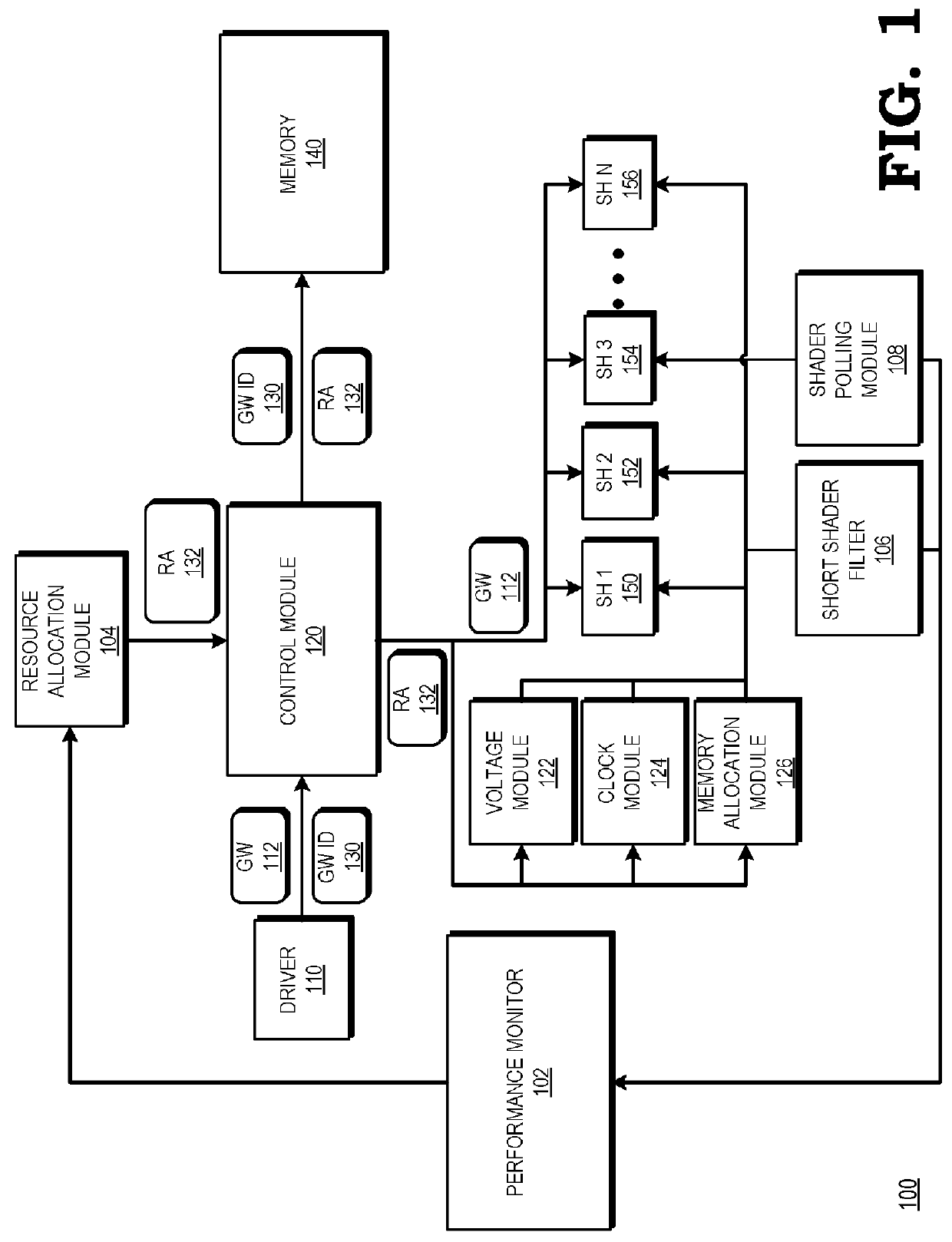
[0008]FIGS. 1-5 illustrate techniques for filtering graphics workloads to identify those graphics workloads that are candidates for profiling, profiling and determining resource allocations among a plurality of shaders of a GPU for processing the filtered graphics workloads, and applying those stored resource allocations when the same or a similar graphics workload is received subsequently by the GPU. In many graphics applications, the same or a similar graphics workload may be received by the GPU repeatedly. Accordingly, the processing demands of the graphics workload are profiled, and a resource allocation based on the profile that assigns resources such as applied voltage, clock frequency, and memory allocations for each shader for each graphics workload is stored. The resource allocation can be recalled and applied for subsequent processing of the same or a similar graphics workload. The GPU can thus dynamically adapt the resource allocations among shaders to more efficiently pr...

the structure of the environmentally friendly knitted fabric provided by the present invention; figure 2 Flow chart of the yarn wrapping machine for environmentally friendly knitted fabrics and storage devices; image 3 Is the parameter map of the yarn covering machine
Login to View More

PUM

No PUM Login to View More

Abstract

A GPU filters graphics workloads to identify candidates for profiling. In response to receiving a graphics workload for the first time, the GPU determines if the graphics workload would require the GPU shaders to use fewer resources than would be spent profiling and determining a resource allocation for subsequent receipts of the same or a similar graphics workload. The GPU can further determine if the shaders are processing more than one graphics workload at the same time, such that the performance characteristics of each individual graphics workload cannot be effectively isolated. The GPU then profiles and stores resource allocations for a plurality of shaders for processing the filtered graphics workloads, and applies those stored resource allocations when the same or a similar graphics workload is received subsequently by the GPU.

Description

BACKGROUNDDescription of the Related Art[0001]Graphics processing units (GPUs) are used in a wide variety of processors to facilitate the processing and rendering of objects for display. The GPU includes a plurality of processing elements, referred to as shaders, to execute instructions, thereby creating images for output to a display. Typically, an incoming instruction set, referred to as a graphics workload, will make varying demands on the shaders of the GPU, such that some shaders may take a much longer time to complete their assigned tasks for a given workload than other shaders take to complete their assigned tasks. Such a workload imbalance can create a processing bottleneck at the GPU and therefore have a detrimental impact on overall processing efficiency. Further, in certain applications, particular graphics workloads are repeatedly processed by the shaders. It can therefore be useful to characterize the processing demands particular graphics workloads place on each of the...

Claims

the structure of the environmentally friendly knitted fabric provided by the present invention; figure 2 Flow chart of the yarn wrapping machine for environmentally friendly knitted fabrics and storage devices; image 3 Is the parameter map of the yarn covering machine
Login to View More

Application Information

Patent Timeline
no application Login to View More
IPC IPC(8): G06T15/00G06T15/80
CPCG06T15/80G06T15/005G06F9/5027G06F9/38
Inventor OREIFEJ, RASHADSOCARRAS, ANGEL E.ANDERSON, MARK RUSSELLRAMSEY, RANDY WAYNE
Owner ADVANCED MICRO DEVICES INC
Features
  • R&D
  • Intellectual Property
  • Life Sciences
  • Materials
  • Tech Scout
Why Patsnap Eureka
  • Unparalleled Data Quality
  • Higher Quality Content
  • 60% Fewer Hallucinations
Social media
Patsnap Eureka Blog
Learn More