Dynamic quantization for deep neural network inference system and method

a deep neural network and quantization technique technology, applied in the field of deep neural network quantization techniques, can solve the problems of limiting the practical application of quantization techniques in mobile and embedded systems, tight resource constraints in terms of performance, energy consumption and memory capacity, and limitations of existing quantization techniques

a deep neural network and quantization technique technology, applied in the field of deep neural network quantization techniques, can solve the problems of limiting the practical application of quantization techniques in mobile and embedded systems, tight resource constraints in terms of performance, energy consumption and memory capacity, and limitations of existing quantization techniques

US20190012559A1Active Publication Date: 2019-01-10TEXAS INSTR INC

Image

Smart Image Click on the blue labels to locate them in the text.
Viewing Examples
Smart Image
  • Dynamic quantization for deep neural network inference system and method
  • Dynamic quantization for deep neural network inference system and method
  • Dynamic quantization for deep neural network inference system and method

Examples

Experimental program
Comparison scheme
Effect test

Embodiment Construction

[0022]As used herein, “channel” may refer to a channel of a layer. For example, RGB (red, green, blue) may correspond to 3 channels for a layer. The words “min”, “minimum”, “Min”, “Minimum” are interchangeably used herein, and may refer to a minimum value of a set of values. Similarly, “max”, “maximum”, “Max”, “Maximum”” are interchangeably used herein, and may refer to a maximum value of a set of values. “Output image” and “output frame” are interchangeably used herein, and may refer to an image displayed on a screen. “Range” and “range statistics,” as used herein, may refer to a difference of maximum value and minimum value from a set of values. For example, if the values of a set from a 2D image are 10, 12, 15, 9, 30, 80, 100, −5, −10, the min value of the set is −10, the max value of the set is 100, and the range of the set is 110. “Input image” and “input frame” are interchangeably used herein after to indicate an image captured by a camera. The terms “scaling”, “scaling data” ...

the structure of the environmentally friendly knitted fabric provided by the present invention; figure 2 Flow chart of the yarn wrapping machine for environmentally friendly knitted fabrics and storage devices; image 3 Is the parameter map of the yarn covering machine
Login to View More

PUM

No PUM Login to View More

Abstract

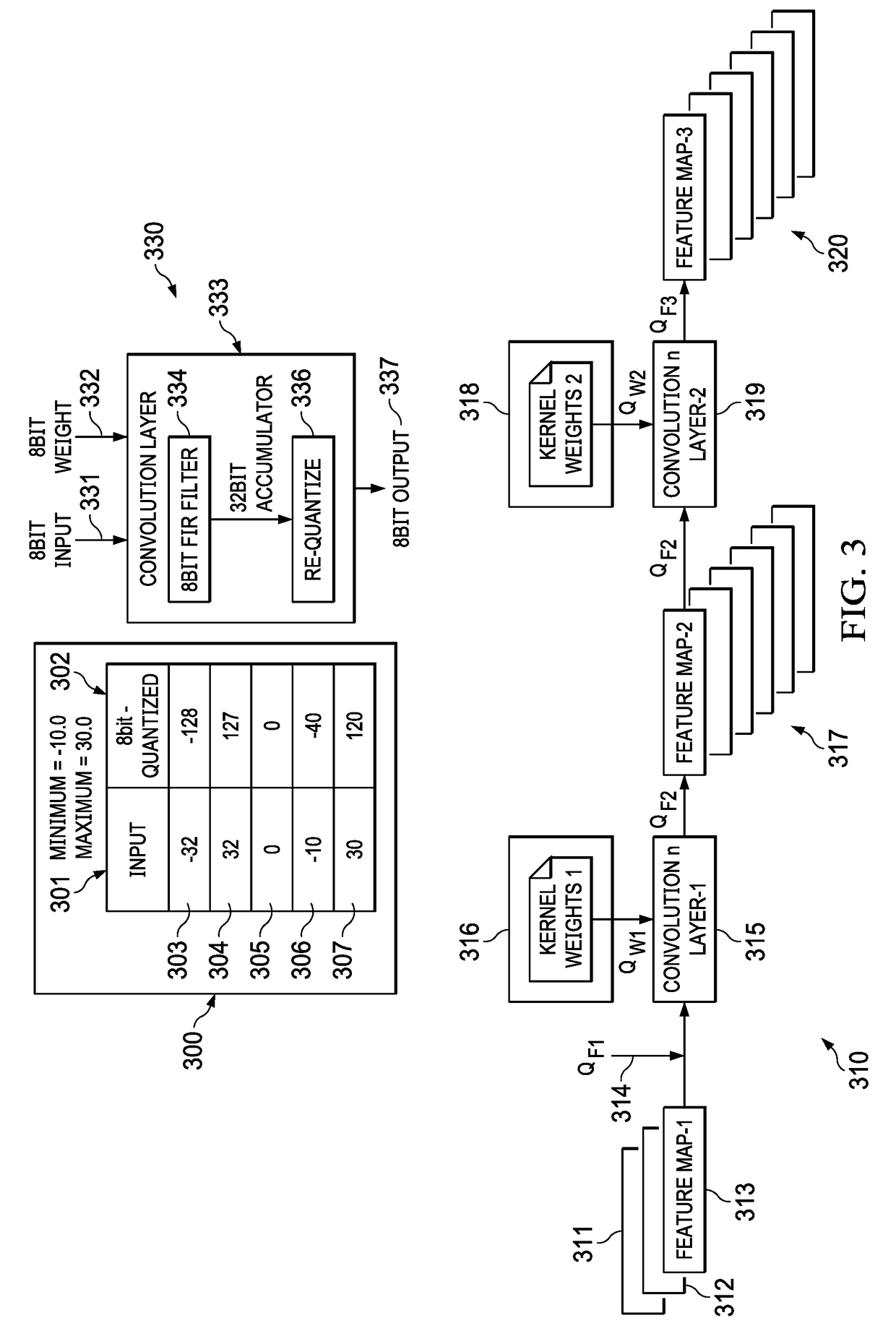
A method for dynamically quantizing feature maps of a received image. The method includes convolving an image based on a predicted maximum value, a predicted minimum value, trained kernel weights and the image data. The input data is quantized based on the predicted minimum value and predicted maximum value. The output of the convolution is computed into an accumulator and re-quantized. The re-quantized value is output to an external memory. The predicted min value and the predicted max value are computed based on the previous max values and min values with a weighted average or a pre-determined formula. Initial min value and max value are computed based on known quantization methods and utilized for initializing the predicted min value and predicted max value in the quantization process.

Description

CROSS REFERENCE TO RELATED APPLICATIONS[0001]This application claims the benefit of Provisional Application No. 201741023782, filed in India on Jul. 6, 2017, the disclosure of which is fully incorporated herein by reference.BACKGROUNDTechnical Field[0002]This disclosure relates to deep neural networks, and more particularly to quantization techniques for neural networks.Description of Related Art[0003]Deep neural networks (DNNs) are becoming more and more popular in mobile and embedded systems. Those systems are characterized by tight resource constraints in terms of performance, energy consumption, and memory capacity. Due to this, today's typical scenario for deploying DNNs to mobile systems is to train such DNNs in servers and perform only the inference in such systems. Therefore, it is imperative to reduce the inference cost of neural networks for widespread application of DNNs to mobile and embedded systems.[0004]One of the most effective methods for reducing the inference cost...

Claims

the structure of the environmentally friendly knitted fabric provided by the present invention; figure 2 Flow chart of the yarn wrapping machine for environmentally friendly knitted fabrics and storage devices; image 3 Is the parameter map of the yarn covering machine
Login to View More

Application Information

Patent Timeline
10 Jan 2019
Publication
US20190012559A1
IPC
G06K9/38; G06N3/04; G06K9/62; G06V10/28; G06V10/764
CPC
G06K9/38; G06K9/6232; G06N3/04; G06N3/063; G06N3/08; G06V10/28; G06V10/454; G06V10/82
Inventors
DESAPPAN, KUMAR; MATHEW, MANU