
Process for hydrogenation of phthalate compound
- Summary
- Abstract
- Description
- Claims
- Application Information
AI Technical Summary
Benefits of technology
Problems solved by technology
Method used
Image

Examples
example
Example 1
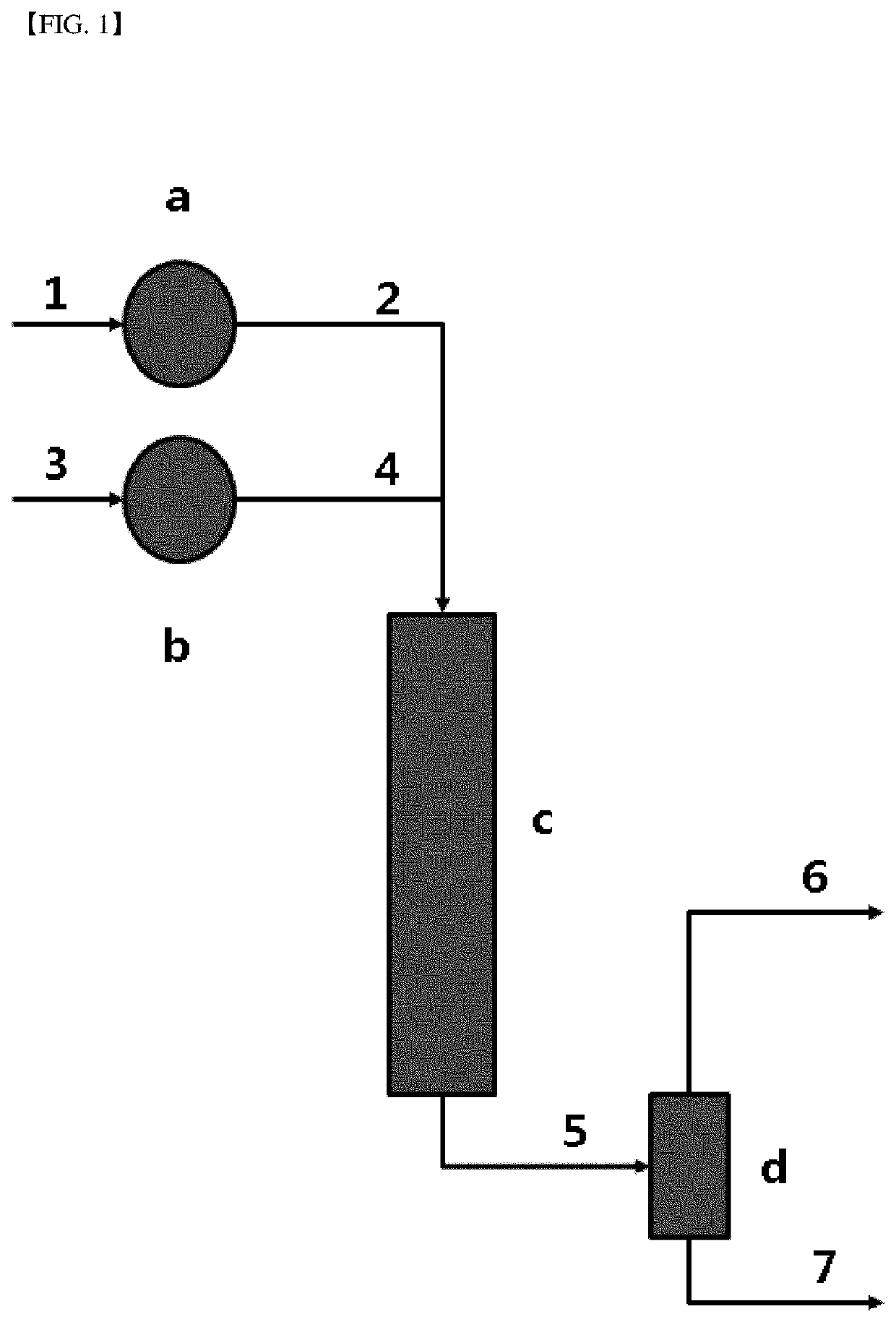
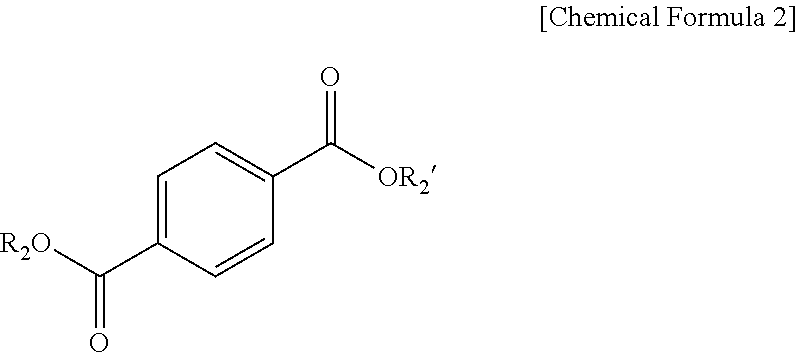
[0076]Dioctyl terephthalate (DOTP) with purity of 99% as a liquid-phase raw material and hydrogen as a gas-phase raw material were introduced into a reactor, and hydrogenation was allowed at a reaction pressure of 110 bar and a reaction temperature of 150° C.
[0077]A mass flow rate of DOTP was 9.6 kg / h, and hydrogen was introduced so that a molar ratio of hydrogen / DOTP became 10 mol. Further, a volume flow ratio of hydrogen and DOTP was 5:1, and the temperature and pressure at the time of introducing hydrogen were 140° C. and 150 bar, respectively, and the temperature and pressure at the time of introducing DOTP were 140° C. and 150 bar, respectively.
[0078]Further, the Reynold's number of the liquid-phase raw material introduced into the reactor was set to 84.9, followed by operating. Here, the Reynold's number is a value calculated by the following Equation 1.
Reynold’sNo.(NRe)=ρ×uz×Dpμ[Equation1]
[0079]μ: viscosity ρ: density uz: axial linear velocity Dp: diameter of catalys...
example 2
[0082]The hydrogenation reaction was performed in the same manner as in Example 1, except that the Reynold's number of the liquid-phase raw material was 8.5.
example 3
[0083]The hydrogenation reaction was performed in the same manner as in Example 1, except that the Reynold's number of the liquid-phase raw material was 1.3.
PUM
| Property | Measurement | Unit |
|---|---|---|
| Percent by mass | aaaaa | aaaaa |
| Percent by mass | aaaaa | aaaaa |
| Substance count | aaaaa | aaaaa |
Abstract
Description
Claims
Application Information
 Login to View More