Although turning the hand wheel in the opposite direction may operate to release the hand brake in proportion to the extent of such turning, some
ratchet wheel and pawl systems may not permit turning the hand wheel in the opposite direction.
However, due to frictional forces within the hand brake mechanism, the hand brake release handle may not return to a start position by the mere force of gravity, but often times will remain extending outwardly from the hand brake mechanism where it was when the brakeman released his grip thereon.
If the brake release handle is left in that position, extending outwardly from the hand brake mechanism, it can become a nuisance, or worse yet, a serious
hazard.
In extending outwardly from the hand brake mechanism, it may in some situations extend into the path of the ladder at the end of the railway car, or even extend beyond the edge of the railway car into the path of persons adjacent to the railway car, and thus present a
hazard not only to railway personnel but also to pedestrians who may be standing or walking adjacent to such a railway car.
Indeed, such a rigid lever arm extending laterally beyond the edge of the railway car would not only be hazardous to personnel, but if the car is in motion, the hazard would be greatly increased, and could even seriously damage railroad structures immediately adjacent to the track upon which such a railroad car is moving, not to mention damage which would result to the railway car itself and the hand brake mechanism attached thereto should such an extending handle strike a fixed object.
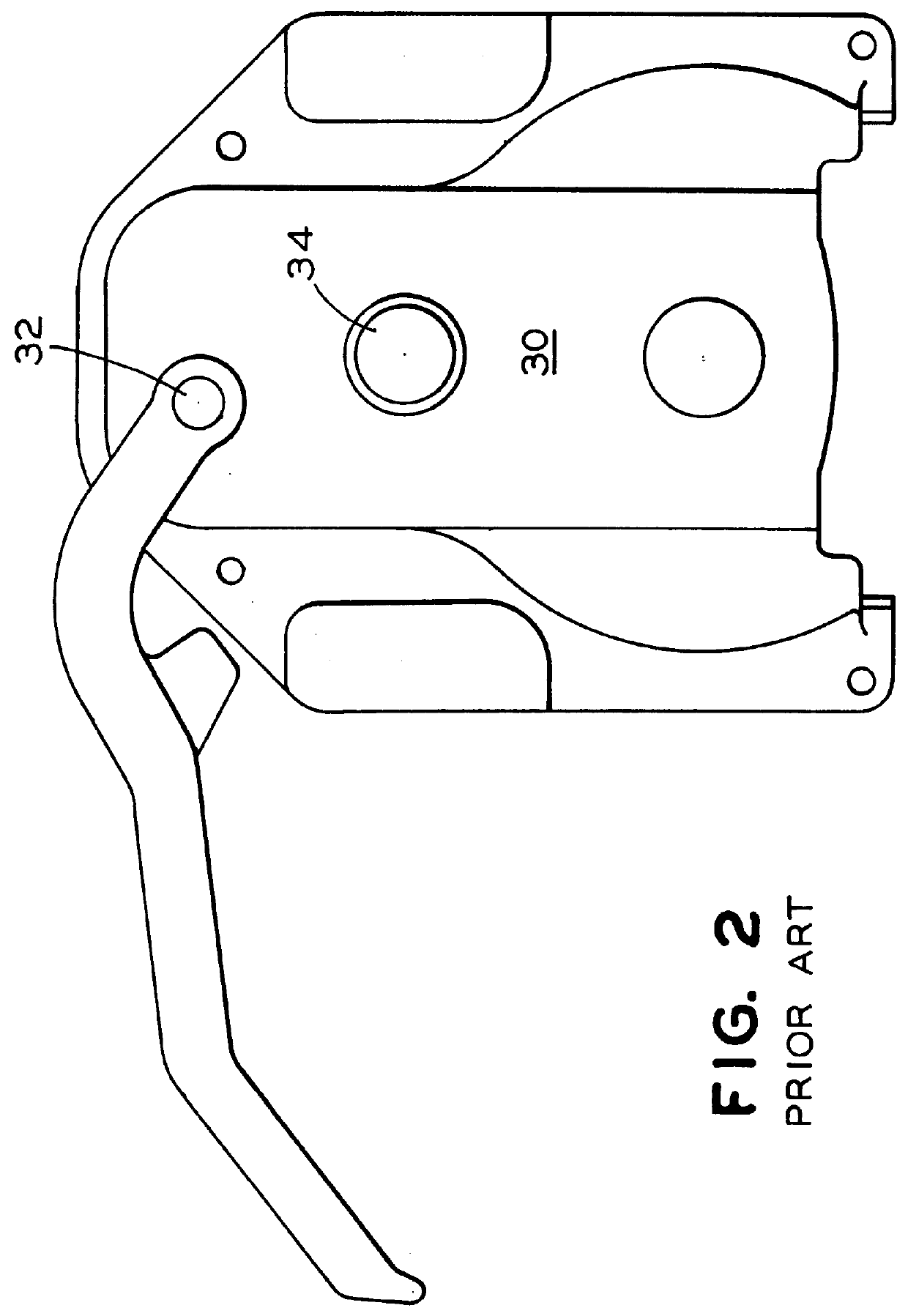
While the hazard could be eliminated by manually forcing the hand brake release handle back to its starting position after it is utilized to effect a brake release, this often is not done by busy railway personnel, thus being inadvertently left in a position as illustrated in FIG. 2, creating the above said nuisance and / or hazard.
While the hazard would automatically be eliminated by making the brake release handle or lever arm significantly shorter so that it cannot extend outwardly by a sufficient length to be a nuisance or hazard, this would obviously also increase the moment force or torque required to effect a brake release, and could even make it impossible to effect a brake release without superhuman strength.
It has also been realized that some sort of a ratcheting
system could be developed for the hand brake release handle or release mechanism to eliminate the above-noted nuisance and hazards, but obviously such a ratcheting
system would even further complicate the already complicated hand brake mechanism, which already includes at least one ratcheting system, and would add significantly to the cost of such a hand brake mechanism.
Furthermore, such a ratcheting system would also include frictional forces therein, and would not necessarily eliminate the hazards of an outwardly extending handle or lever arm, without still requiring concerted effort by railroad personnel to assure its proper functioning and return to the starting position.



 Login to View More
  Login to View More