Hybrid magnetic-based and impedance-based position sensing
What is AI technical title?
AI technical title is built by Patsnap AI team. It summarizes the technical point description of the patent document.
a technology of impedance-based sensing and hybrid magnetic based, which is applied in the field of sensing the position, can solve the problems of inaccuracy of impedance-based position sensing and magnetic-based methods, and achieve the effect of low cost and high accuracy of magnetic position sensing
Active Publication Date: 2009-05-19
BIOSENSE WEBSTER INC
View PDF23 Cites 944 Cited by
Summary
Abstract
Description
Claims
Application Information
AI Technical Summary
This helps you quickly interpret patents by identifying the three key elements:
Problems solved by technology
Method used
Benefits of technology
Benefits of technology
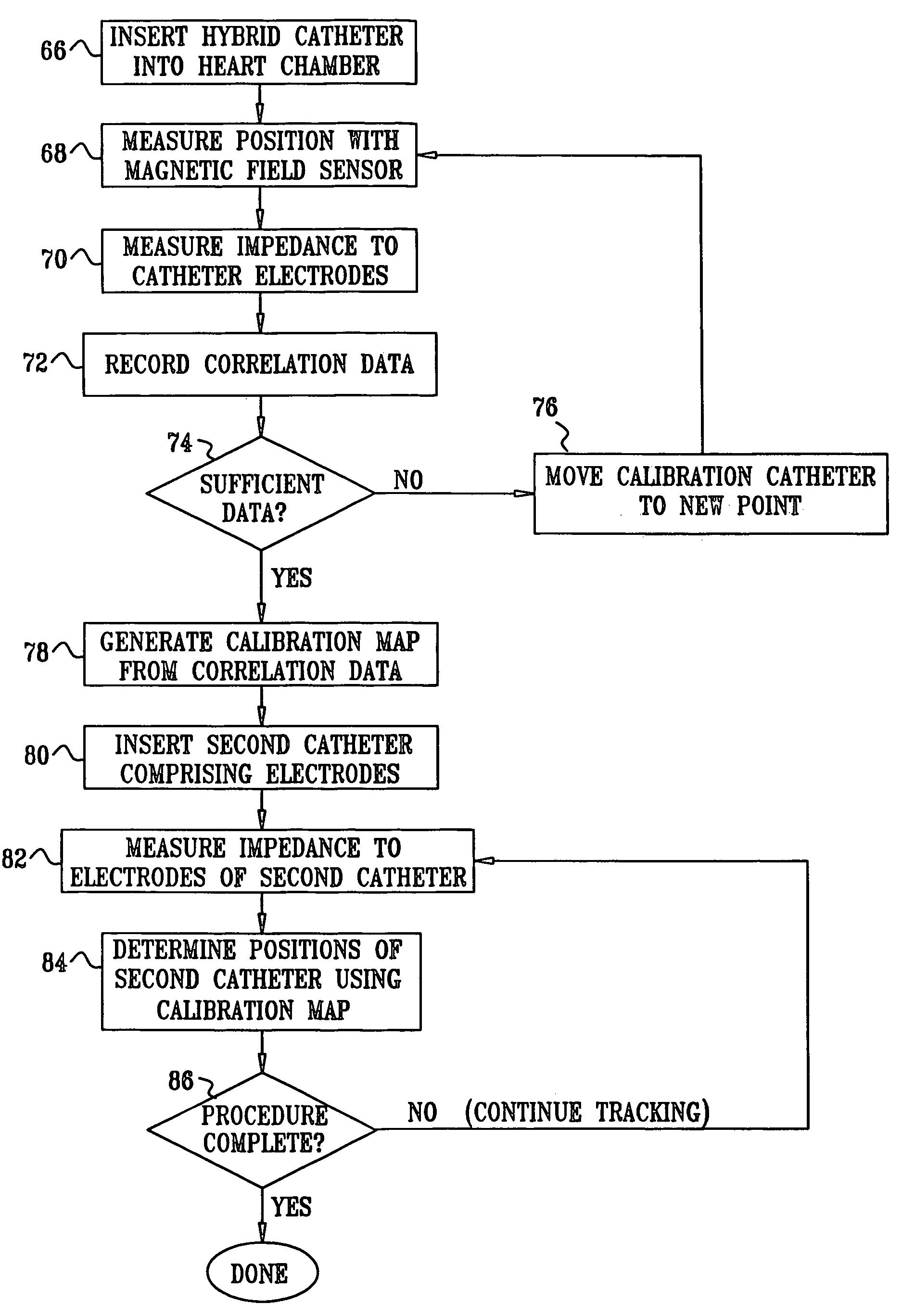
[0008]Embodiments of the present invention provide hybrid position sensing systems and methods, which combine magnetic and electrical position sensing techniques. In these systems, a magnetic position sensor provides an accurate position reference for calibrating less accurate, electrical impedance-based measurements. For this purpose, a hybrid probe, such as a catheter, comprising a magnetic position sensor and one or more electrodes is used to correlate the magnetic position measurements with the impedance-based measurements. Systems of this sort alleviate the need for multiple magnetic position sensors, and thus benefit from both the high accuracy of magnetic position sensing and the low cost of impedance-based sensing.
[0011]In other embodiments of the present invention, the hybrid catheter comprises a deformable portion, such as a lasso at the distal end of the catheter, with electrodes on the deformable portion. Both magnetic and impedance-based measurements are taken while the catheter is held steady, in a known configuration (i.e., when the shape is undeformed). In this configuration, the position of each electrode is known a priori relative to the magnetic sensor. Positions of the electrodes are therefore known on the basis of the magnetic position measurements, and the known positions may be used to calibrate impedance measurements taken at each electrode. When the catheter is subsequently deformed during a medical procedure, the small deflections in the electrode positions from their calibrated positions can be measured relatively accurately by impedance-based methods.
Problems solved by technology
However, due in part to the non-linear impedance of the body, impedance-based position sensing is not as accurate as magnetic-based methods.
Method used
the structure of the environmentally friendly knitted fabric provided by the present invention; figure 2 Flow chart of the yarn wrapping machine for environmentally friendly knitted fabrics and storage devices; image 3 Is the parameter map of the yarn covering machine
View more
Image
Smart Image Click on the blue labels to locate them in the text.
Viewing Examples
Smart Image
Click on the blue label to locate the original text in one second.
Reading with bidirectional positioning of images and text.
Smart Image
Examples
Experimental program
Comparison scheme
Effect test
Embodiment Construction
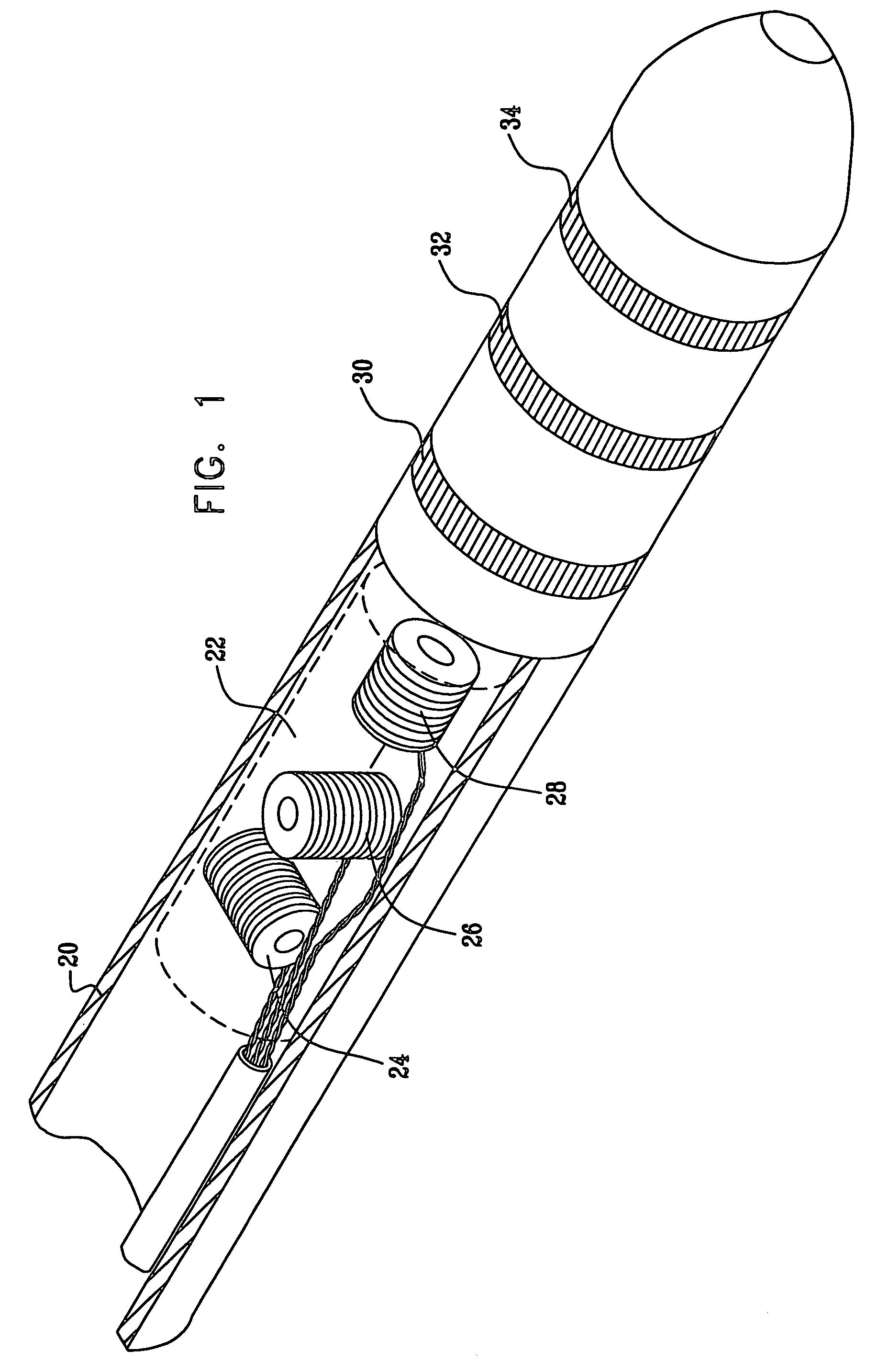
[0043]FIG. 1 is a schematic detail view showing the distal end of a hybrid catheter 20, comprising a magnetic field position sensor 22 and multiple catheter electrodes 30, 32, and 34, in accordance with an embodiment of the present invention.
[0044]Magnetic field sensor 22 comprises three orthogonal coils 24, 26, and 28, which may be used to determine the coordinates of catheter 20 in six position and orientation dimensions, as described in the patents cited in the Background of the Invention. Alternatively, magnetic field sensor 22 may comprise one or two coils or a greater number of coils, or magnetic field sensors other than coils, such as Hall effect devices or other antennae. In the context of the present patent application and in the claims, such coils and other sensors are referred to generically as magnetic field transducers, and may generally be used either to sense magnetic fields or to generate magnetic fields.
[0045]Electrodes 30, 32, and 34 may be of any suitable shape an...
the structure of the environmentally friendly knitted fabric provided by the present invention; figure 2 Flow chart of the yarn wrapping machine for environmentally friendly knitted fabrics and storage devices; image 3 Is the parameter map of the yarn covering machine
Login to View More
PUM
Login to View More
Abstract
A position sensing system includes a probe adapted to be introduced into a body cavity of a subject. The probe includes a magnetic field transducer and at least one probe electrodes. A control unit is configured to measure position coordinates of the probe using the magnetic field transducer. The control unit also measures an impedance between the at least one probe electrodes and one or more points on a body surface of the subject. Using the measured position coordinates, the control unit calibrates the measured impedance.
Description
FIELD OF THE INVENTION[0001]The present invention relates generally to sensing the position of an object placed within a living body, and specifically to providing an accurate reference for impedance-based position sensors.BACKGROUND OF THE INVENTION[0002]Tracking the position of intrabody objects, such as sensors, tubes, catheters, dispensing devices, and implants, is required for many medical procedures. Well-established, highly accurate systems for determining the position of an intrabody object have been developed based on magnetic field sensing. These systems utilize sensors affixed to the intrabody object to measure the relative strengths of externally-generated magnetic fields and to derive from these measurements the position of the object. Methods for magnetic-based position sensing are disclosed, for example, in U.S. Pat. Nos. 5,391,199, 5,443,489, and 6,788,967 to Ben-Haim, in U.S. Pat. No. 6,690,963 to Ben-Haim, et al., in U.S. Pat. No. 5,558,091 to Acker et al., in U.S....
Claims
the structure of the environmentally friendly knitted fabric provided by the present invention; figure 2 Flow chart of the yarn wrapping machine for environmentally friendly knitted fabrics and storage devices; image 3 Is the parameter map of the yarn covering machine
Login to View More
Application Information
Patent Timeline
Application Date:The date an application was filed.
Publication Date:The date a patent or application was officially published.
First Publication Date:The earliest publication date of a patent with the same application number.
Issue Date:Publication date of the patent grant document.
PCT Entry Date:The Entry date of PCT National Phase.
Estimated Expiry Date:The statutory expiry date of a patent right according to the Patent Law, and it is the longest term of protection that the patent right can achieve without the termination of the patent right due to other reasons(Term extension factor has been taken into account ).
Invalid Date:Actual expiry date is based on effective date or publication date of legal transaction data of invalid patent.


 Login to View More
  Login to View More