
Gas sensor
- Summary
- Abstract
- Description
- Claims
- Application Information
AI Technical Summary
Benefits of technology
Problems solved by technology
Method used
Image

Examples
example 1
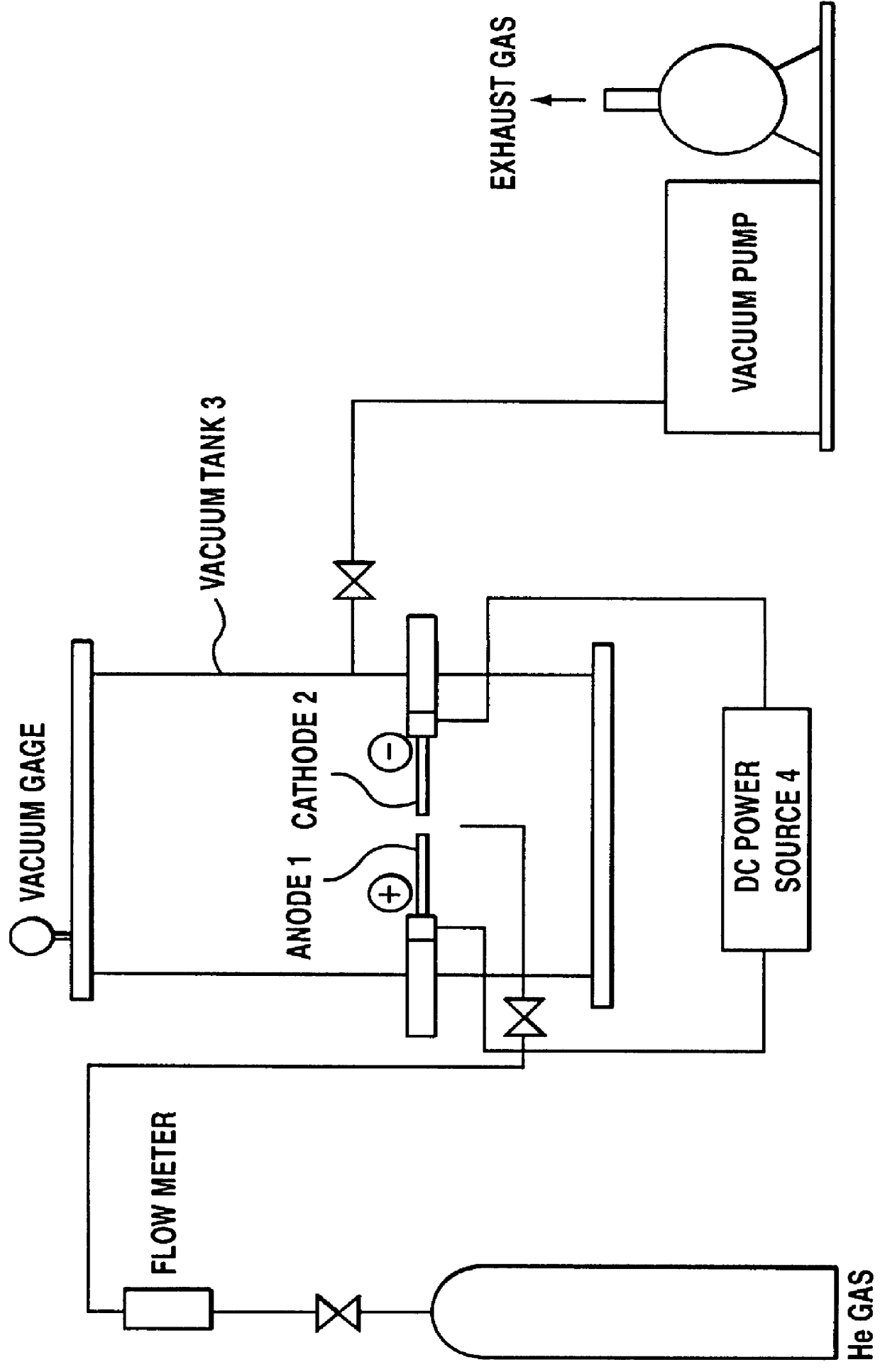
A carbon mixture was produced by using an arc discharge apparatus having carbon electrodes as shown in FIG. 1. In the apparatus, carbon electrodes having .phi.20 mm and 500 mm length were used as anode 1 and cathode 2. After evacuating the inside of a vacuum tank 3, helium gas was introduced into the vacuum tank 3 so that the pressure was 100 torr. Then, a direct current was passed to carbon electrodes 1 and 2 by using a DC power source 4 for arc discharge so that the current density on the discharge faces (opposite faces on each of the electrodes) become about 2 A / mm.sup.2, and the carbon mixture was evaporated. Thereafter, a nitrogen gas for industrial use was introduced into the vacuum tank 3, so that the pressure was at atmospheric pressure and the carbon mixture attached to the inside of the vacuum tank 3 was taken out.
0.2 g of the thus obtained carbon mixture was put into a die of .phi.14 mm, was loaded with load of 1 ton by a presser, and was formed into a pellet.
A test for d...
example 2
A cylindrical hole of .phi.3.2 mm with 15 mm depth was made on a central part of a bottom of a cylindrical carbon electrode of .phi.20 mm and 500 mm length and the hole filled wits. 0.9 g of nickel powder (of 200 mesh) so that nickel-containing electrodes were produced. Thus obtained electrodes were used as anode 1 and cathode 2. The surfaces on which nickel was filled were placed so as to face each other at a fixed interval for electric discharge. Using the same arc discharge apparatus having carbon electrodes as in EXAMPLE 1, arc discharge was conducted at the same conditions as those of EXAMPLE 1, so that the electrodes were evaporated. As result, a nickel-containing carbon mixture was obtained as deposited on the inside of the vacuum tank. The thus obtained carbon mixture contained 2.95% by weight of nickel with a particle size of about 200 .ANG..
By using the thus obtained nickel-containing carbon mixture as a gas sensor material, a test for detecting a gas was conducted.
The sam...
PUM
 Login to View More
 Abstract
Description
Claims
Application Information
 Login to View More