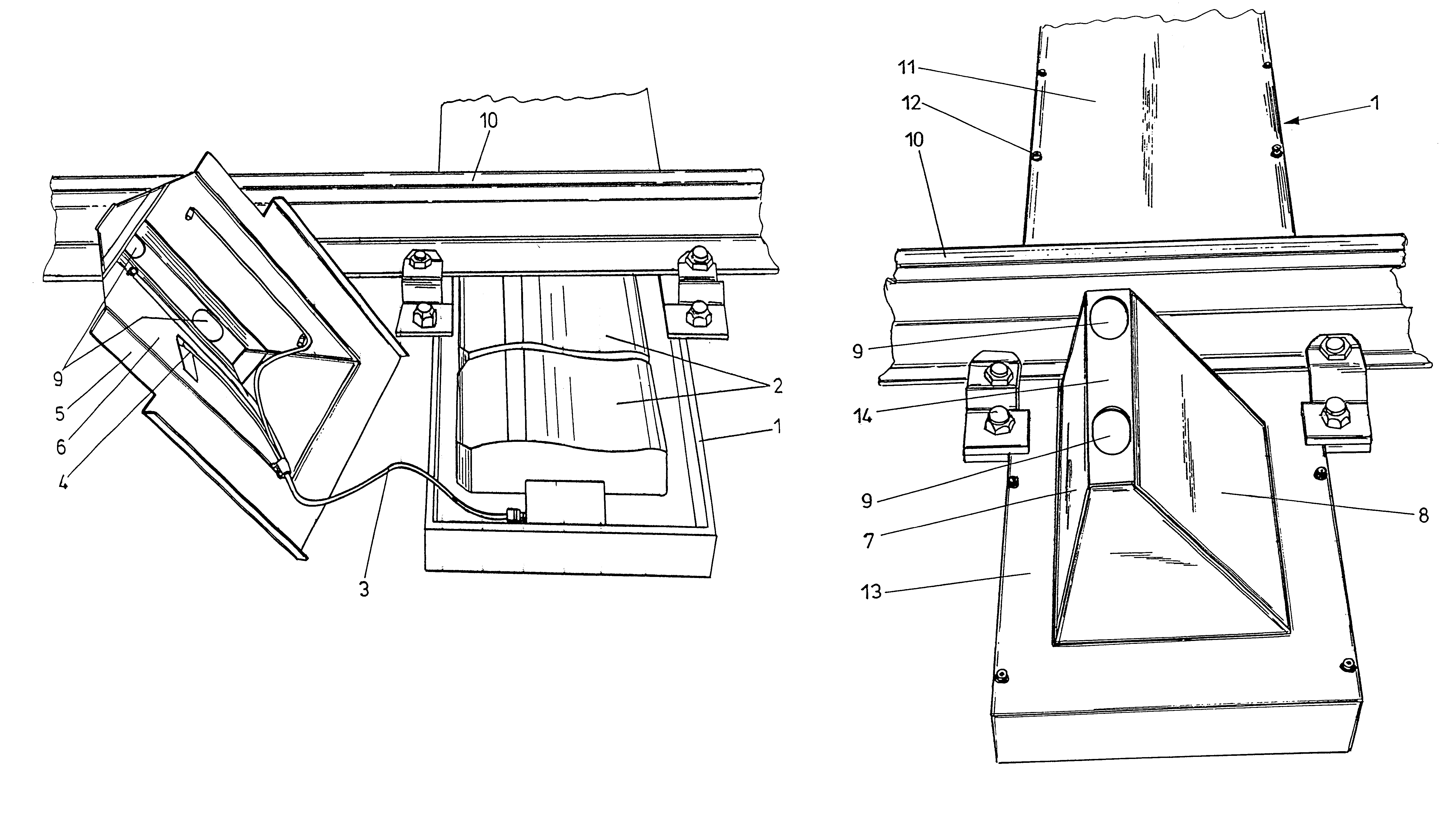
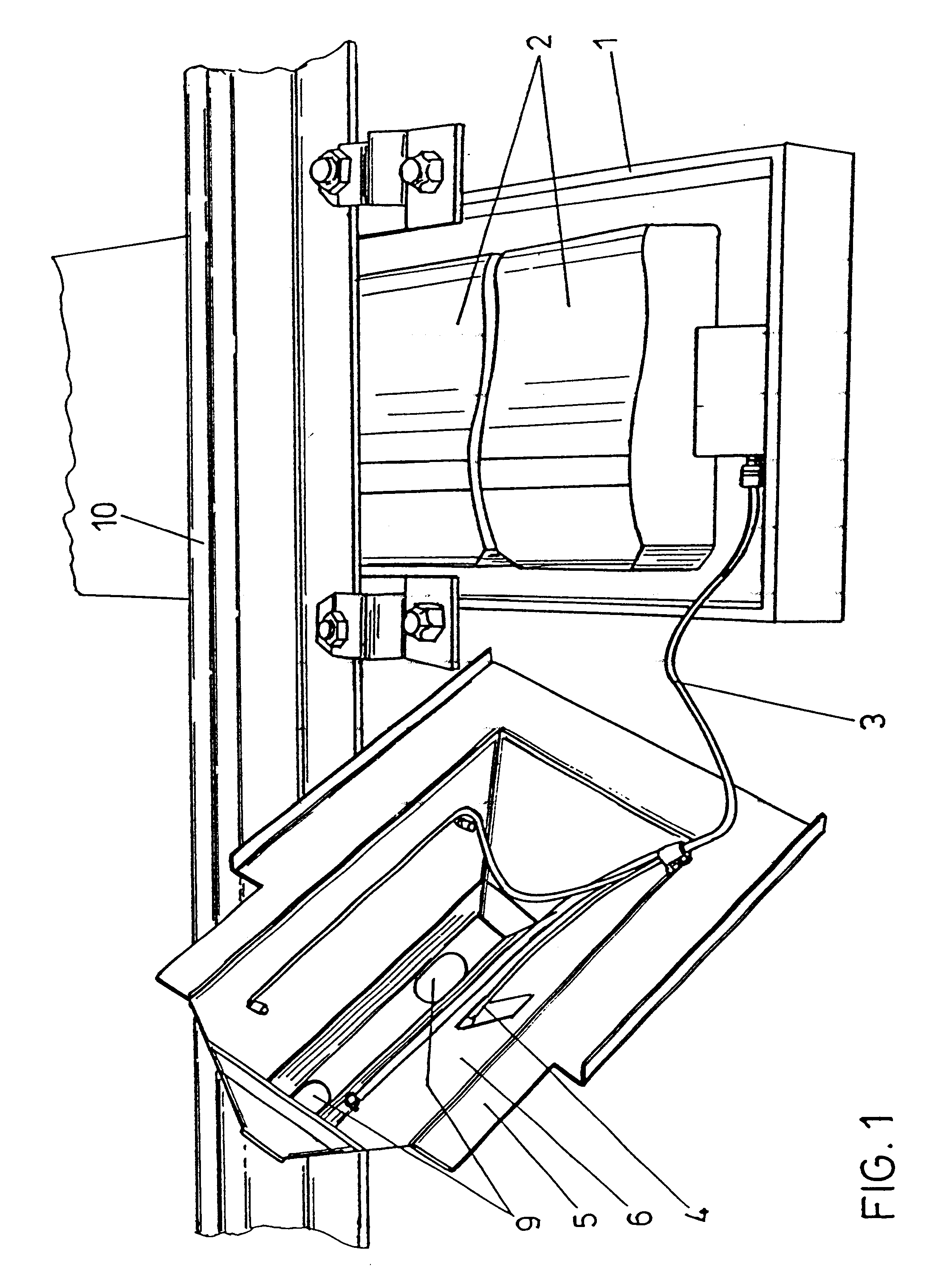
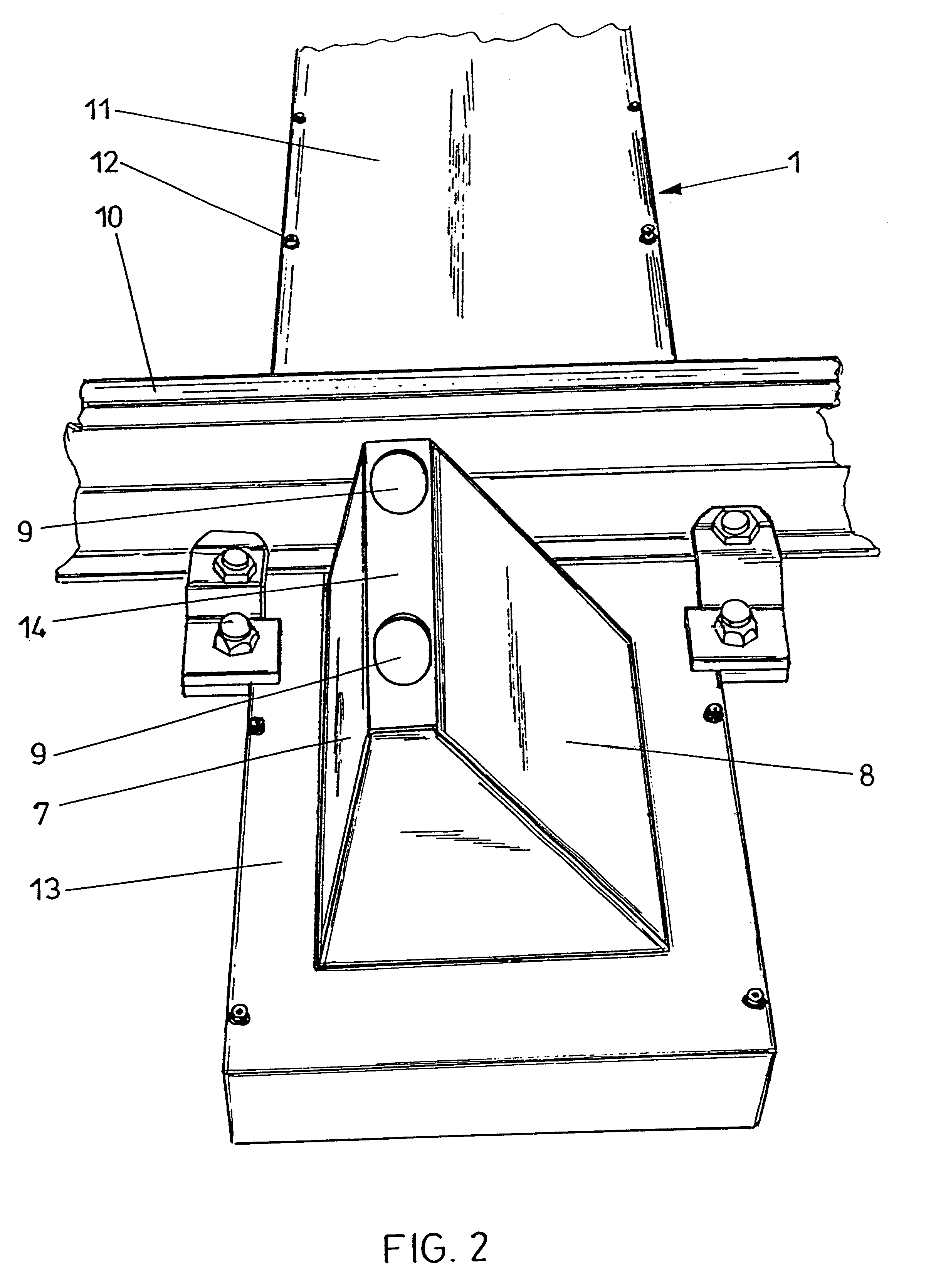
The invention aims at providing a casing of the initially defined kind, which is suitable for being incorporated in a trough-shaped sleeper which safely utilizes the advantages of an installation directly in the trough-shaped sleeper even in adverse meteorological conditions and, in particular, when intensive snow fall or the like is likely to build up a thick layer of snow or ice on the detector. To solve this problem, the configuration according to the invention essentially consists in the casing being comprised of a casing lower part and a lid, the lid being designed as a
chimney top with lateral surfaces converging towards the upper thereof and carrying an electrical heating means on their inner sides. The lid includes openings for the scanning beams of one or more infrared detectors on its upper edge or near its upper edge. By providing, in addition to a casing lower part which, in accordance with a preferred further development of the invention, is formed by the trough-shaped sleeper itself and a lid which is designed as a
chimney top having lateral surfaces converging towards the upper edge, it is ensured that even in case of heavy snow fall, the snow will descend along the converging lateral surfaces under the action of gravity. By providing electrical heating means on the inner sides of the lateral surfaces and openings for the scanning beams of the
infrared detector in the lid on its upper edge or near its upper edge, it is ensured that the integrated heating reliably keeps clear from snow or ice the respective opening cross section on the upper side of the lid by ascending hot air so as to allow the safe scanning and detection of hot boxes or blocked brakes. The surface available for a possible
snow cover is relatively small, since that surface directly merges into the laterally sloping lateral surfaces converging towards the upper edge. By heating those lateral surfaces, at least a film of snow in direct contact with the lateral walls will melt such that the snow load can descend under its own weight and melt subsequently. Due to a stacking effect, the openings on the upper edge are safely kept clear even at a comparatively low heating performance, since, bearing in mind the small upper surface, the overall amount of snow or ice built up thereabove remains relatively small. This applies all the more, since the upper edge of the casing lid is brought near the travelling edges of the rail due to the chimney top such that even the
relative wind of rolling rail vehicles will cause an additional mechanical cleaning effect. Advantageously, the configuration is devised such that the casing lower part comprises a further electrical heating means and is provided with
discharge openings for melt water so as to prevent major amounts of snow from collecting in the interior of the upwardly open casing.
In a particularly simple manner, the heating means of the lid is designed as an electrical resistance heater having windings which extend substantially parallel with the bottom of the casing lower part. Such an arrangement of the electrical resistance heater directly results in the desired flow course of the ascending hot air, thus ensuring particularly efficient clearing of snow even at low heating performances.



 Login to View More
  Login to View More