
Screening test for the lethal genetic trait of recurrent spontaneous pregnancy loss
a genetic trait and screening test technology, applied in the field of screening test for the lethal genetic trait of recurrent spontaneous pregnancy loss, can solve the problems of difficult identification of recessive lethal traits, extensive and complex diagnostic evaluation of rsa, and likely an underestimation, so as to increase the reliability of conclusions. the effect of increasing the reliability
- Summary
- Abstract
- Description
- Claims
- Application Information
AI Technical Summary
Benefits of technology
Problems solved by technology
Method used
Image

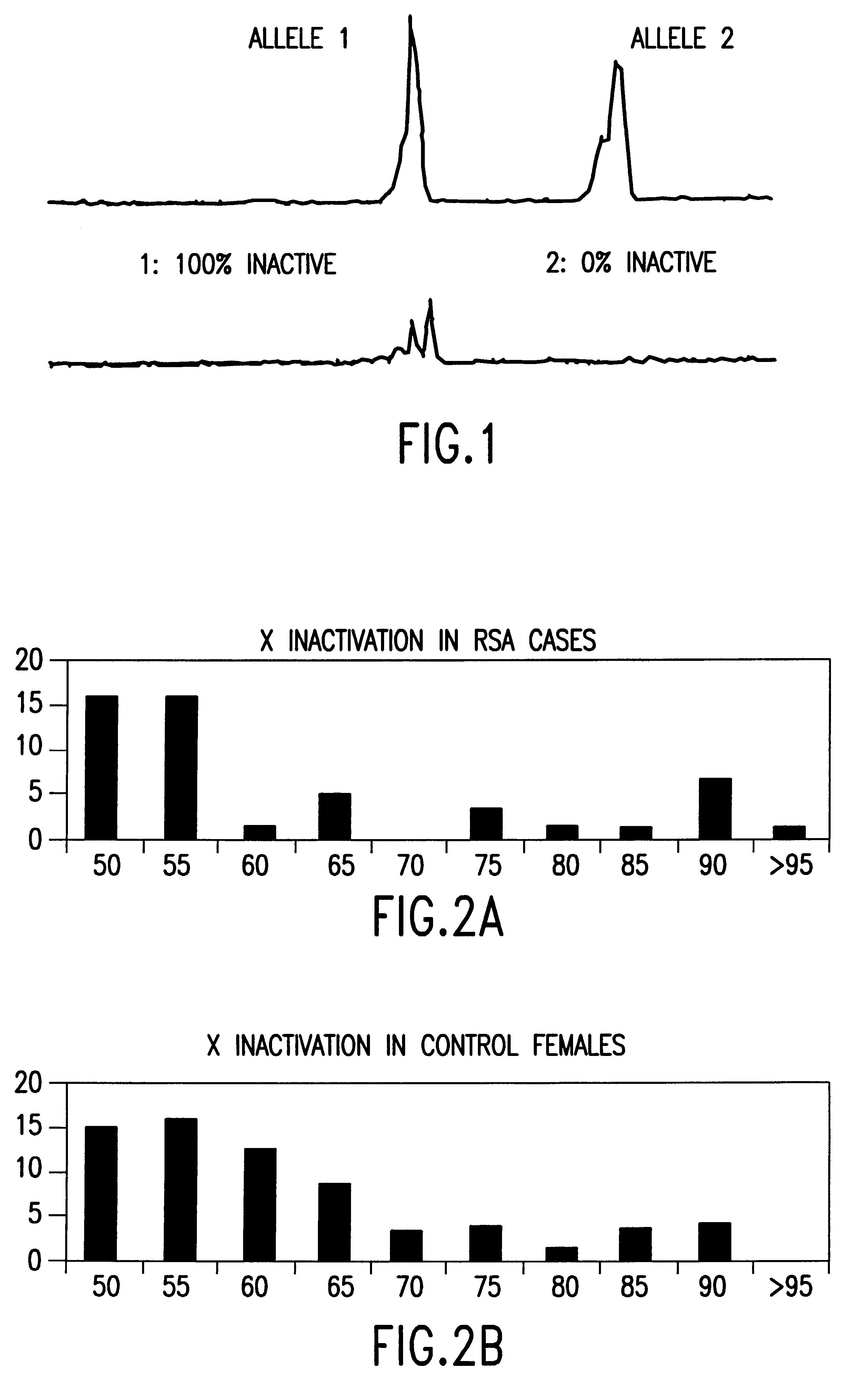
Examples
example 1
DNA Extraction
Peripheral blood was collected in EDTA tubes, and DNA isolated from leukocytes, as described elsewhere (Pegoraro et al., 1994, above).
Muscle DNA was isolated from cryosections of muscle biopsies, as described elsewhere (Pegoraro et al., 1995, above).
To isolate oral (cheek) mucosal cellular DNA, mouthwashing was done for 30 s in about 10 ml of 3% sucrose, and the rinse collected in tubes containing 10 mM EDTA as a preservative. Cells were isolated from this suspension by centrifugation at 14,000.times.g for 20 min. Cells were solubilized in lysis buffer. Proteinase K digestion in PCR buffer was done at 60 C for 2 hr. Samples were extracted with phenol-chloroform and chloroform, and the DNA was concentrated by use of Amicon MICROCON microconcentrators.
X-chromosome Inactivation Method
X-inactivation patterns in the aforementioned DNA samples were quantified by the use of fluorescent PCR as described elsewhere (Allen et al., 1992, above; Pegoraro et al., 1...
example 2
Association Between Idiopathic RSA and X Lethal Loci
A limited case-control study was done using the techniques described in Example 1, above. In this study the frequency of highly skewed X chromosome inactivation in women with two or more unexplained spontaneous abortions, was compared to female controls. In this study skewed X chromosome was defined as preferential use of one chromosome in greater than or equal to 90% of peripheral leukocytes, and assumed that such extreme skewing reflects the carrier state for X-linked lethal conditions.
It was found that 4 of 34 (11.7%) women with unexplained spontaneous abortions and one of 62 (1.6%) control women to have skewed X inactivation by these criteria. This represents a statistically significant odds ratio of 8.13 with 95% confidence limits of 55.9 to 1.18.
These data demonstrate that the X chromosome inactivation assay is a powerful method for ascertaining cell-autonomous X-linked recessive lethal defects. Identification of such women i...
example 3
Association Between Idiopathic RSA and X-linked Lethal Loci
In another study, similar to that described in Example 2, women characterized with a number of spontaneous abortions underwent a complete evaluation to rule out any of the known causes of RSA described above (Stephanson 1996, above). The tests performed were as follows: cytogenetic-parental and abortus karyotyping; anatomic-hysterosalpingogram; infections-cervical cultures for mycoplasma, ureaplasma, gonnococcus, and chlamydia; immunologic-anticardiolipin antibodies, antinuclean antibodies, and lupus anticoagulant; and, hormonal-serum progesterone, late luteal phase endometrial biopsy, and thyroid stimulating hormone.
The controls were women from the same demographic region with no known history of spontaneous abortion.
Further, the cases and controls were age-distribution matched, and the age distribution between the two groups was about the same.
Defining X inactivation as preferential use of one X chromosome in at least 90% ...
PUM
| Property | Measurement | Unit |
|---|---|---|
| Fraction | aaaaa | aaaaa |
| Frequency | aaaaa | aaaaa |
Abstract
Description
Claims
Application Information
 Login to View More