Unlock instant, AI-driven research and patent intelligence for your innovation.

Optical node with add-drop or cross-connect functionality

Inactive Publication Date: 2005-08-16
SIEMENS AG
View PDF9 Cites 4 Cited by
  • Summary
  • Abstract
  • Description
  • Claims
  • Application Information

AI Technical Summary

Benefits of technology

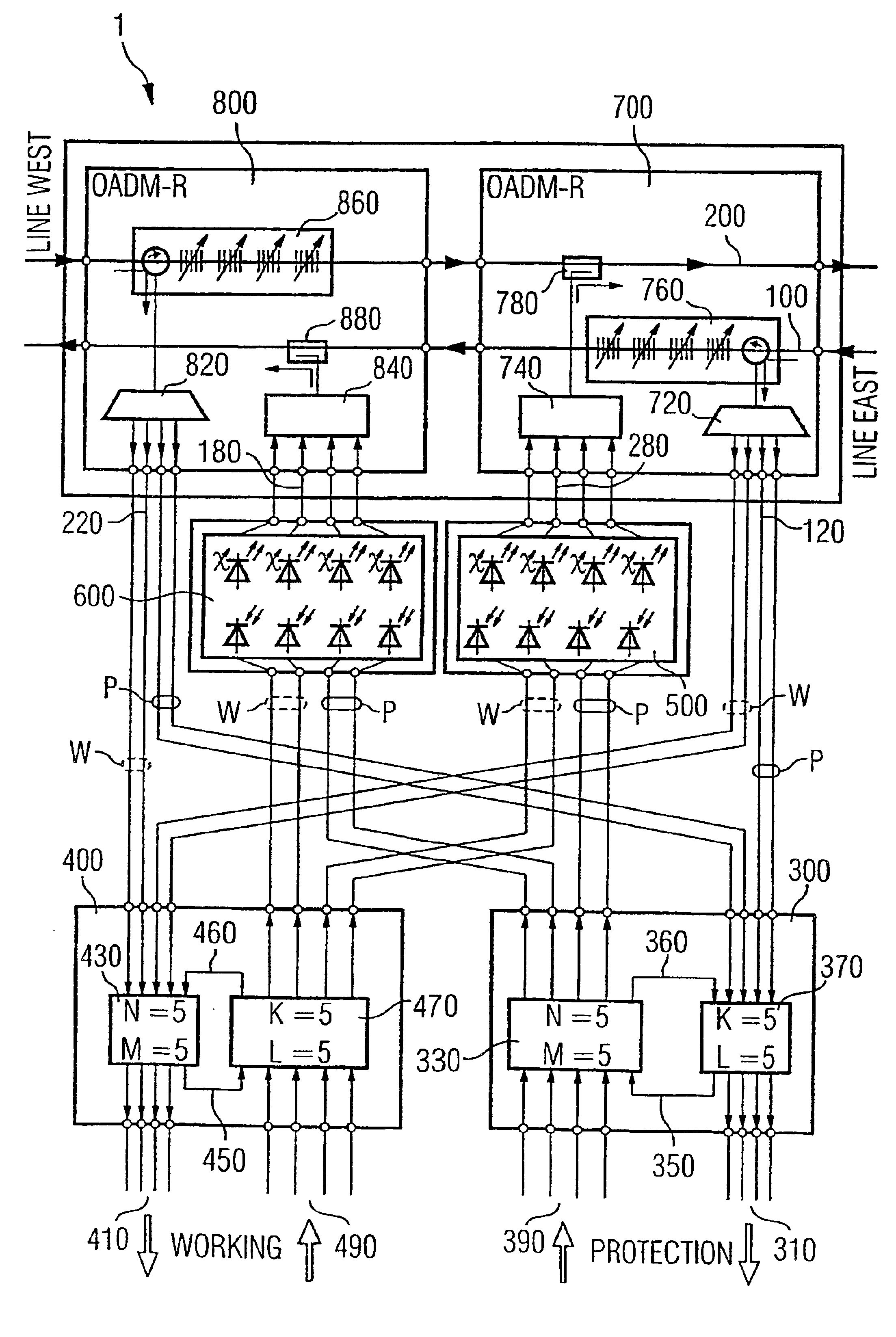
[0010]The cross-connects are designed in such a manner that they are interconnected with the tributary side of the network node with add-drop functions and with the first and second add branches and the first and second drop branches of the first and second optical lines. The cross-connect preferably can be remotely configurable and, even more preferably, can be connected to a centralized network management system. The inputs at the tributary side consist of a working line and a protection line. Such interconnection is advantageous since, as a result, the inputs of the tributary side of the network node can be arbitrarily interconnected with the fibers of the line side of the network node with add-drop functions.
[0030]In addition, the present invention provides for a method for interconnecting optical transmit signals in an optical network node, where an optical transmit signal from the first tributary input is interconnected to the first tributary output. The method includes the following steps. Firstly, optical transmit signals are applied via a tributary input to a first cross-connect and are then interconnected to the first tributary output by the first cross-connect. Analogously, optical transmit signals from the second tributary input can be interconnected to the second tributary output. This has the advantage that interconnection of the inputs of the tributary side is possible via the optical network node of the present invention. The optical network node of the present invention made it possible to find an integrated solution which provides for an interconnection of the inputs of the tributary side and an interconnection of the tributary side with the line side. According to the present invention, the comprehensive interconnection is now achieved by only one network element and no longer by a further network element preceding the network node.

Problems solved by technology

At present, known add-drop multiplexers are not able to satisfy these increased demands on the network since they often only can be used statically.
A further disadvantage of known optical add-drop multiplexers is that the network cannot be optimally occupied with transmit wavelengths.
It is not possible to feed a transmit wavelength into the optical WDM network.
This represents additional hardware expenditure and can lead to a further deterioration in the signal.
An additional disadvantage in previous optical add-drop multiplexers is that the tributary inputs only can be interconnected at the electrical level.

Method used

the structure of the environmentally friendly knitted fabric provided by the present invention; figure 2 Flow chart of the yarn wrapping machine for environmentally friendly knitted fabrics and storage devices; image 3 Is the parameter map of the yarn covering machine
View more

Image

Smart Image Click on the blue labels to locate them in the text.
Viewing Examples
Smart Image
  • Optical node with add-drop or cross-connect functionality
  • Optical node with add-drop or cross-connect functionality
  • Optical node with add-drop or cross-connect functionality

Examples

Experimental program
Comparison scheme
Effect test

Embodiment Construction

[0038]FIG. 1 shows a network node 1 with add-drop functions according to the present invention. The first optical line 100 is shown as line east and the second optical line 200 is shown as line west. The first optical line 100 and the second optical line 200 are connected to a first module 700 and to a second module 800, the first drop branch 120 of the first optical line 100 and the second add branch 280 of the second optical line 200 being arranged on the first module 700. In contrast, the first add branch 180 of the first optical line 100 and the second drop branch 220 of the second optical line 200 are arranged on the second module 800. On the first module 700, the first optical line 100 is connected to the first optical drop branch 120 via the first filter and circulator device 760 and to a first demultiplex device 720 while the second add branch 280 is connected to the second optical line 200 via the first coupler 780 and the first multiplex device 740. On the second module 80...

the structure of the environmentally friendly knitted fabric provided by the present invention; figure 2 Flow chart of the yarn wrapping machine for environmentally friendly knitted fabrics and storage devices; image 3 Is the parameter map of the yarn covering machine
Login to View More

PUM

No PUM Login to View More

Abstract

An optical network node is provided having add-drop and / or cross-connect functions, wherein the optical network node includes a first optical line with a first drop branch and a first add branch, and a second optical line with a second drop branch and a second add branch, wherein the first drop branch and the second drop branch are in each case connected to a first cross-connect and to a second cross-connect, the first add branch is connected to the first cross-connect and to the second cross-connect via a first wavelength converter, and the second add branch is connected to the first cross-connect and to the second cross-connect via a second wavelength converter.

Description

BACKGROUND OF THE INVENTION[0001]The present invention relates to an optical network node with add-drop and / or cross-connect functions. Due to the increasing volume of data in optical networks, existing network capacity must be utilized optimally. At present, known add-drop multiplexers are not able to satisfy these increased demands on the network since they often only can be used statically. To provide optimal utilization of the network capacity, therefore, new and more comprehensive concepts for optimizing the traffic routing are necessary.[0002]A further disadvantage of known optical add-drop multiplexers is that the network cannot be optimally occupied with transmit wavelengths. If, in the WDM network, wavelengths are occupied which should be fed in via an optical add-drop multiplexer, the tributary input of the optical add-drop multiplexer is blocked. It is not possible to feed a transmit wavelength into the optical WDM network.[0003]Wavelength conversion in WDM networks previ...

Claims

the structure of the environmentally friendly knitted fabric provided by the present invention; figure 2 Flow chart of the yarn wrapping machine for environmentally friendly knitted fabrics and storage devices; image 3 Is the parameter map of the yarn covering machine
Login to View More

Application Information

Patent Timeline
no application Login to View More
IPC IPC(8): H04J14/02H04Q11/00
CPCH04J14/0204H04J14/0205H04J14/0206H04J14/021H04J14/0212H04J14/0213H04J14/0293H04Q11/0005H04J14/0283H04Q2011/0011H04Q2011/0018H04Q2011/0022H04Q2011/0035
Inventor BOCK, HARALDLEISCHING, PATRICKRICHTER, ALEXANDERSTOLL, DETLEF
Owner SIEMENS AG