
Electroconductive rubber roller
Active Publication Date: 2006-07-04
SUMITOMO RUBBER IND LTD
View PDF7 Cites 16 Cited by
- Summary
- Abstract
- Description
- Claims
- Application Information
AI Technical Summary
Benefits of technology
[0014]The present invention has been made in view of the above-described problems. Therefore it is an object of the present invention to provide an electroconductive rubber roller which can be made uniform in its electric resistance and is capable of charging toner favorably and keeping the charged electrostatic property thereof for a long time. The present invention is particularly intended to provide an electroconductive rubber roller which can be suitably used as a development roller which is used for single-component toner.
Problems solved by technology
The development roller used in the system employing the single-component toner is incapable of displaying a magnetic force.
When the charged quantity of the toner is insufficient, the toner cannot be transported faithfully to the electrostatic latent image on the photosensitive member owing to shortage of the power of static electricity.
Consequently defective images are formed.
Although the rubber material disclosed in Japanese Patent Application Laid-Open No. 2002-194203 makes the electric resistance of the rubber layer uniform to some extent, the rubber material is incapable of providing toner with favorable electrostatic property nor allowing the toner to have the charged electrostatic property for a long time.
Therefore the development roller made of the rubber material does not provide a preferable printed image.
According to the disclosure made in Japanese Patent Application Laid-Open No. 2001-357735, the surface of the electroconductive member of the development roller or the like cannot be treated very accurately with the treating agent.
Thus the rubber material is incapable of allowing the formation of a high-quality image.
Since the material of the development roller is different from that of the coating agent, there is a possibility that the coating agent peels off from the material of the development roller during production and the use thereof.
It is difficult to control both the toner-transporting performance and the electrostatic property of the toner.
Method used
the structure of the environmentally friendly knitted fabric provided by the present invention; figure 2 Flow chart of the yarn wrapping machine for environmentally friendly knitted fabrics and storage devices; image 3 Is the parameter map of the yarn covering machine
View moreImage
Smart Image Click on the blue labels to locate them in the text.
Smart ImageViewing Examples

Examples
Experimental program
Comparison scheme
Effect test
examples 1 through 4
[0068]In the electroconductive rubber roller of each of the examples 1 through 4, the rubber component consisted of 100 parts by weight of the epichlorohidrin rubber. In the electroconductive rubber roller of each of the examples 1, 3, and 4, the weak electroconductive carbon black was added to the rubber component as the dielectric loss tangent-adjusting filler. In the electroconductive rubber roller of the example 2, the calcium carbonate treated with the fatty acid was used as the dielectric loss tangent-adjusting filler. The oxide film was formed on the rubber layer of the electroconductive rubber roller of the examples 1 through 4 in the conditions shown in table 1.
the structure of the environmentally friendly knitted fabric provided by the present invention; figure 2 Flow chart of the yarn wrapping machine for environmentally friendly knitted fabrics and storage devices; image 3 Is the parameter map of the yarn covering machine
Login to View More PUM
 Login to View More
 Abstract
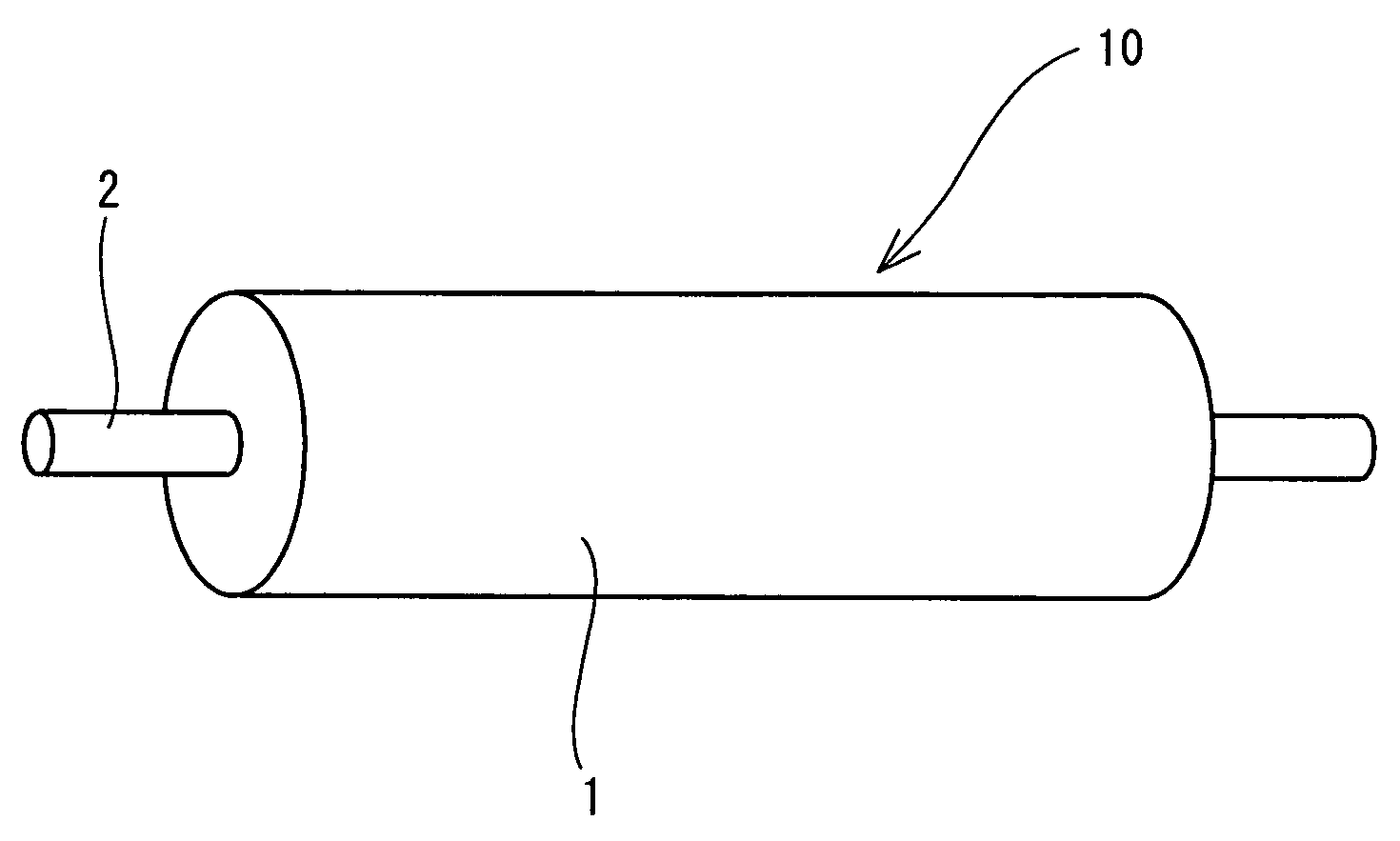
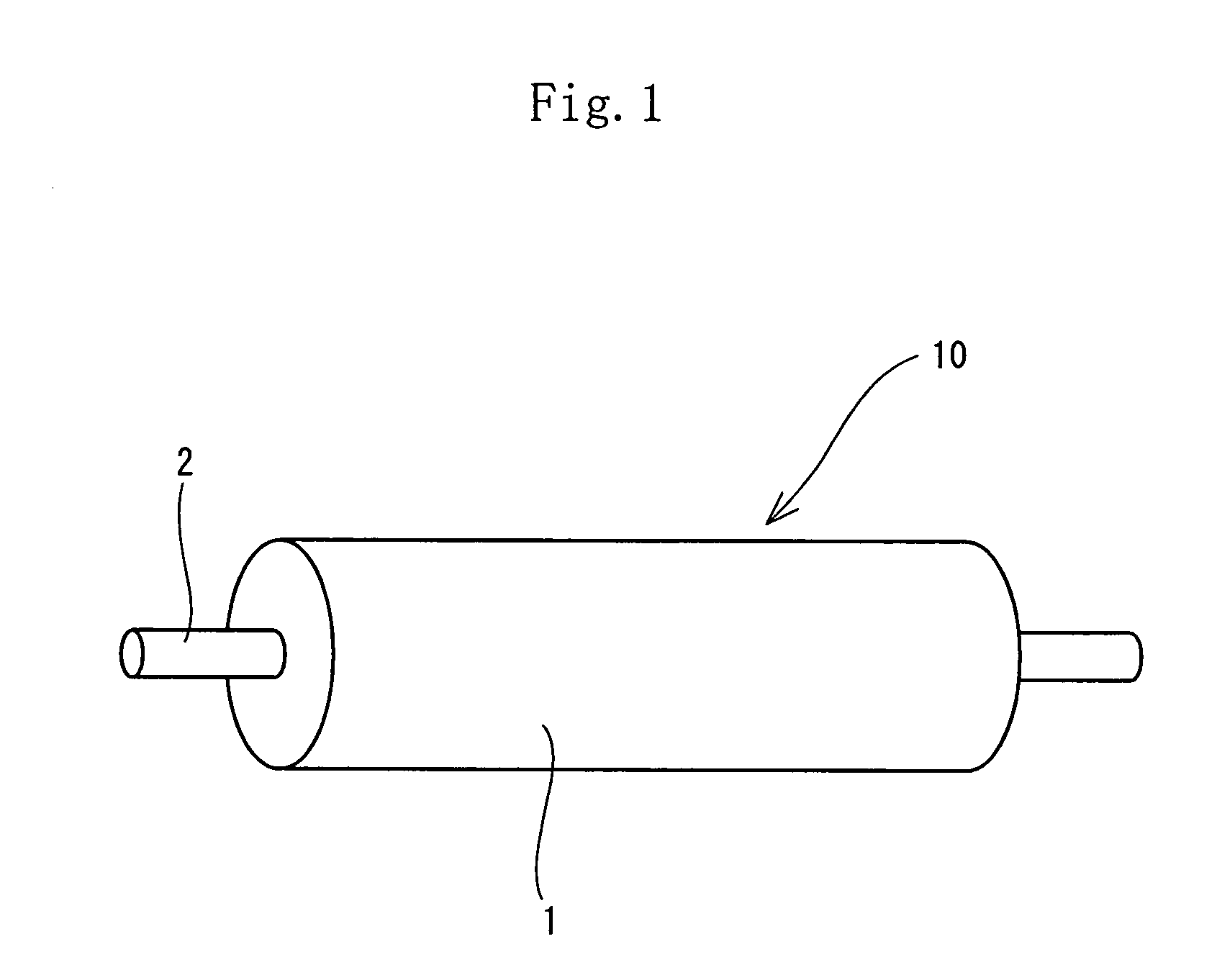
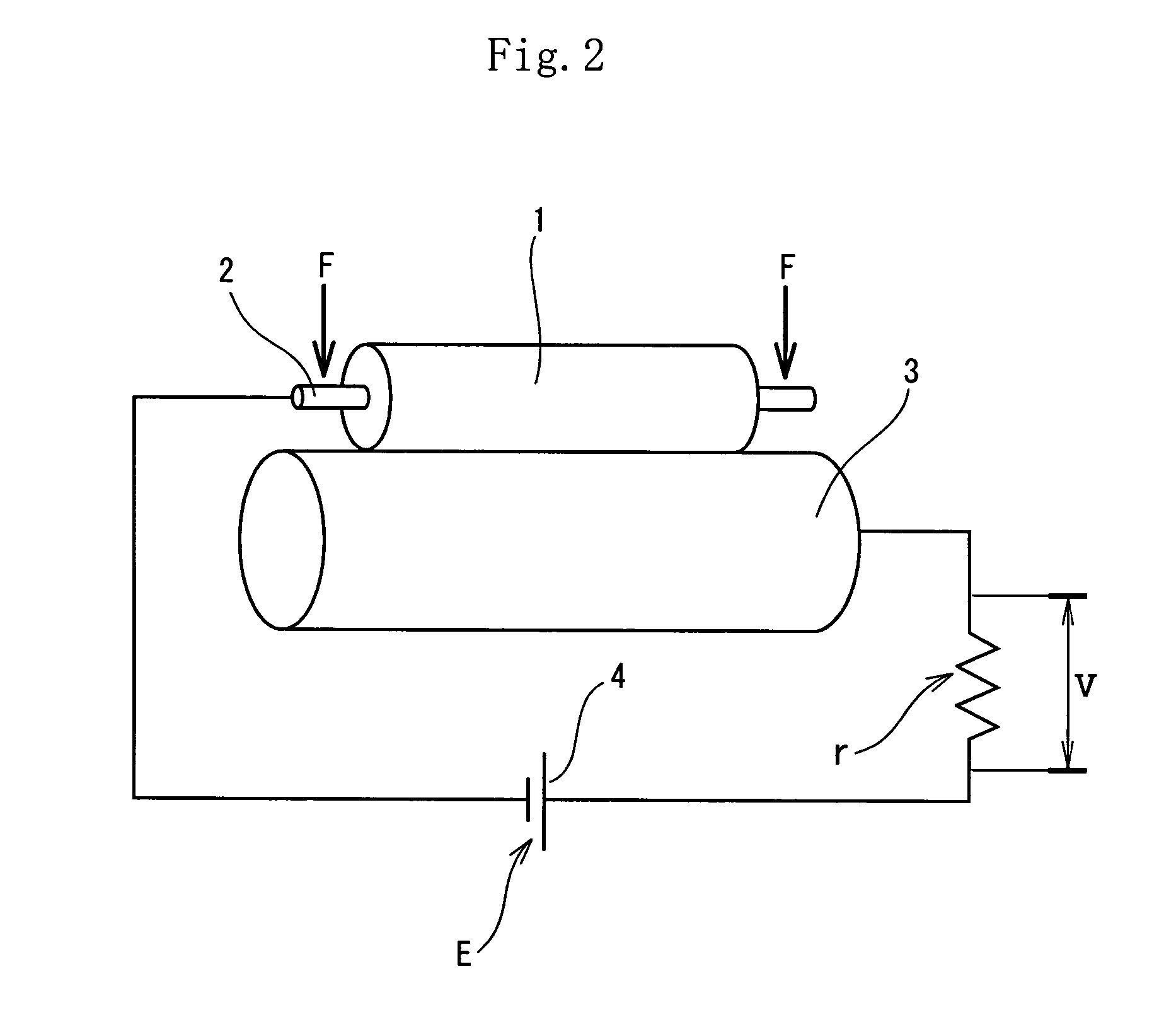
An electroconductive rubber roller (10) whose outermost layer consists of a rubber layer (1) made of a rubber composition containing an ionic-conductive rubber as a main component thereof. The surface of the rubber layer consists of an oxide film; and the rubber composition contains a dielectric loss tangent-adjusting filler to set a dielectric loss tangent of the electroconductive rubber roller to 0.1 to 1.5. Weak electroconductive carbon black and / or calcium carbonate treated with fatty acid can be used as the dielectric loss tangent-adjusting filler.
Description
[0001]This nonprovisional application claims priority under 35 U.S.C. § 119(a) on Patent Application No. 2002-338968 filed in JAPAN on Nov. 22, 2002, the entire contents of which are hereby incorporated by reference.BACKGROUND OF THE INVENTION[0002]1. Field of the Invention[0003]The present invention relates to an electroconductive rubber roller. More particularly, the present invention relates to the electroconductive rubber roller that is used preferably as a development roller provided in an image-forming mechanism of a laser printer and the like to make toner adhere to a photosensitive member. The development roller is superior in its toner-transporting performance and in charging the toner.[0004]2. Description of the Related Art[0005]In recent years, electrophotographic apparatuses such as a laser printer form images having a high quality at a high speed. In the laser printer, a photosensitive member directly connected to image formation and members disposed in the vicinity the...
Claims
the structure of the environmentally friendly knitted fabric provided by the present invention; figure 2 Flow chart of the yarn wrapping machine for environmentally friendly knitted fabrics and storage devices; image 3 Is the parameter map of the yarn covering machine
Login to View More Application Information
Patent Timeline
 Login to View More
 IPC IPC(8): B25F5/02F16C13/00C08L101/12G03G15/08
CPCG03G15/0808C08L101/12
InventorMIZUMOTO, YOSHIHISA
OwnerSUMITOMO RUBBER IND LTD