

Zipper strip and method of positioning the strip transverse longitudinal axis
a technology of longitudinal axis and zipper strip, which is applied in the direction of sacks, packaging, flexible containers, etc., can solve the problems of high occurrence of leakage of packages, difficulty in achieving satisfactory sealing of bags or packages, and consistent and successful achievemen
- Summary
- Abstract
- Description
- Claims
- Application Information
AI Technical Summary
Benefits of technology
Problems solved by technology
Method used
Image



Examples
first embodiment
[0027]Referring specifically to the figures identified above, FIG. 1 is a cross-sectional view of the zipper strip 10 of the present invention. The zipper strip 10 comprises a male interlocking profile 12 and a female interlocking profile 14. The male interlocking profile 12 includes a male interlocking member 16 which may have an arrowhead-shaped cross section or, as is shown in FIG. 1, an asymmetrical arrowhead-shaped cross section, designed to make the zipper strip 10 easier to open from one side than from the other. The female interlocking profile 14 includes a female interlocking member 18 comprising two inwardly curving members forming a receptacle or channel into which male interlocking member 16 may be snappingly engaged.
[0028]Both the male and female interlocking profiles 12, 14 include webs coextruded with the male and female interlocking members 16, 18. Web 20 of male interlocking profile 12, it may be observed, is wider than web 22 of female interlocking profile 14. As a...
second embodiment
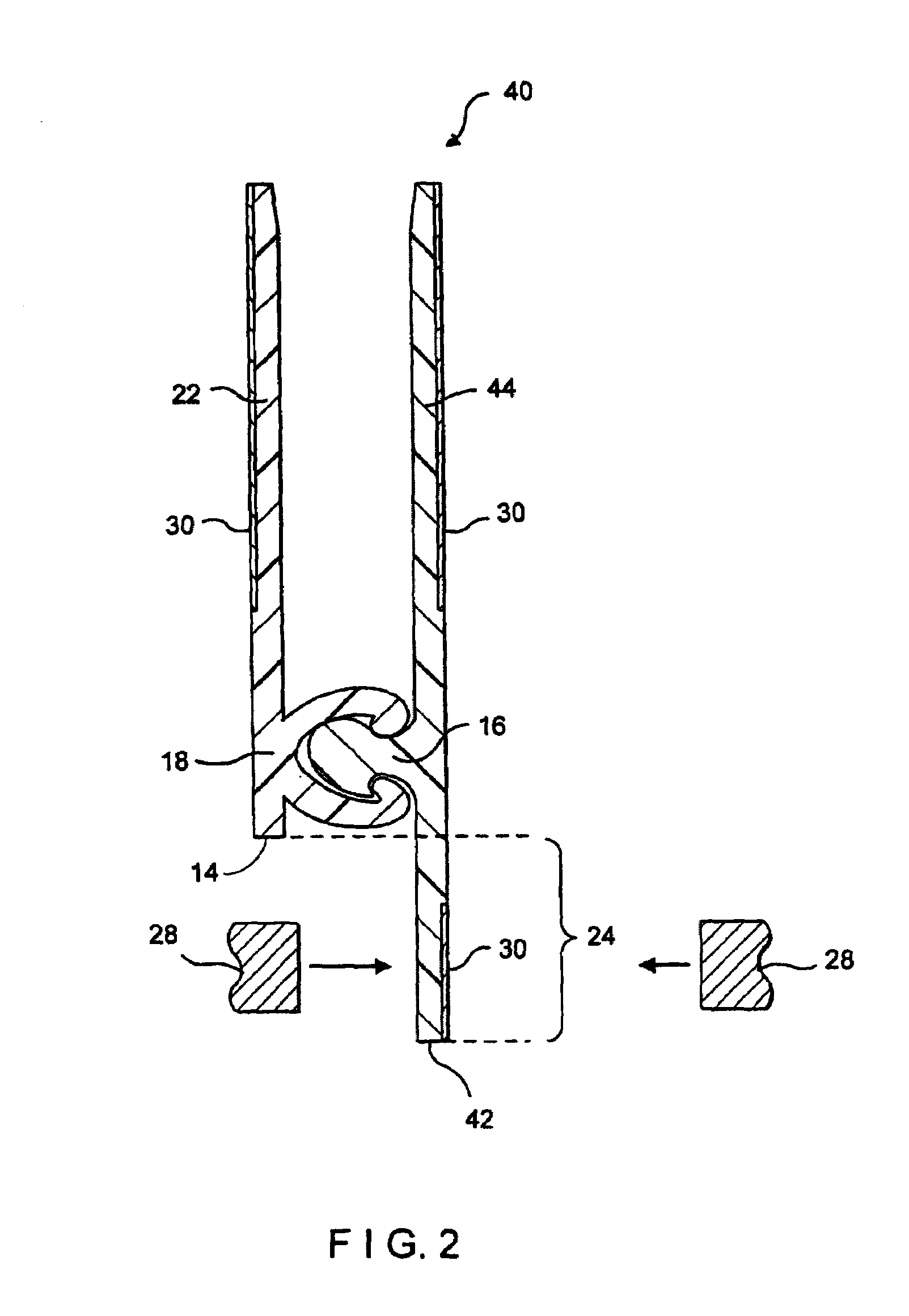
[0032]FIG. 2 is a cross-sectional view of the zipper strip 40 of the present invention. Elements common to both zipper strip 40 and zipper strip 10 described above are identified in FIG. 2 using the same reference numbers. A comparison between FIGS. 1 and 2 indicates that zipper strip 40 lacks a trailing flange 26, but is identical to zipper strip 10 in all other respects. As was the case with zipper strip 10, zipper strip 40 is disposed transversely across thermoplastic sheet material during the manufacture of plastic bags or packages on an FFS machine. Male interlocking profile 42 rests upon the thermoplastic sheet material. Heat seal bars 28 or the like, applied against the leading flange 24, as suggested by the arrows in FIG. 2, seal the male interlocking profile 42 to the thermoplastic sheet material (not shown) without sealing web 22 of the female interlocking profile 14 to web 44 of the male interlocking profile 42. As before, while the male interlocking profile 42 is shown t...
PUM
 Login to View More
 Abstract
Description
Claims
Application Information
 Login to View More