[0013]The structure necessary to support the hammock is a form-fitting athletic short chassis of the style typically known as a
trunk, compression short, or bicycle short, with certain modifications to support the improvement of the invention. The short's chief characteristic being that they are composed of cloth which has elastic properties and are constructed so as to tightly conform to the shape of the wearer around the top of his legs and his lower
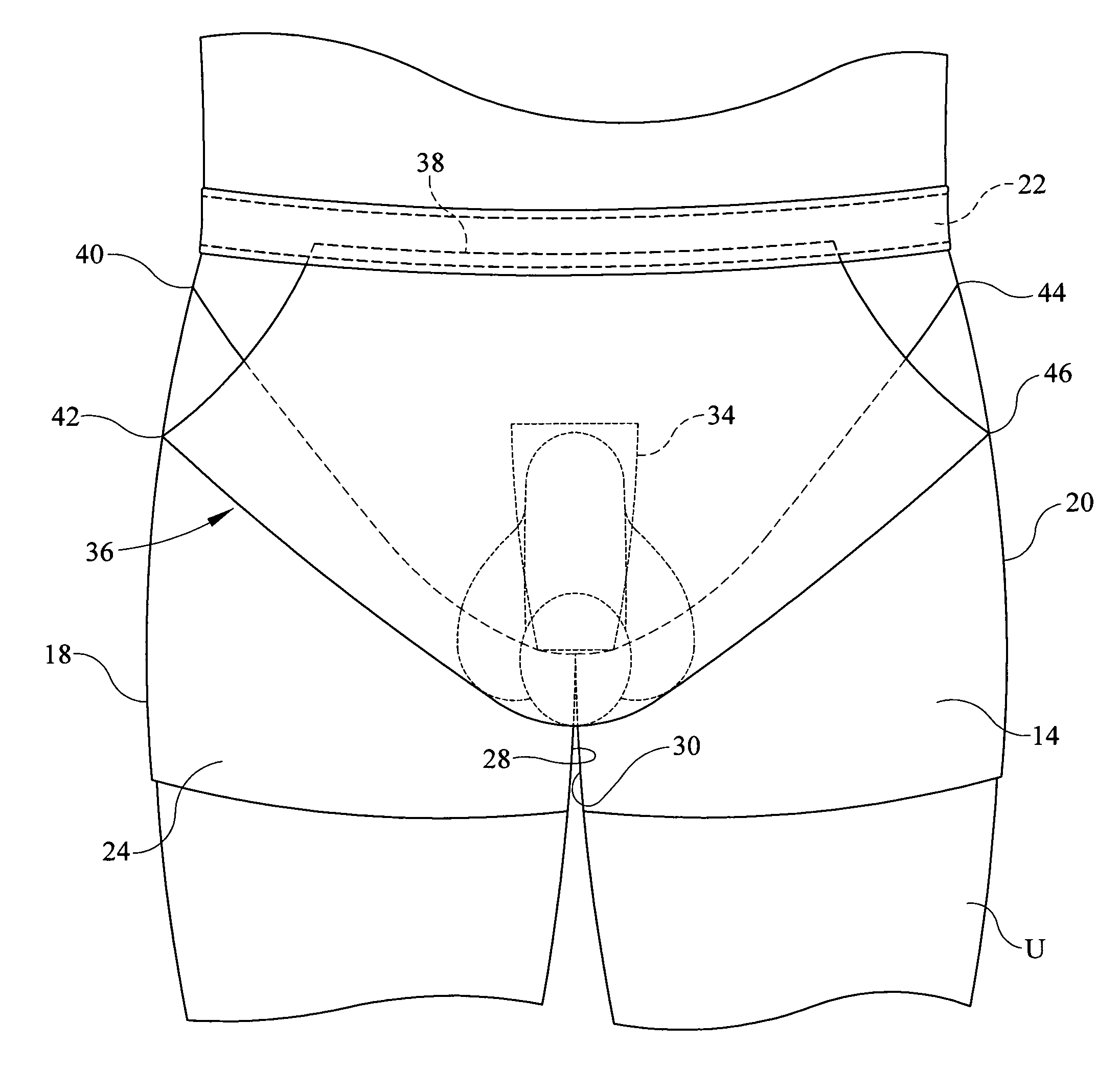
waist. This design makes the shorts less prone to twisting and provides a stable structure (or chassis) on which to attach the hammock element of the garment. The chief difference in the athletic hammock's construction from the usual form being that the present invention has an opening in the front which begins at a point between the legs of the wearer just aft of the
scrotum and extends up to a point adjacent to the top of the pubic bone. This opening has an inelastic reinforced basting which is sewn around its perimeter to make the size and shape of the opening constant or nearly so. Obviously, the wearer's genitals would simply hang exposed if not for the addition of the hammock or some other modesty enhancing element.
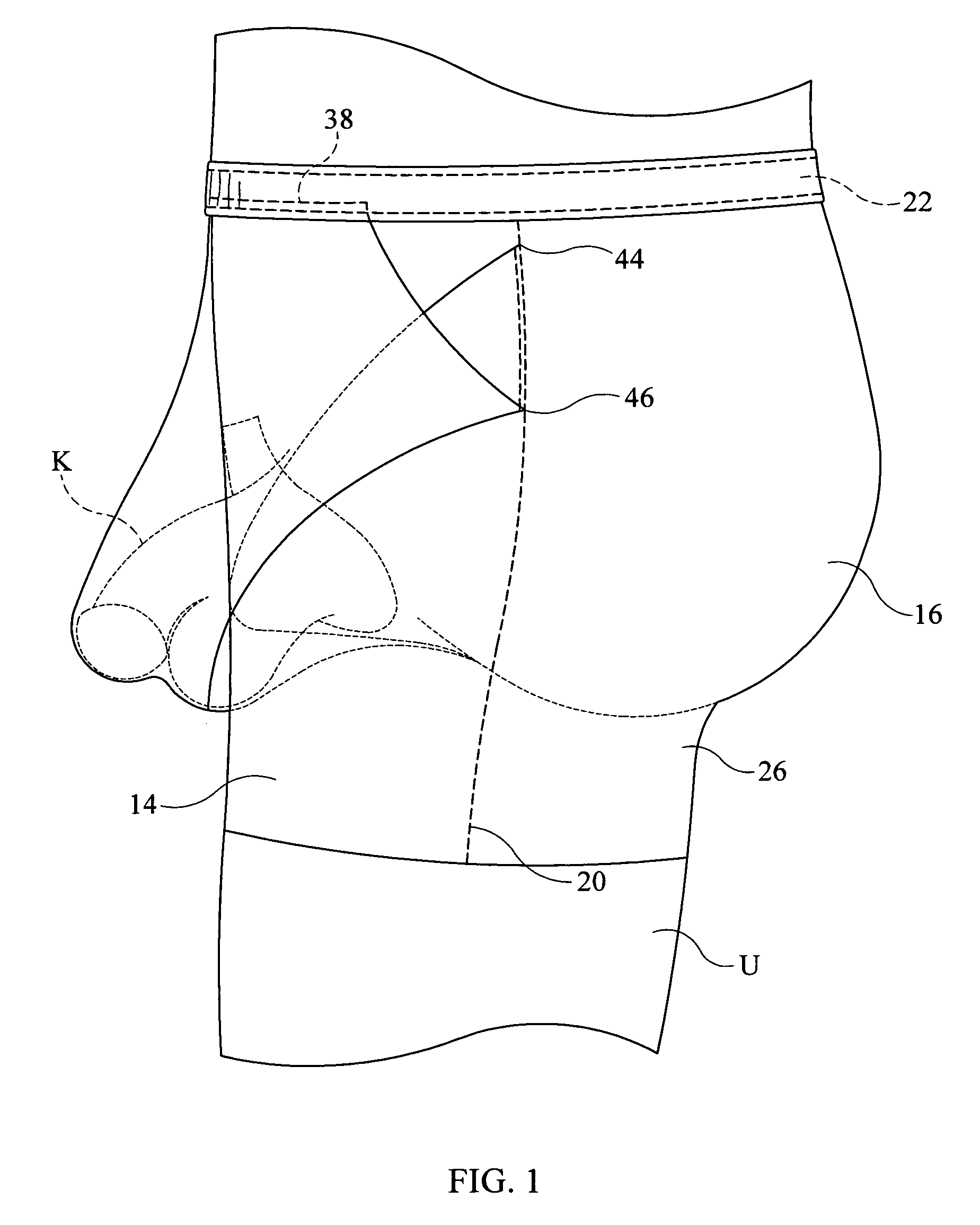
[0014]The athletic hammock is comprised of a fabric which, though soft and comfortable, has little stretch capability in the transverse direction (the direction which is generally parallel with that of the waistband). The hammock portion is somewhat banana-leaf in shape and is secured to the bottom of the opening of the chassis (adjacent to the posterior of the
scrotum) with an inelastic stitch technique. From the top of each side opening, the hammock is attached to the remainder of the shorts on a line roughly following the natural joining of the leg and
torso, to a point at the outside top of the hipbone. The width of the hammock (anterior to posterior) at its lowest point is sufficient to establish a platform. The forward edge of this platform is held approximately horizontal while the wearer stands. This is due to the hammock's non-stretch bias being oriented on line with the anchor points. The end result is that it acts as a cable in tension, supporting the platform on which the genitals rest. The placement of anchor points for this support cable below the anchor points for the posterior edge ensures the cable is held forward by the bulk of the wearer's legs. The genitals are cradled in this created sling, the forward edge of which is in tension, anchored at only two points (on the body centerline below the
waist). From this forward edge the hammock fabric wraps up, forming a pouch, and is secured at the elastic
waistline of the chassis with a stitch technique allowing for the stretch of the waistband. Attachment at the
waistline requires darts, pleats, an asymmetrically weaved cloth, or a similar manufacturing technique to prevent undesirable bunching of the excess materiel thereat. As the wearer raises his legs or spreads his legs, the hammock
assembly is pulled forward and / or up due to the anchor points moving farther apart. The inelastic bias of the hammock prevents excessive stretching, thereby ensuring the cable-like action which pulls on and displaces the platform in concert with the leg movement. By lowering the terminus of the hammock from the
waistline, the effect of the action of the leg movement on the hammock can be modulated. The larger the wearer's legs, the farther the forward edge of the hammock is pulled. It is by ensuring the cloth used for the hammock is
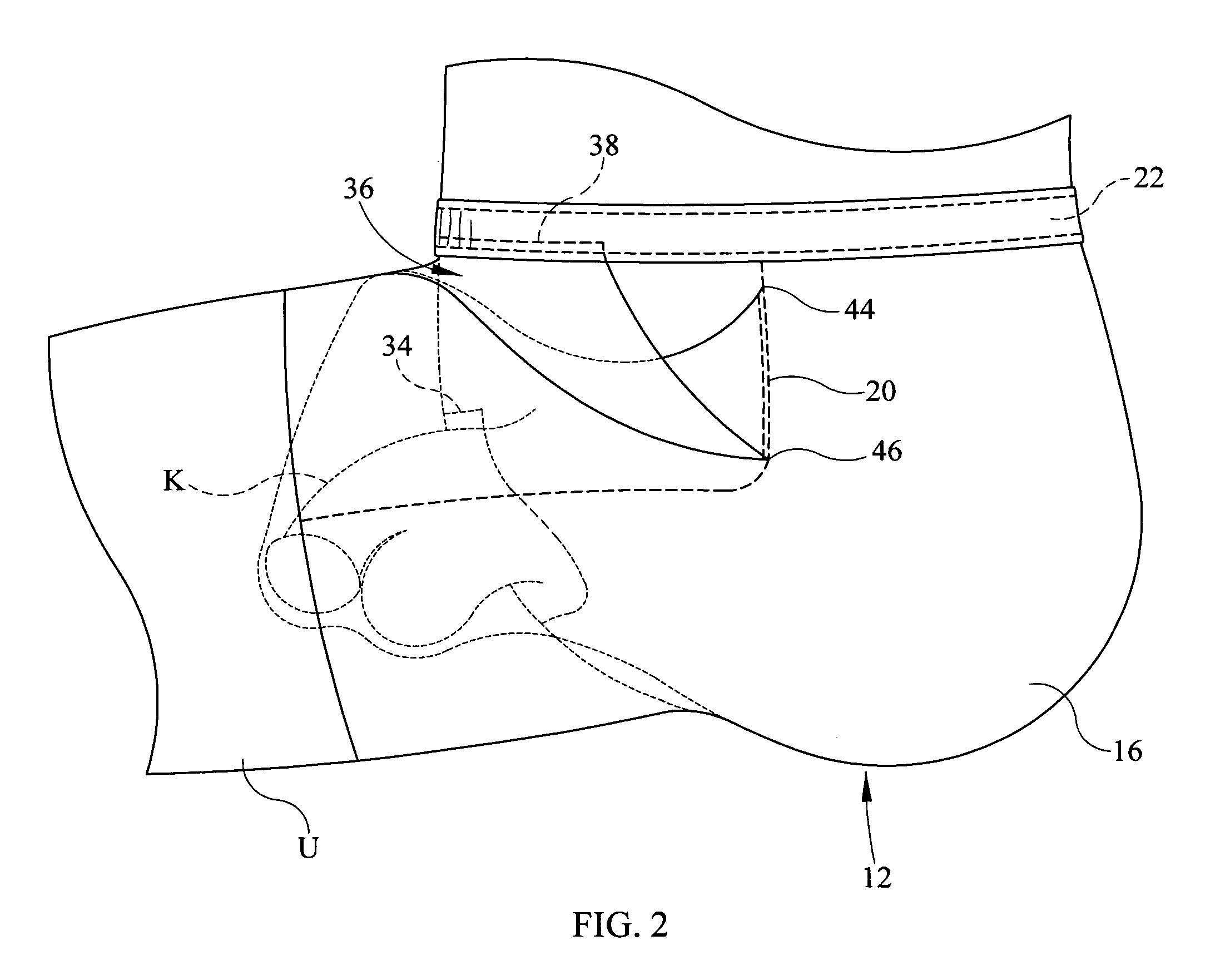
cut to such a width and anchored appropriately (meaning that the lowest point of the V-shaped line from hip-to body centerline-to hip does not fall below the bottom of the opening in the chassis), that the full realization of the hammock effect is achieved. When the wearer is seated, the hammock passes from the outside of the leg, across the top of the leg, under the genitals, back across the top of the opposite leg to its
anchor point on the opposite side. This supports the genitals and prevents them from falling between the wearer's legs.


 Login to View More
  Login to View More