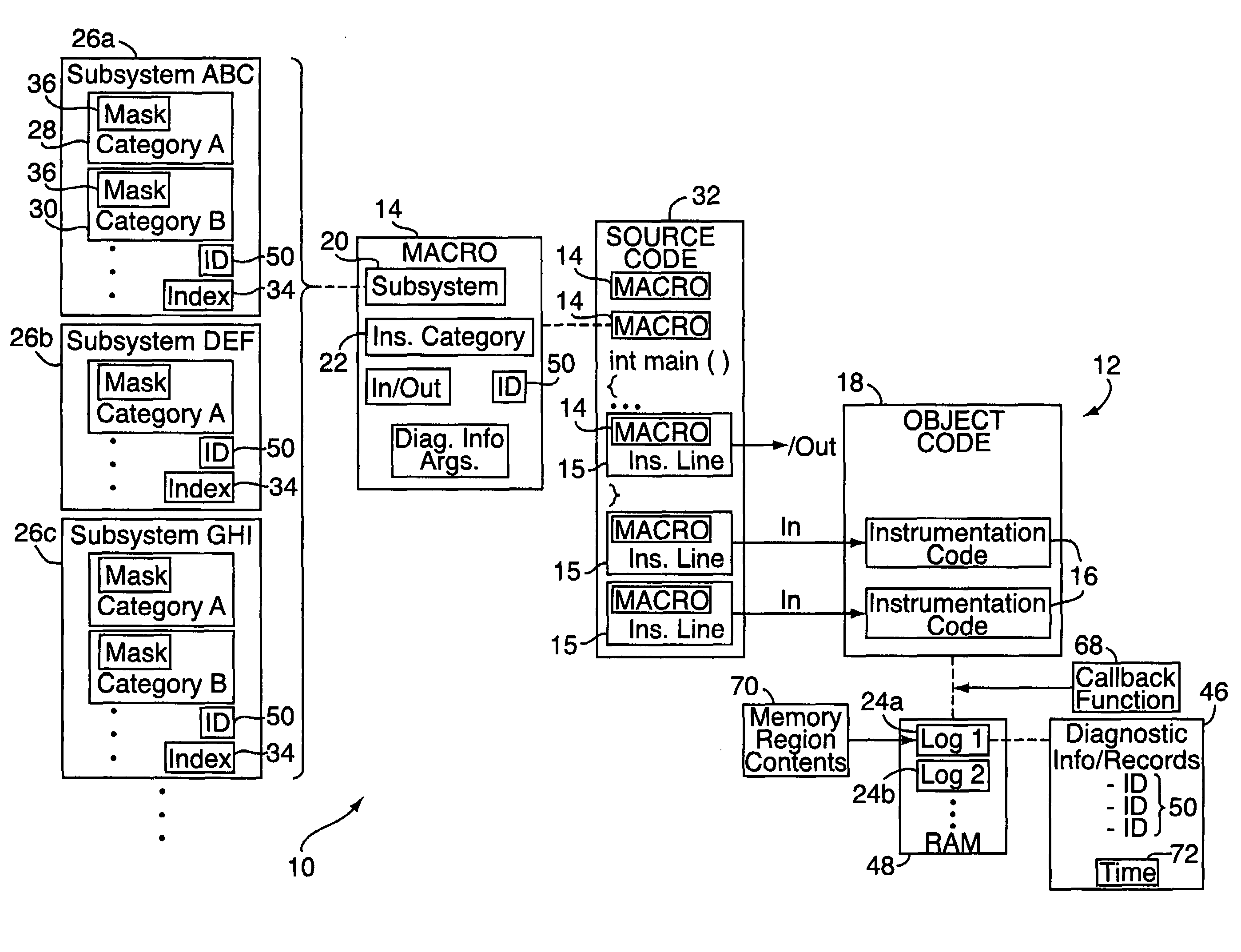
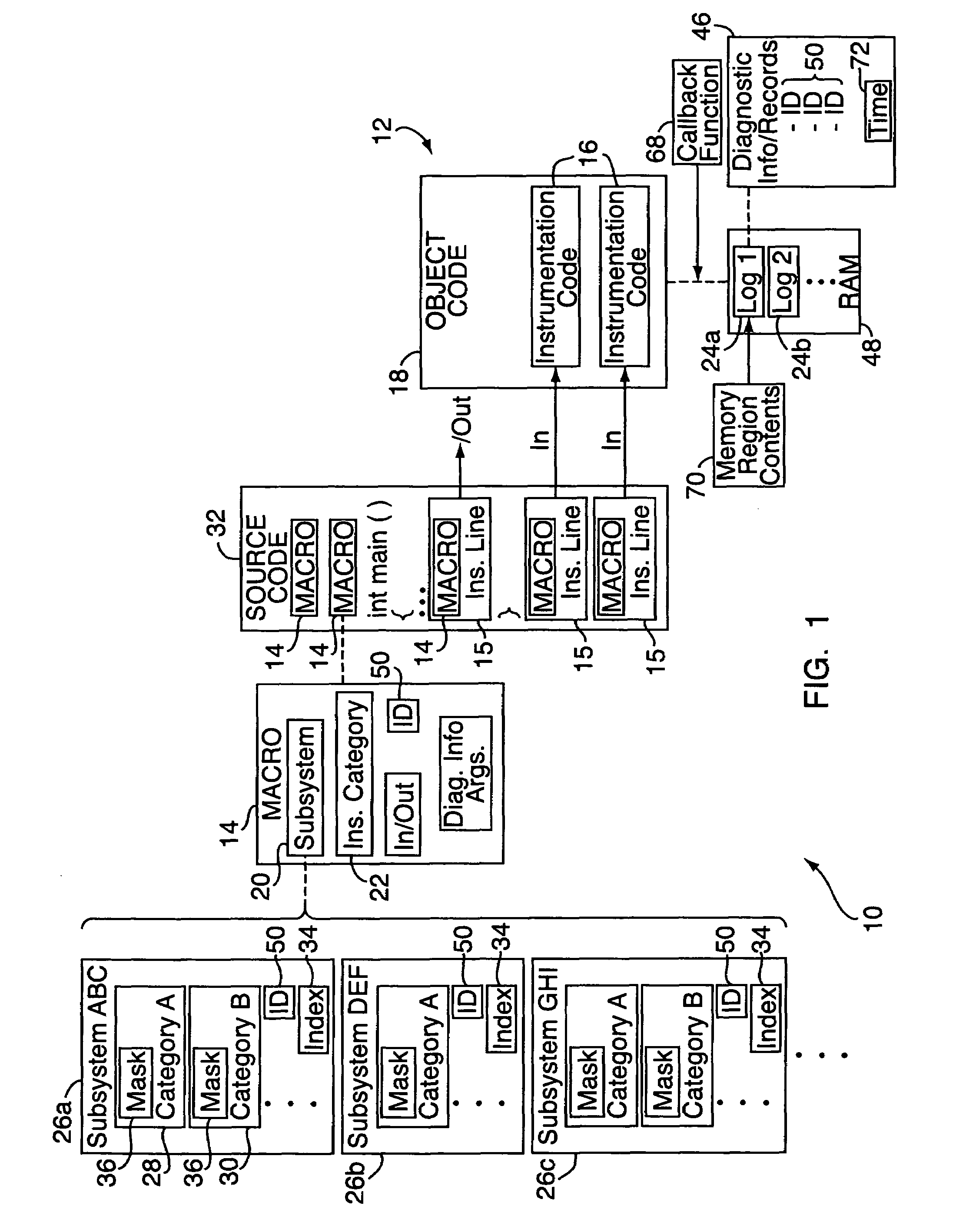
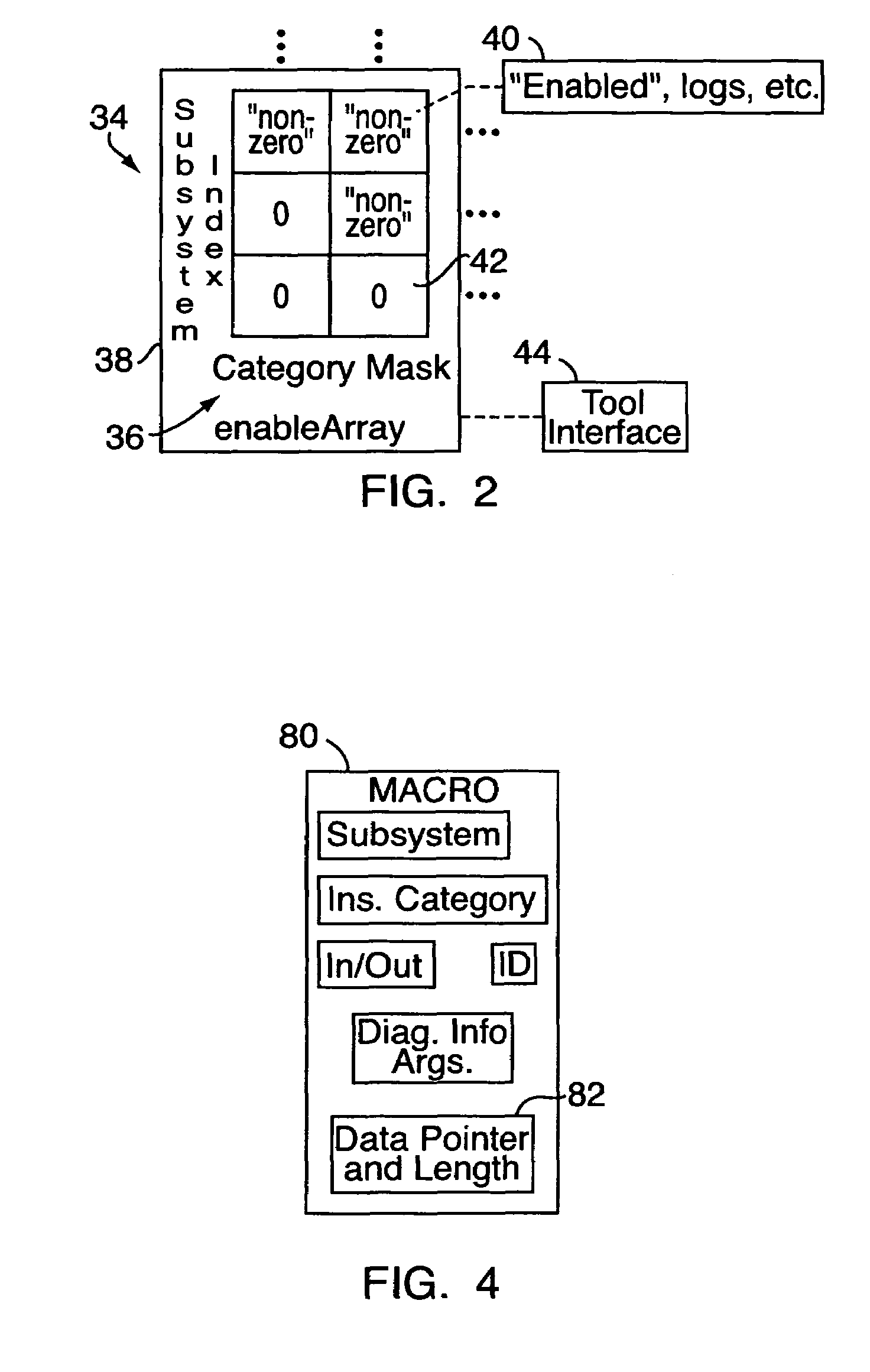
[0011]A diagnostics tool for tracing the real-time operation of software for the purposes of testing, debugging, or performance analysis includes a number of diverse instrumentation macros. (The term “macro” as used herein encompasses macros, inline functions, variable argument macros, and the like.) Diagnostic instrumentation for generating records containing details of software operation is incorporated into the software by inserting calls to the macros. Each macro takes one or more arguments specifying both a subsystem and a category of instrumentation within the subsystem, along with additional arguments, as described below. Based on the specified subsystem and category, the instrumentation can be included or excluded from the compiled object code and, if included, can be dynamically enabled or disabled at run-time. Disabled instrumentation does not result in a function call, but only a single, inline “if,” thereby keeping disabled instrumentation overhead to a minimum. Because of this last advantage over the prior art, it is practical to leave extensive instrumentation in the final (i.e., compiled and delivered) software product. Because of the first aforementioned advantage over the prior art, it is practical to leave a small number of specially selected instrumentation categories intended for lab-only use in the source code, while excluding them from (i.e., “compiling them out of”) the final software product. It is also practical to obtain high quality, diagnostic information in an operational system by enabling desired, selected categories at run-time.
[0012]Each macro also takes an argument specifying an ID, and diagnostic logging can be halted in an arbitrary window around a run-time specified sequence of those ID's. The ability to capture a selected window of relevant diagnostic information enables the use of smaller, faster local memory (used, e.g., in a circular fashion) to log high rates of diagnostic information leading up to the window. (Discussion of memory log operation is outside the scope of the present invention, although such is well known to those skilled in the art.) This also permits the logging rate to be independent of the bandwidth of the interface through which the diagnostic information is accessed and displayed.
[0013]Some macros accept arguments specifying both what values should be recorded, as well as a custom formatting and text with which the values should be displayed. However, the formatting is not performed while logging in real-time, but only when subsequently printing a log that has simply recorded the values and a pointer to the format specification. These two aspects of the invention enable software to be more easily instrumented such that diagnostic information is captured and displayed in the most desirable format, while at the same time being efficient of processor real-time and log space. Additionally, the format specification itself, though in the source code, does not need to occupy space in the compiled object code. Further, at run-time, memory regions may be specified whose contents would be monitored and possibly recorded at the time each record is logged, thereby providing information to diagnose problems such as wild writes.
[0014]The diagnostics tool requires no special hardware support, enabling use extending from initial testing in a lab environment through to support at a customer's site. The diagnostics tool is easy to use, both in terms of instrumenting the software, and in later collecting diagnostic information from it. Additionally, the diagnostics tool is configured for use without special consideration of the software version that was instrumented. The tool could be used in existing software that has been previously instrumented with prior-art tools. In such cases, the diagnostics tool would be able to capture, with its more efficient mechanism and other benefits, the diagnostic information from the prior-art tools, without replacing or changing lines of legacy instrumentation.



 Login to View More
  Login to View More