
17-phosphorous steroid derivatives useful as progesterone receptor modulators
a technology of progesterone receptor and steroid derivative, applied in the field of 17phosphorous steroid derivatives, can solve problems such as varied side effects, and achieve the effect of elevating blood glucose levels
- Summary
- Abstract
- Description
- Claims
- Application Information
AI Technical Summary
Benefits of technology
Problems solved by technology
Method used
Image

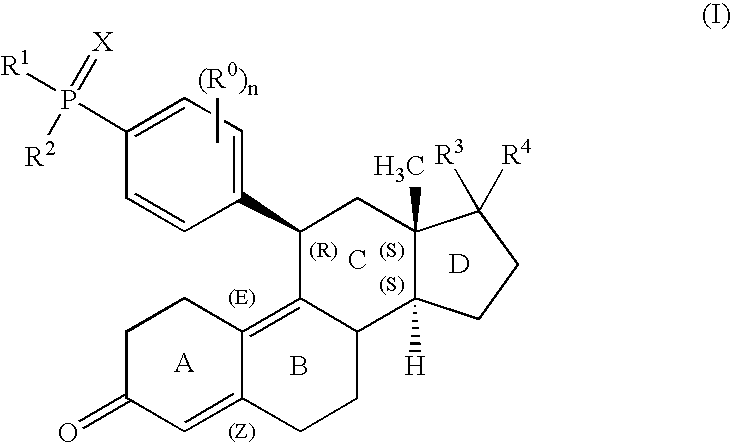
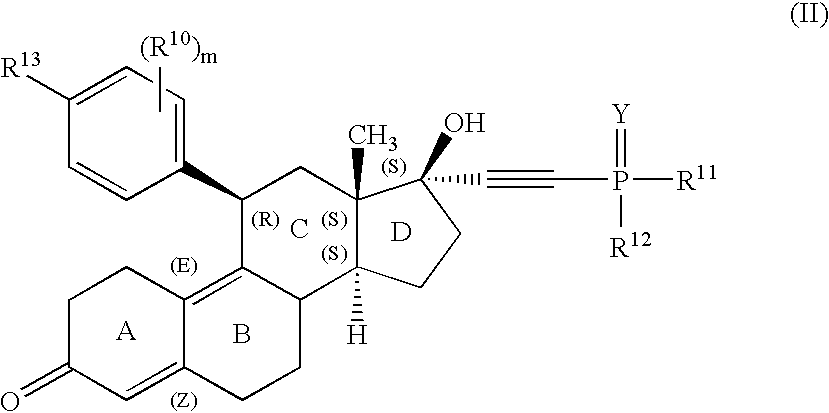
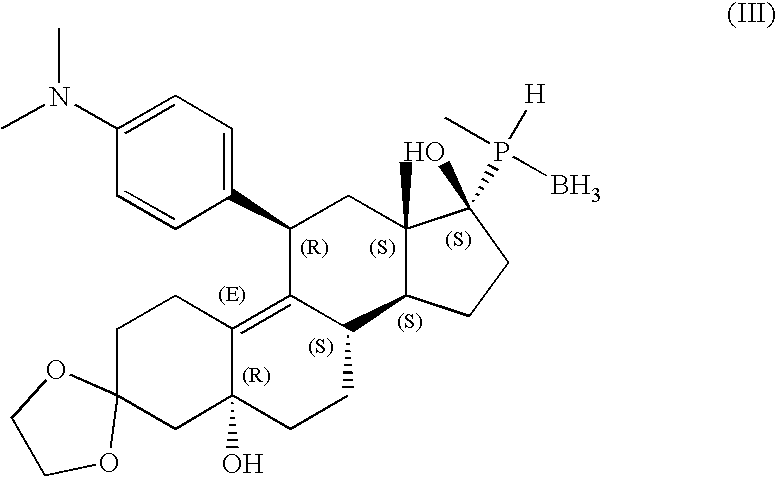
Examples
example 1
See Also Procedure as Described in JACS, 1989. Vol. 111, 4392-4398
[0176]
[0177]A freshly opened vial of CeCl3 (5.0 g, 20 mmol) was transferred into a 250 mL round bottom flask. The resulting mixture was stirred at 140° C. for 4 hrs under high vacuum. An inert atmosphere was introduced into the flask while flask was still hot. The flask was then cooled down on an ice bath. THF (30 mL) was then added all at once with vigorous stirring. The ice bath was removed and the resulting suspension was stirred at ambient temperature for 16 hrs. Ethylene deltanone (3.14 g, 10 mmol) in THF (15 mL) was then added to the above suspension. The resulting mixture was stirred at room temperature for 1 hr and then cooled to 0° C. Isopropenyl magnesium bromide (15 mmol, 30 mL, 0.5 M in THF) was added with vigorous stirring. After 30 min, the reaction mixture was treated with sat. aqueous NH4Cl (60 mL). The product was extracted into EtOAc (3×50 mL). The combined extracts were washed with brine and aqueous...
example 2
[0180]
[0181]A solution of ethylene deltanone (6.28 g, 20.0 mmol) in THF (200 mL) was prepared. To this solution was added allylmagnesium bromide (1.0 M in ethyl ether, 44 mL, 44 mmol). The resulting solution turned from yellow to brown upon addition of allyl magnesium bromide, then back to yellow. The reaction mixture was stirred overnight under nitrogen at room temperature. Saturated ammonium chloride was then added, the reaction was mixture stirred, then ethyl acetate was added and the reaction mixture stirred. The layers were separated and the aqueous layer was extracted with ethyl acetate. The organic layers were dried over magnesium sulfate, filtered and evaporated to yield a residue. The residue was purified by column chromatography eluting with 0 to 10% ether / dichloromethane to yield the title compound as a residue.
[0182]1H NMR (400 MHz, CDCl3) δ 6.00 (m, 1H), 5.61 (s, 1H), 5.21-5.13 (m, 2H), 3.99 (s, 4H), 2.55-2.48 (s, 1H), 2.33-1.55 (m, 17H), 1.50-1.32 (m, 2H), 1.26-1.16 (m...
example 3
[0184]
[0185]The title compound was prepared according to the procedure described in Example 2 above, starting from ethylene deltanone (5 g, 15.0 mmol). After silica gel column chromatograph (10% EtOAc / Hexane), the title compound product was obtained as an off-white solid.
[0186]1H NMR (CDCl3) δ 6.02 (m, 1H), 5.60 (s, 1H), 5.12 (d, 1H, J=5.6 Hz), 3.08 (s, 4H), 3.46 (s, 1H), 2.57-1.15 (m, 19H), 1.08 (d, 3H, J=7.0 Hz), 0.93 (s, 3H)
[0187]MS: MH+ (371), MNa+ (393)
PUM
| Property | Measurement | Unit |
|---|---|---|
| enantiomeric excess | aaaaa | aaaaa |
| enantiomeric excess | aaaaa | aaaaa |
| enantiomeric excess | aaaaa | aaaaa |
Abstract
Description
Claims
Application Information
 Login to View More