
Adaptive USB mass storage devices that reduce power consumption
a technology of mass storage and adaptive usb, applied in the field of computer systems, can solve problems such as the size and weight of such devices
- Summary
- Abstract
- Description
- Claims
- Application Information
AI Technical Summary
Problems solved by technology
Method used
Image

Examples
first embodiment
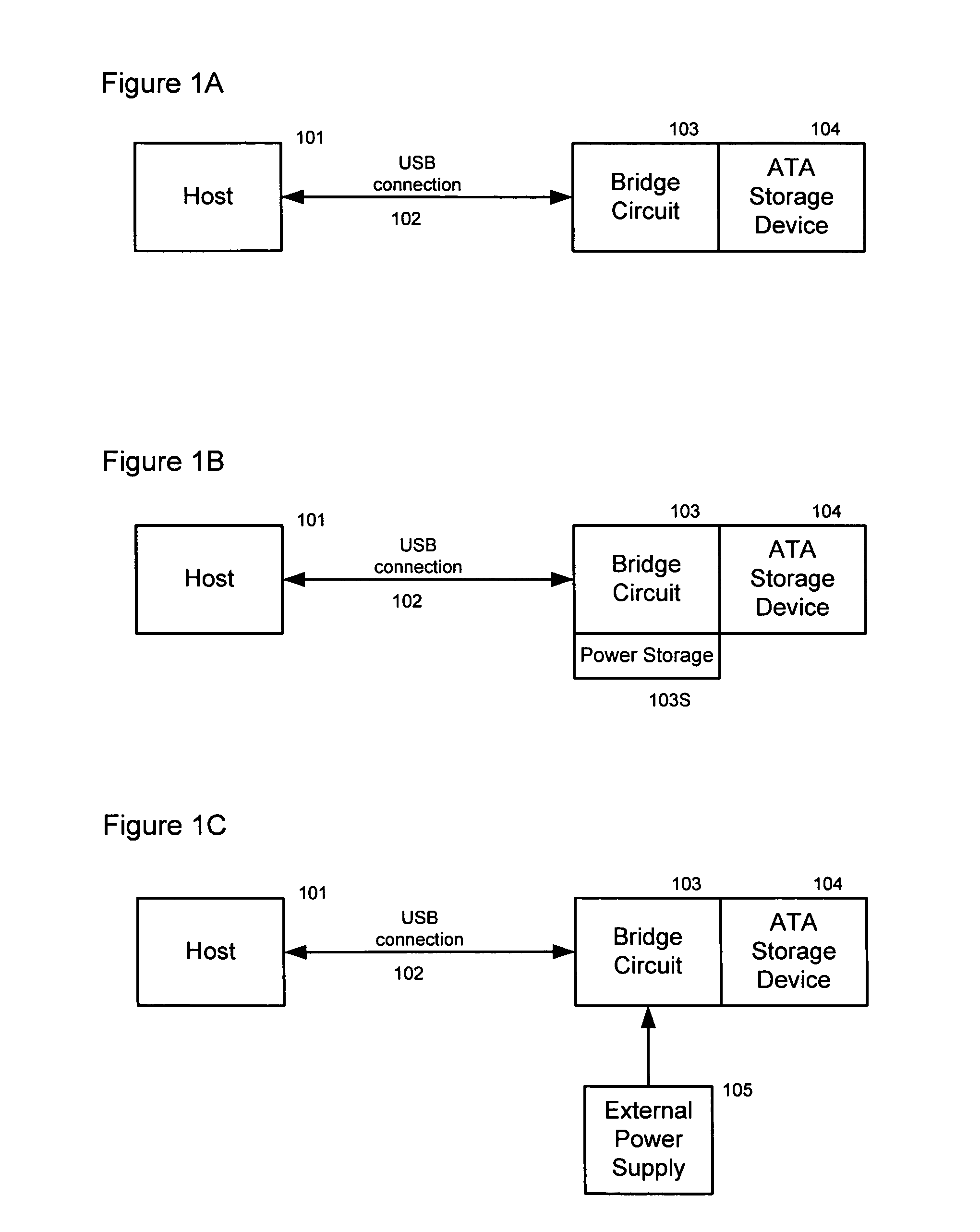
[0025]In the first embodiment shown in FIG. 1A, all of the power comes from the host via the USB connection. Thus, commands can only be executed if the power requires is less than (or equal to) the amount of power available from the USB port to which the device is connected. If the bridge is connected to a 100 ma USB port, only commands that require 100 ma or less or power can be executed. If the bridge is connected to a 500 ma USB port, only commands that require 500 ma or less or power can be executed.
second embodiment
[0026]In the second embodiment shown in FIG. 1B, the bridge circuit 103 includes a power storage device 103S. The power storage device 103S can be a capacitor array or some other type of re-chartable power storage device. In this embodiment, a command can be executed if the power available from the host, plus the power available for the storage device is sufficient for the particular command. Since the storage device 103S is a chargeable storage, in some cases, delaying a command may give the storage device time the re-charge so that the command can be executed.
third embodiment
[0027]In the third embodiment shown in FIG. 3C, there is an external power supply. In some cases, this external power supply might be large enough that all commands received by the bridge can be executed. In other cases the external supply might be a small supply so that only certain commands can be executed not withstanding the existence of the external supply.
[0028]It should also be understood that the three embodiments shown in FIGS. 1A, 1B and 1C are not mutually exclusive. For example a bridge might be capable of having an external power connection but it may also be able to work without such a connection. In such a situation, when there is no external supply, the system would operate as shown in FIG. 1A and when there is an external supply the system would operate as shown in FIG. 1C.
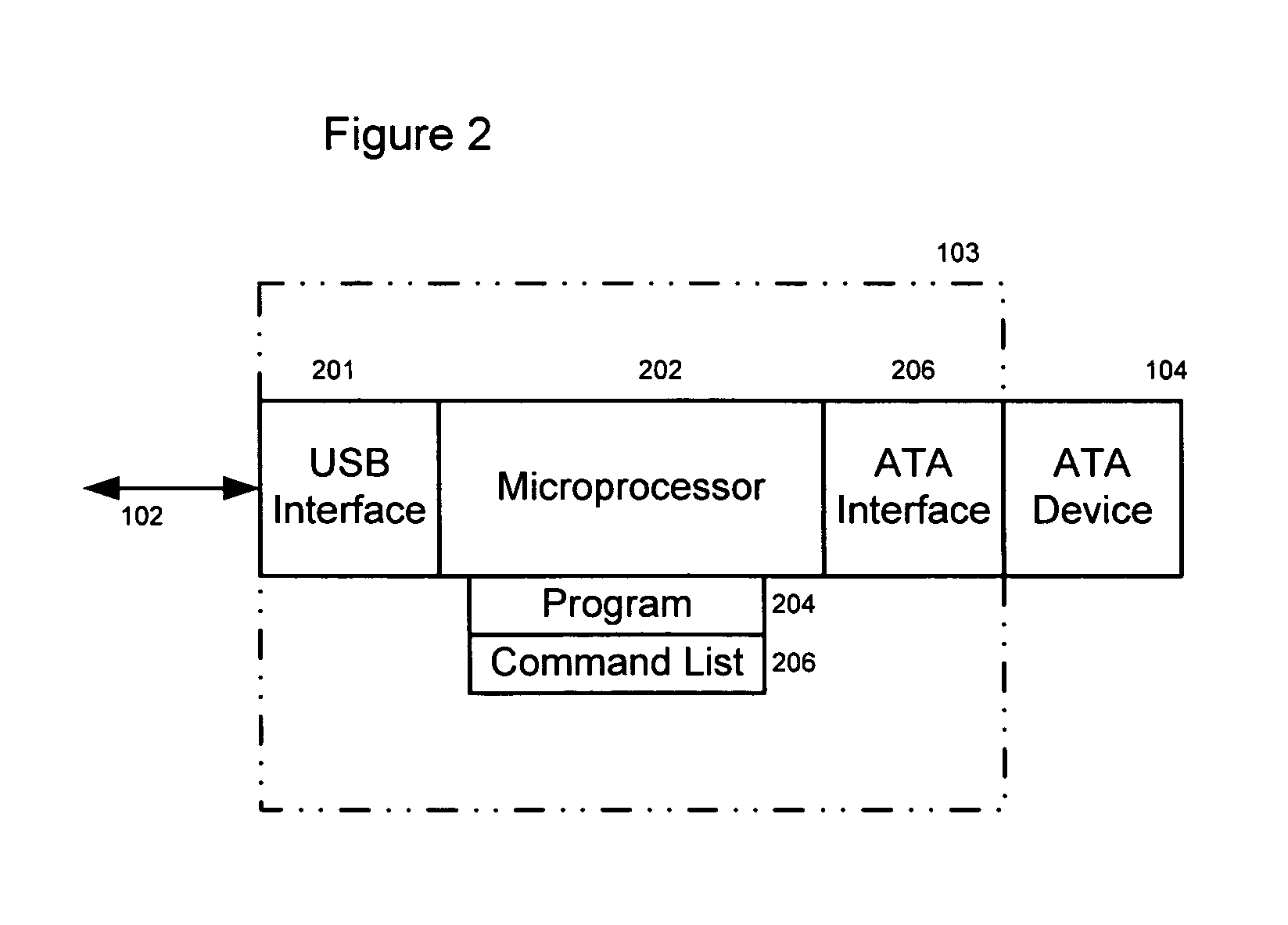
[0029]The internal details of the bridge circuit 103 are shown in FIG. 2. Similar to commercially available bridge circuits, the bridge circuit 103 includes a USB interface 201, a microprocessor 2...
PUM
 Login to View More
 Abstract
Description
Claims
Application Information
 Login to View More