Supercharge Your Innovation With Domain-Expert AI Agents!

Memory cell with memory element contacting an inverted T-shaped bottom electrode

a memory cell and bottom electrode technology, applied in the direction of digital storage, semiconductor/solid-state device details, instruments, etc., can solve the problems of low efficiency, low efficiency, and inability to meet the requirements of large-scale, and achieve the effect of reducing the amount of current needed, reducing the magnitude of current, and improving adhesion

Active Publication Date: 2011-02-01
MACRONIX INT CO LTD
View PDF247 Cites 5 Cited by
  • Summary
  • Abstract
  • Description
  • Claims
  • Application Information

AI Technical Summary

Benefits of technology

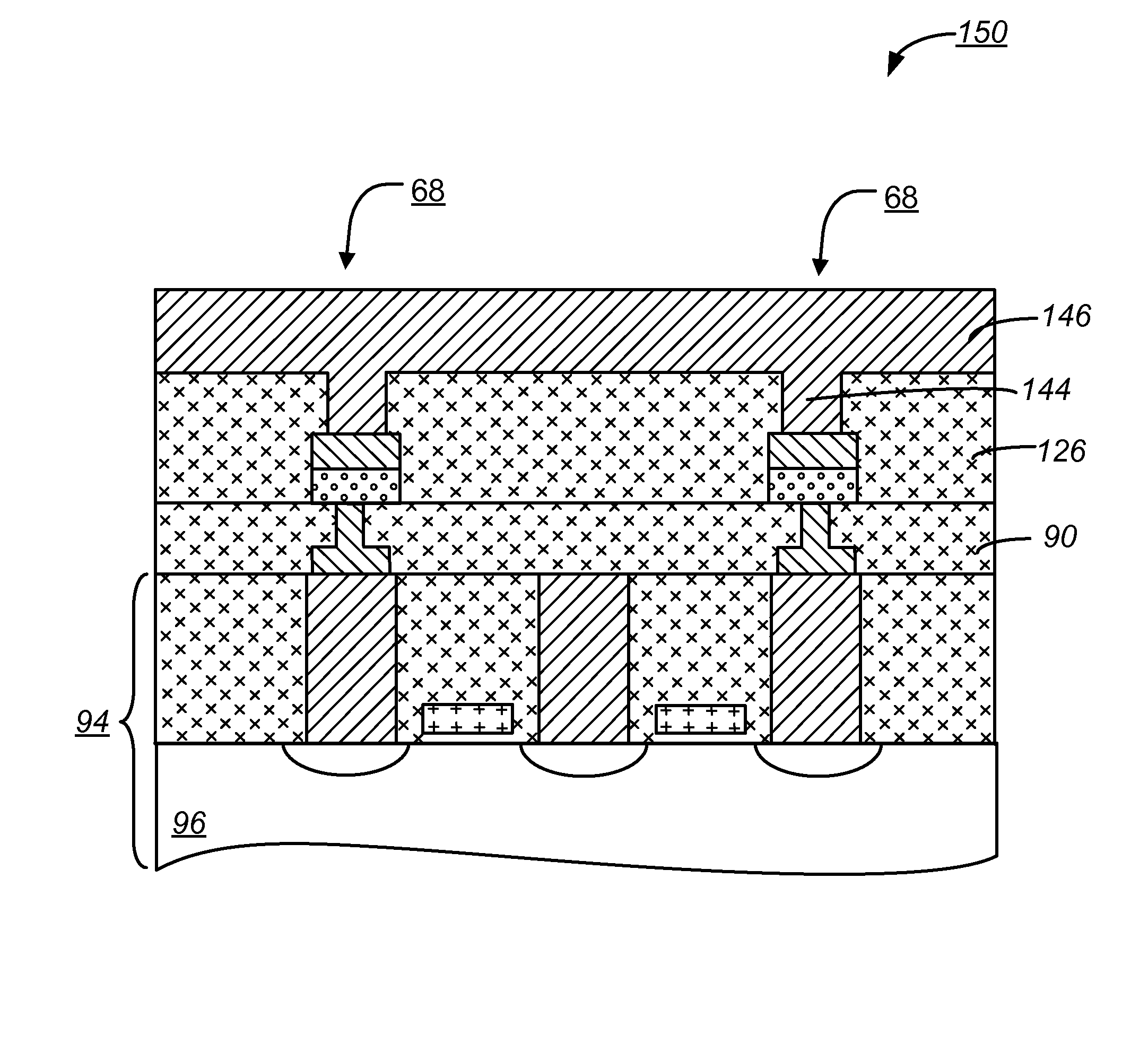
A memory cell as described herein results in an active region within the memory element that can be made extremely small, thereby reducing the amount of current needed for reset. The extremely small active region is a result of the width of the pillar portion of the bottom electrode being less than the width of the memory element and preferably less than a minimum feature size for a process, typically a lithographic process, used to form the memory cell. The small pillar portion of the bottom electrode concentrates current density in the portion of the memory element adjacent the bottom electrode, thereby reducing the magnitude of the current needed to induce a phase change in the active region. The thickness of the memory element can be established using thin film deposition techniques and thus can be made very thin. Furthermore, dielectric material on the outside surface of the pillar portion can provide some thermal isolation to the active region.
The larger width of the base portion of the bottom electrode provides better adhesion of the bottom electrode and reduces the risk of the bottom electrode falling over during manufacturing than would be achieved if the base portion were the same width as the pillar portion. This improved mechanical stability of the bottom electrode improves the yield of the device during manufacturing.

Problems solved by technology

One problem associated with phase change memory devices arises because the magnitude of the current required for reset operations depends on the volume of phase change material that must change phase.
Thus, cells made using standard integrated circuit manufacturing processes have been limited by the minimum feature size of manufacturing equipment.
Thus, techniques to provide sublithographic dimensions for the memory cells must be developed, which can lack uniformity or reliability needed for large scale, high density memory devices.
One problem associated with manufacturing devices having very small electrodes arises because of poor adhesion of the very small electrodes, which can cause the bottom electrode to fall over during manufacturing.

Method used

the structure of the environmentally friendly knitted fabric provided by the present invention; figure 2 Flow chart of the yarn wrapping machine for environmentally friendly knitted fabrics and storage devices; image 3 Is the parameter map of the yarn covering machine
View more

Image

Smart Image Click on the blue labels to locate them in the text.
Viewing Examples
Smart Image
  • Memory cell with memory element contacting an inverted T-shaped bottom electrode
  • Memory cell with memory element contacting an inverted T-shaped bottom electrode
  • Memory cell with memory element contacting an inverted T-shaped bottom electrode

Examples

Experimental program
Comparison scheme
Effect test

Embodiment Construction

The following description of the invention will typically be with reference to specific structural embodiments and methods. It is to be understood that there is no intention to limit the invention to the specifically disclosed embodiments and methods but that the invention may be practiced using other features, elements, methods and embodiments. Preferred embodiments are described to illustrate the present invention, not to limit its scope, which is defined by the claims. Those of ordinary skill in the art will recognize a variety of equivalent variations on the description that follows. Like elements in various embodiments are commonly referred to with like reference numerals.

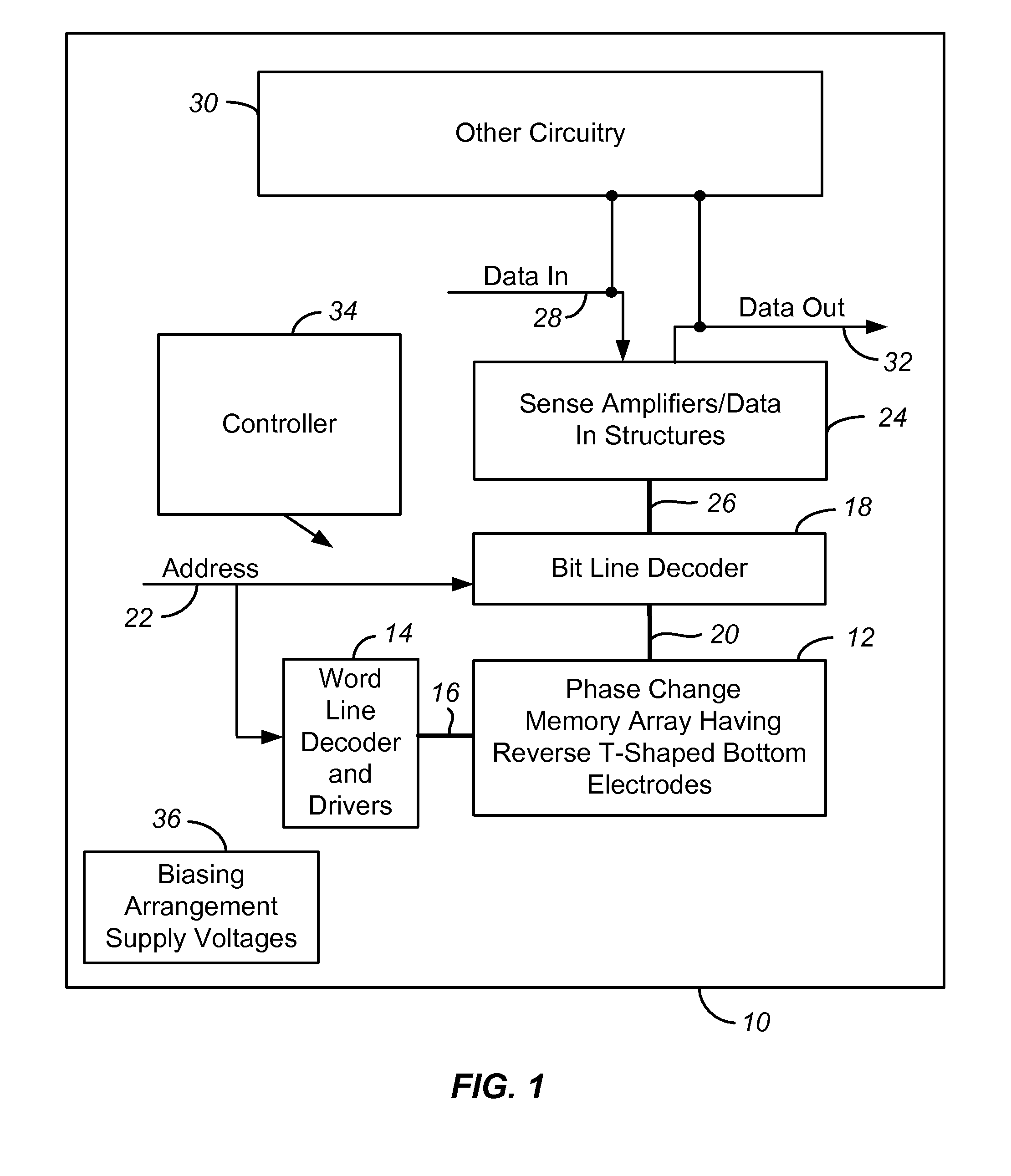
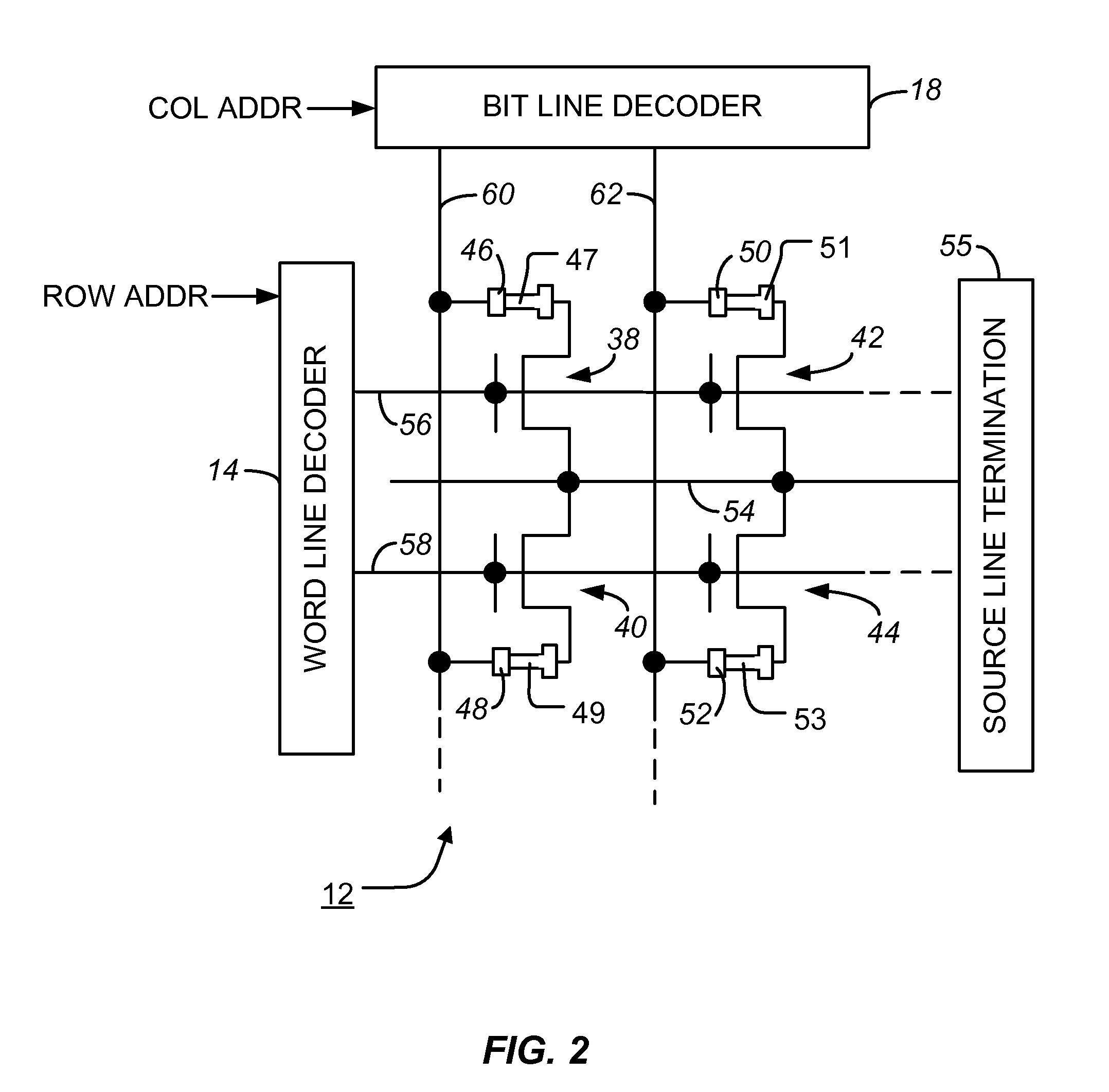
FIG. 1 is a simplified block diagram of an integrated circuit 10 including a memory array 12 implemented using memory cells as described herein having inverted T-shaped bottom electrodes. A word line decoder 14 is coupled to and in electrical communication with a plurality of word lines 16. A bit line (column)...

the structure of the environmentally friendly knitted fabric provided by the present invention; figure 2 Flow chart of the yarn wrapping machine for environmentally friendly knitted fabrics and storage devices; image 3 Is the parameter map of the yarn covering machine
Login to View More

PUM

No PUM Login to View More

Abstract

Memory cells are described along with methods for manufacturing. A memory cell described herein includes a bottom electrode comprising a base portion and a pillar portion on the base portion, the pillar portion having a top surface and a width less than that of the base portion. A memory element is on the top surface of the pillar portion and comprises memory material having at least two solid phases. A top electrode is on the memory element.

Description

PARTIES TO A JOINT RESEARCH AGREEMENTInternational Business Machines Corporation, a New York corporation; Macronix International Corporation, Ltd., a Taiwan corporation, and Infineon Technologies A.G., a German corporation, are parties to a Joint Research Agreement.BACKGROUND OF THE INVENTION1. Field of the InventionThe present invention relates to high density memory devices based on memory materials, for example phase change memory (PCM) devices, and to methods for manufacturing such devices. The memory material is switchable between electrical property states by the application of energy. The memory materials may be phase change based memory materials, including chalcogenide based materials, and other materials.2. Description of Related ArtPhase change based memory materials are widely used in read-write optical disks. These materials have at least two solid phases, including for example a generally amorphous solid phase and a generally crystalline solid phase. Laser pulses are u...

Claims

the structure of the environmentally friendly knitted fabric provided by the present invention; figure 2 Flow chart of the yarn wrapping machine for environmentally friendly knitted fabrics and storage devices; image 3 Is the parameter map of the yarn covering machine
Login to View More

Application Information

Patent Timeline
no application Login to View More
Patent Type & Authority Patents(United States)
IPC IPC(8): H01L21/00H01L21/336
CPCH01L45/06H01L45/1233H01L27/2436H01L45/144H01L45/16H01L45/1625H01L45/1273G11C13/0004H10B63/30H10N70/8418H10N70/231H10N70/026H10N70/011H10N70/8828H10N70/826
Inventor LUNG, HSIANG-LAN
Owner MACRONIX INT CO LTD
Features
  • R&D
  • Intellectual Property
  • Life Sciences
  • Materials
  • Tech Scout
Why Patsnap Eureka
  • Unparalleled Data Quality
  • Higher Quality Content
  • 60% Fewer Hallucinations
Social media
Patsnap Eureka Blog
Learn More