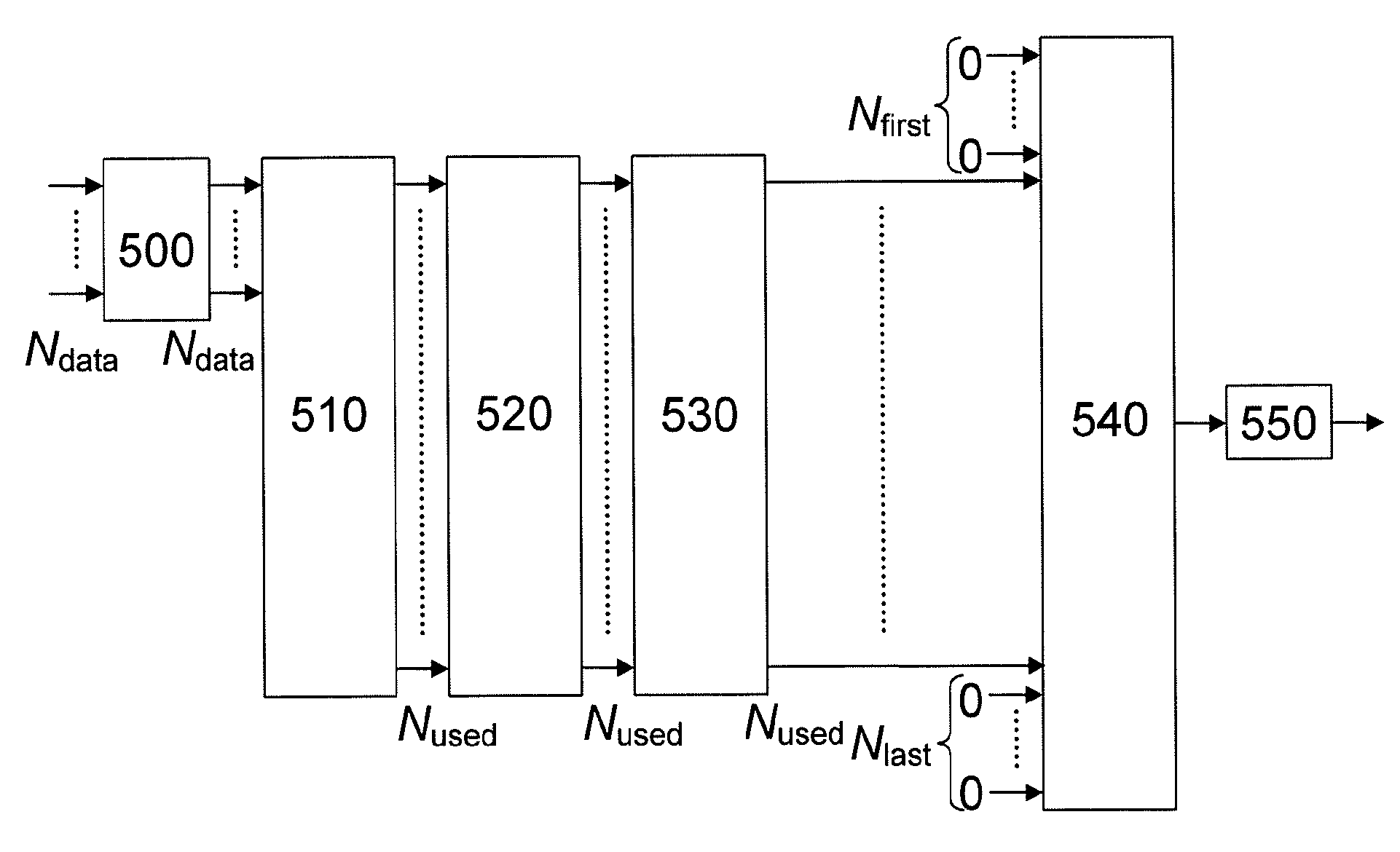
DFT spread OFTM

a technology of dft spread and spread, applied in the field of dft spread oftm, can solve the problems of limiting the achievable bit rate of that user, affecting the quality of uplink resources,

US7983145B2Active Publication Date: 2011-07-19TELEFON AB LM ERICSSON (PUBL)
9 Cites 8 Cited by

Patent Information

Authority / Receiving Office
US · United States
Patent Type
Patents(United States)
Current Assignee / Owner
Publication Date
2011-07-19

Smart Images

  • Figure 1
    Figure 1
  • Figure 2
    Figure 2
  • Figure 3
    Figure 3
Patent Text Reader

Abstract

The invention applies Discrete Fourier Transform (DFT)-spread-OFDM (Orthogonal Frequency Division Multiple Access), which is proposed for the Third Generation Partnership Program Long Term Evolution (3GPP LTE) uplink. The core of the invention is that we use a cyclic frequency shift operation over part of the bandwidth spanned by the Inverse Fast Fourier Transform (IFFT). Furthermore, the cyclic frequency shift enables efficient inter-cell interference coordination in case neighboring cells hop with the same pattern and different initial offsets. An equivalent operation may be performed in the time domain.
Need to check novelty before this filing date? Find Prior Art

Description

TECHNICAL FIELD

[0001] The present application is related to a modification of a transmission scheme proposed for 3G LTE (Long Term Evolution) known as DFT-S-OFDMA (Discrete Fourier Transform Spread Orthogonal Frequency Division Multiple Access).BACKGROUND OF THE INVENTION

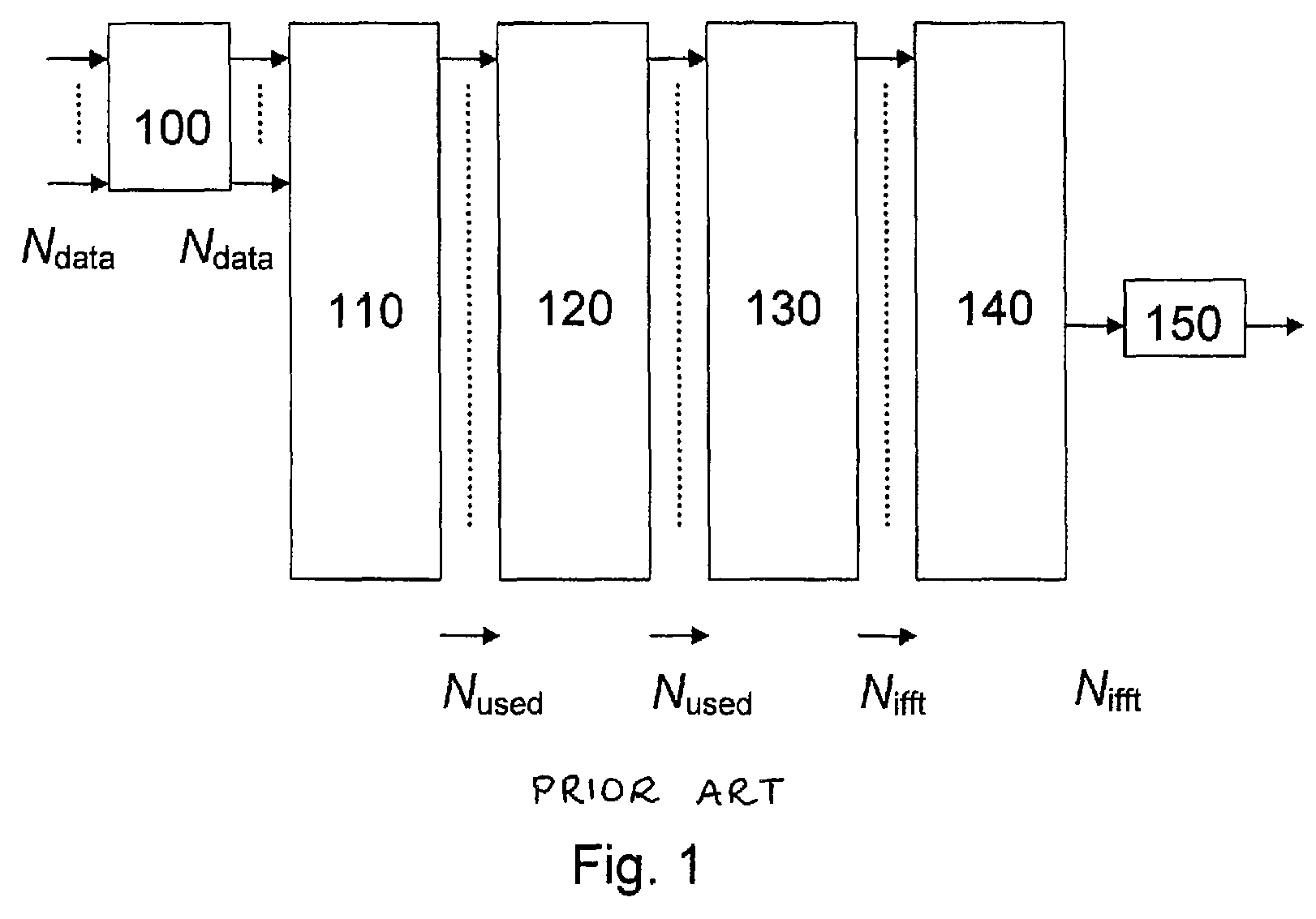
[0002] In the standardization of 3GPP (Third Generation Partnership Project) LTE (Long Term Evolution) an orthogonal single carrier transmission scheme with frequency multiplexing of users is selected for the uplink. The uplink transmission scheme proposed for LTE is known as DFT-S-OFDMA and the basic principle is depicted in FIG. 1.

[0003] At step 100, a size N DFT (Discrete Fourier Transform) is first applied to a block of N modulation symbols Ndata. This transforms the modulation symbols to the frequency domain. Next, at steps 110-120, spectrum shaping of the thus transformed symbols Ndata is applied in the frequency domain. The first step at 110 involves the bandwidth expansion of the DFT-transformed modulation symb...

Examples

Embodiment Construction

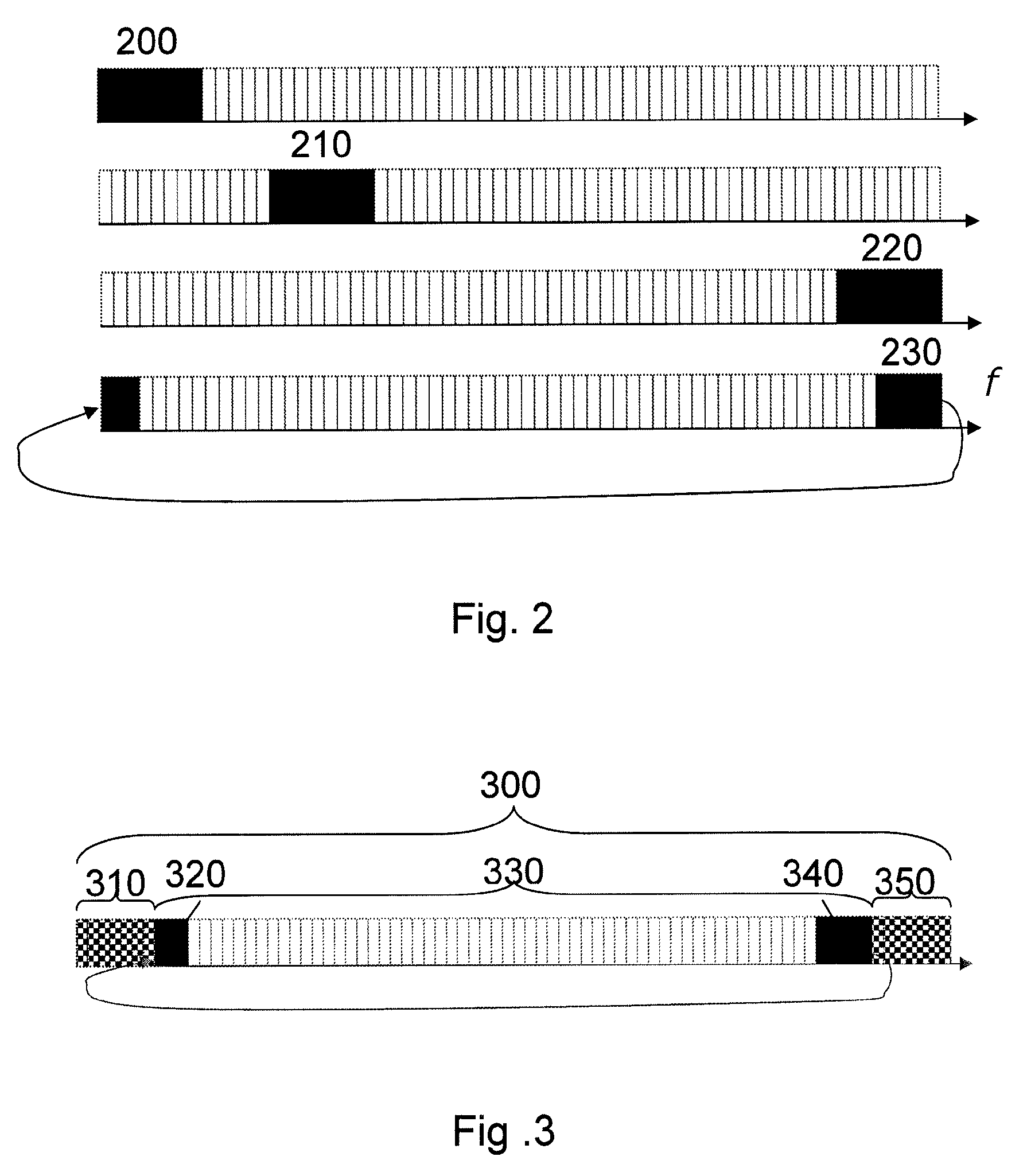
[0054]FIG. 2 illustrates the cyclic wraparound of a DFT spread OFDMA signal according to one embodiment of the present invention.

[0055]The block consisting of filled and empty vertical bars represents the available bandwidth expressed as the available frequency spectrum, whereas the filled and empty vertical bars represent allocated and unallocated sub-carrier frequencies, respectively.

[0056]A user depicted may for example be allocated sub-carrier frequencies at the beginning of the frequency spectrum shown by the filled vertical bars 200 in the uppermost block.

[0057]Also, the Ndata sub-carrier frequencies allocated to the user may be shifted upwards in the available frequency spectrum as shown by the filled vertical bars 210 and 220 in the second and third blocks. By shifting the sub-carriers assigned to different users by different amounts we can obtain orthogonality between users in the same cell that are transmitting simultaneously.

[0058]Finally, using the periodical and symmetr...