Unlock instant, AI-driven research and patent intelligence for your innovation.

Methods and systems for forecasting product demand during promotional events using statistical confidence filters

a technology of confidence filter and product demand, applied in the field of methods and systems for forecasting product demand during promotional events, can solve the problems of loss of sales and revenues for organizations, adversely affecting the profits of organizations, and loss of goods

Active Publication Date: 2013-01-22
TERADATA
View PDF7 Cites 4 Cited by
  • Summary
  • Abstract
  • Description
  • Claims
  • Application Information

AI Technical Summary

Benefits of technology

This approach enhances the accuracy of demand forecasts by dynamically selecting the most confident uplift coefficients, reducing errors and optimizing promotional uplift calculations, leading to better inventory management and revenue optimization.

Problems solved by technology

Inaccurate demand forecasts can result in shortages of inventory that are needed to meet current demand, which can result in lost sales and revenues for the organizations.
Conversely, inventory that exceeds a current demand can adversely impact the profits of an organization.
Excessive inventory of perishable goods may lead to a loss for those goods.
However, this method of computing promotional uplift coefficients does not account for the dispersion of the historical data, or the difference in the number of data points in a product class level.

Method used

the structure of the environmentally friendly knitted fabric provided by the present invention; figure 2 Flow chart of the yarn wrapping machine for environmentally friendly knitted fabrics and storage devices; image 3 Is the parameter map of the yarn covering machine
View more

Image

Smart Image Click on the blue labels to locate them in the text.
Viewing Examples
Smart Image
  • Methods and systems for forecasting product demand during promotional events using statistical confidence filters
  • Methods and systems for forecasting product demand during promotional events using statistical confidence filters
  • Methods and systems for forecasting product demand during promotional events using statistical confidence filters

Examples

Experimental program
Comparison scheme
Effect test

Embodiment Construction

[0024]In the following description, reference is made to the accompanying drawings that form a part hereof, and in which is shown by way of illustration specific embodiments in which the invention may be practiced. These embodiments are described in sufficient detail to enable one of ordinary skill in the art to practice the invention, and it is to be understood that other embodiments may be utilized and that structural, logical, optical, and electrical changes may be made without departing from the scope of the present invention. The following description is, therefore, not to be taken in a limited sense, and the scope of the present invention is defined by the appended claims.

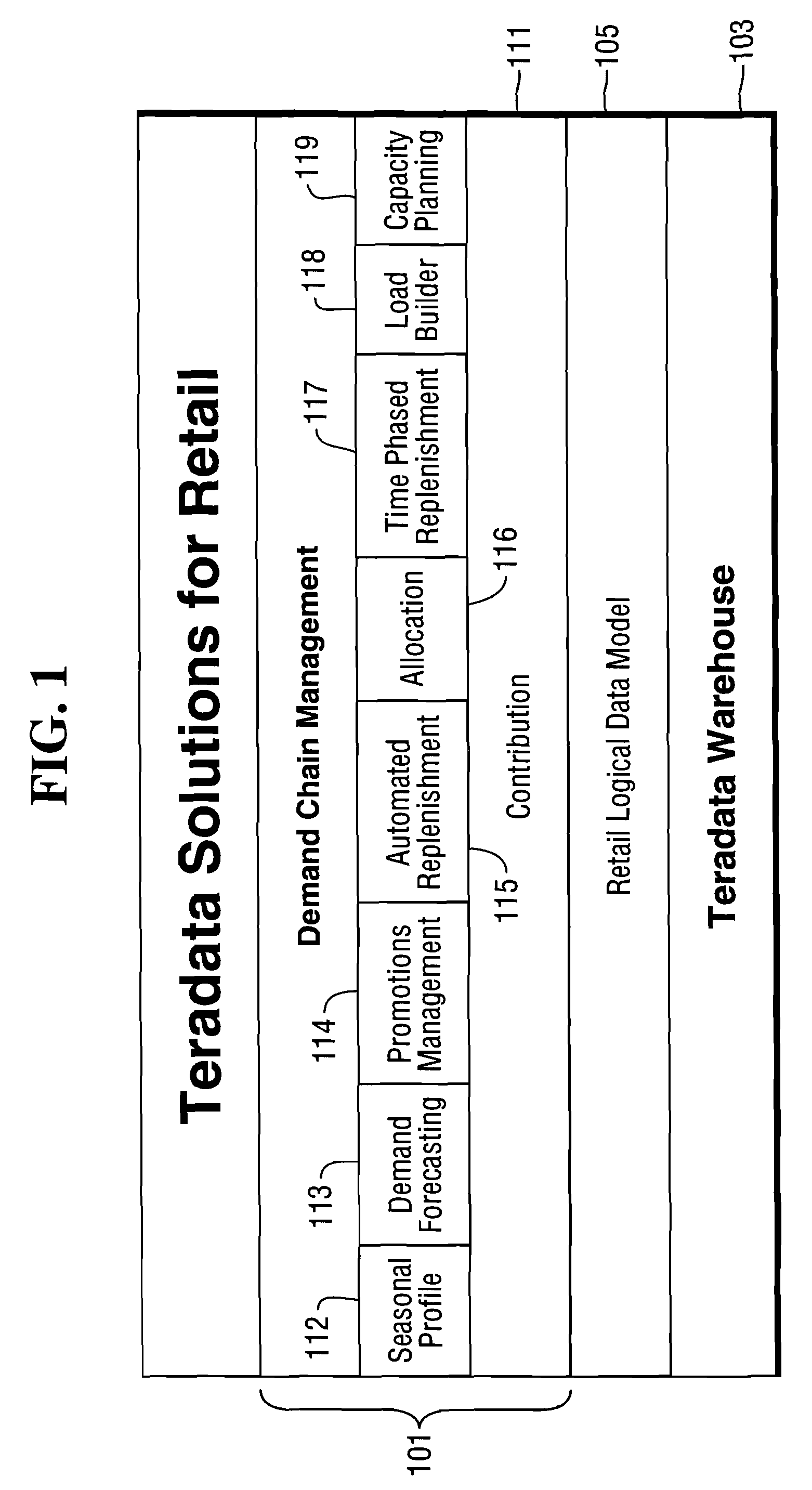
[0025]In various embodiments of the present invention, product data is housed in a data store. In one embodiment, the data store is a data warehouse, such as a Teradata data warehouse, distributed by NCR Corporation of Dayton, Ohio. Various data store applications interface to the data store for acquiring and...

the structure of the environmentally friendly knitted fabric provided by the present invention; figure 2 Flow chart of the yarn wrapping machine for environmentally friendly knitted fabrics and storage devices; image 3 Is the parameter map of the yarn covering machine
Login to View More

PUM

No PUM Login to View More

Abstract

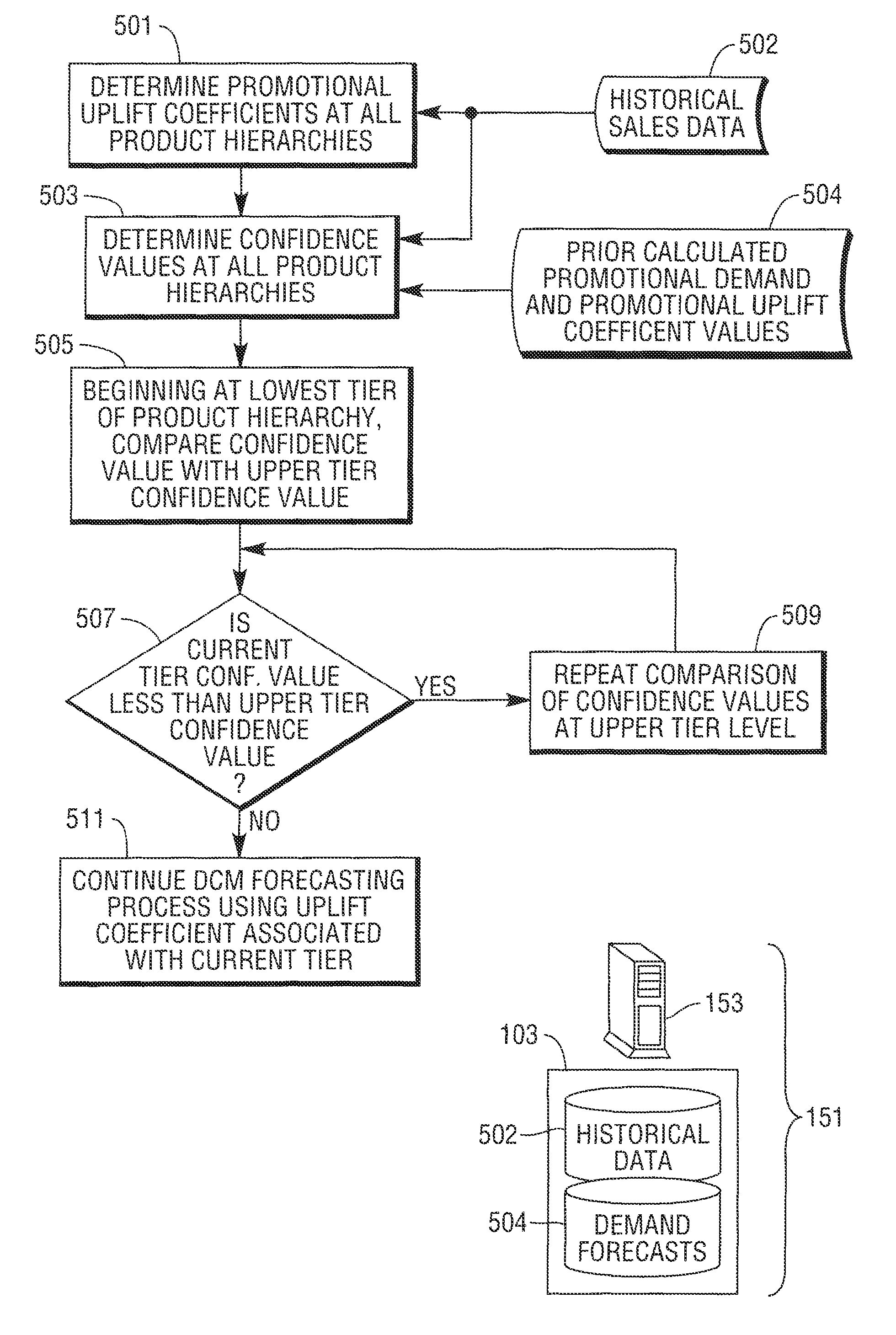
An improved method for forecasting and modeling product demand for a product during promotional periods. The forecasting methodology employs information about prior promotional demand forecasts, prior product sales, and the data dispersion and the number of data samples in a product class hierarchy to dynamically determine the optimal level at which to compute promotional uplift coefficients. The methodology calculates confidence values for promotional uplift coefficients for products at each level in a merchandise product hierarchy, and uses the confidence values as a filter to determine the optimal level for promotional uplift aggregation.

Description

CROSS REFERENCE TO RELATED APPLICATIONS[0001]This application claims priority under 35 U.S.C. §119(e) to the following co-pending and commonly-assigned patent application, which is incorporated herein by reference:[0002]application Ser. No. 11 / 614,258, entitled “METHODS AND SYSTEMS FOR DETERMINING RELIABILITY OF PRODUCT DEMAND FORECASTS,” filed on Dec. 21, 2006, by Edward Kim, Jean-Philippe Vorsanger, Jin Gao and Mahzar Khan.FIELD OF THE INVENTION[0003]The present invention relates to methods and systems for forecasting product demand for retail operations, and in particular to the forecasting of product demand during promotional events.BACKGROUND OF THE INVENTION[0004]Accurately determining demand forecasts for products are paramount concerns for retail organizations. Demand forecasts are used for inventory control, purchase planning, work force planning, and other planning needs of organizations. Inaccurate demand forecasts can result in shortages of inventory that are needed to m...

Claims

the structure of the environmentally friendly knitted fabric provided by the present invention; figure 2 Flow chart of the yarn wrapping machine for environmentally friendly knitted fabrics and storage devices; image 3 Is the parameter map of the yarn covering machine
Login to View More

Application Information

Patent Timeline
no application Login to View More
Patent Type & Authority Patents(United States)
IPC IPC(8): G06Q40/00
CPCG06Q30/02G06Q30/0202G06Q10/04
Inventor BATENI, ARASHKIM, EDWARDLIEW, PHILIPVORSANGER, JEAN-PHILIPPE
Owner TERADATA