
Method for glycosylating and separating plant fiber material
a technology of plant fibers and glycosylated fibers, which is applied in the production of saccharides, biofuels, food science, etc., can solve the problems of increased saccharide production cost and high amount of cluster acid catalysts, and achieve excellent catalytic activity, easy separation from the produced saccharide, and energy efficiency.
- Summary
- Abstract
- Description
- Claims
- Application Information
AI Technical Summary
Benefits of technology
Problems solved by technology
Method used
Image



Examples
example 1
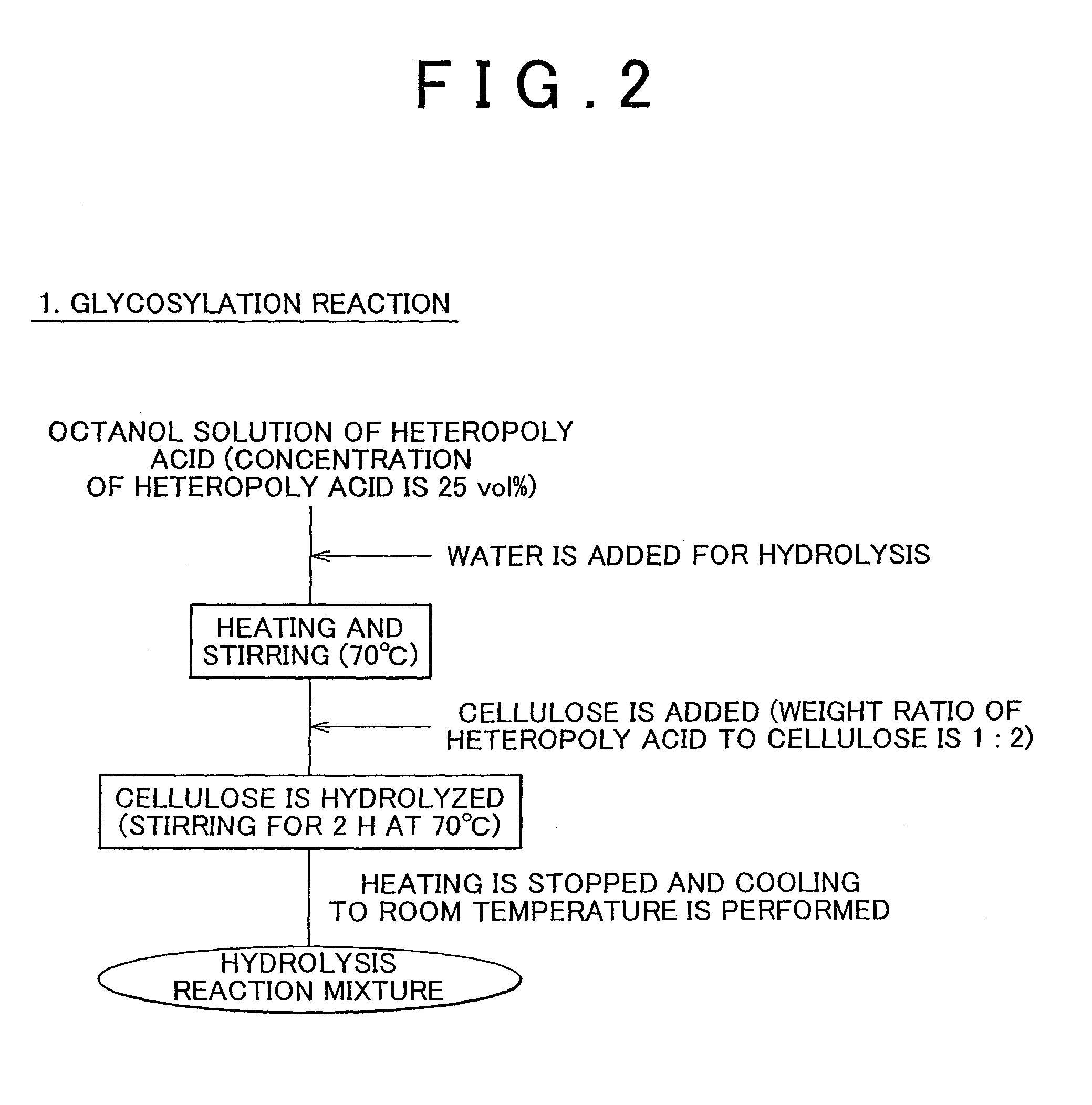
[0055]A heteropoly acid octanol solution was prepared in advance in which a heteropoly acid (phoshotungstic acid) was dissolved in octanol (concentration of heteropoly acid: 25 vol. %). Distilled water was placed in advance in a sealed container, the temperature was raised to a predetermined reaction temperature (70° C.), a saturated vapor pressure state was obtained inside the container, and water vapor was caused to adhere to the inner surface of the container. Then, the heteropoly acid octanol solution including 250 g of heteropoly acid and the amount of water (55.6 g) necessary to hydrolyze cellulose and obtain glucose were charged into the container and stirred under heating, as shown in FIG. 2. Once the temperature inside the container reached 70° C., stirring was further continued for 5 min. Then, 0.5 kg of cellulose was charged (weight ratio of heteropoly acid to cellulose was 1:2), the temperature was raised to 70° C. under stirring, and then stirring was continued for 2 h ...
example 2
[0059]A heteropoly acid octanol solution was prepared in advance in which a heteropoly acid (phosphotungstic acid) was dissolved in octanol (concentration of heteropoly acid: 25 vol. %). Distilled water was placed in advance in a sealed container, the temperature was raised to a predetermined reaction temperature (70° C.), a saturated vapor pressure state was obtained inside the container, and water vapor was caused to adhere to the inner surface of the container. Then, 0.5 kg of cellulose was charged into the container. The heteropoly acid octanol solution including 250 g of heteropoly acid (weight ratio of heteropoly acid to cellulose was 1:2), and the amount of water (55.6 g) necessary to hydrolyze cellulose and obtain glucose were charged into the container, the temperature was raised to 70° C. under stirring, and then stirring was continued for 2 h at a temperature of 70° C. The heating was then stopped, the container was opened, and the hydrolysis reaction mixture was cooled t...
PUM
| Property | Measurement | Unit |
|---|---|---|
| solubility | aaaaa | aaaaa |
| boiling point | aaaaa | aaaaa |
| solubility | aaaaa | aaaaa |
Abstract
Description
Claims
Application Information
 Login to View More