[0006]The object of the present invention is to avoid the disadvantages of the related art described above, and, in particular, to provide an agricultural working vehicle such that even an untrained operator may optimize the setting parameters of the working assemblies rapidly and reliably.
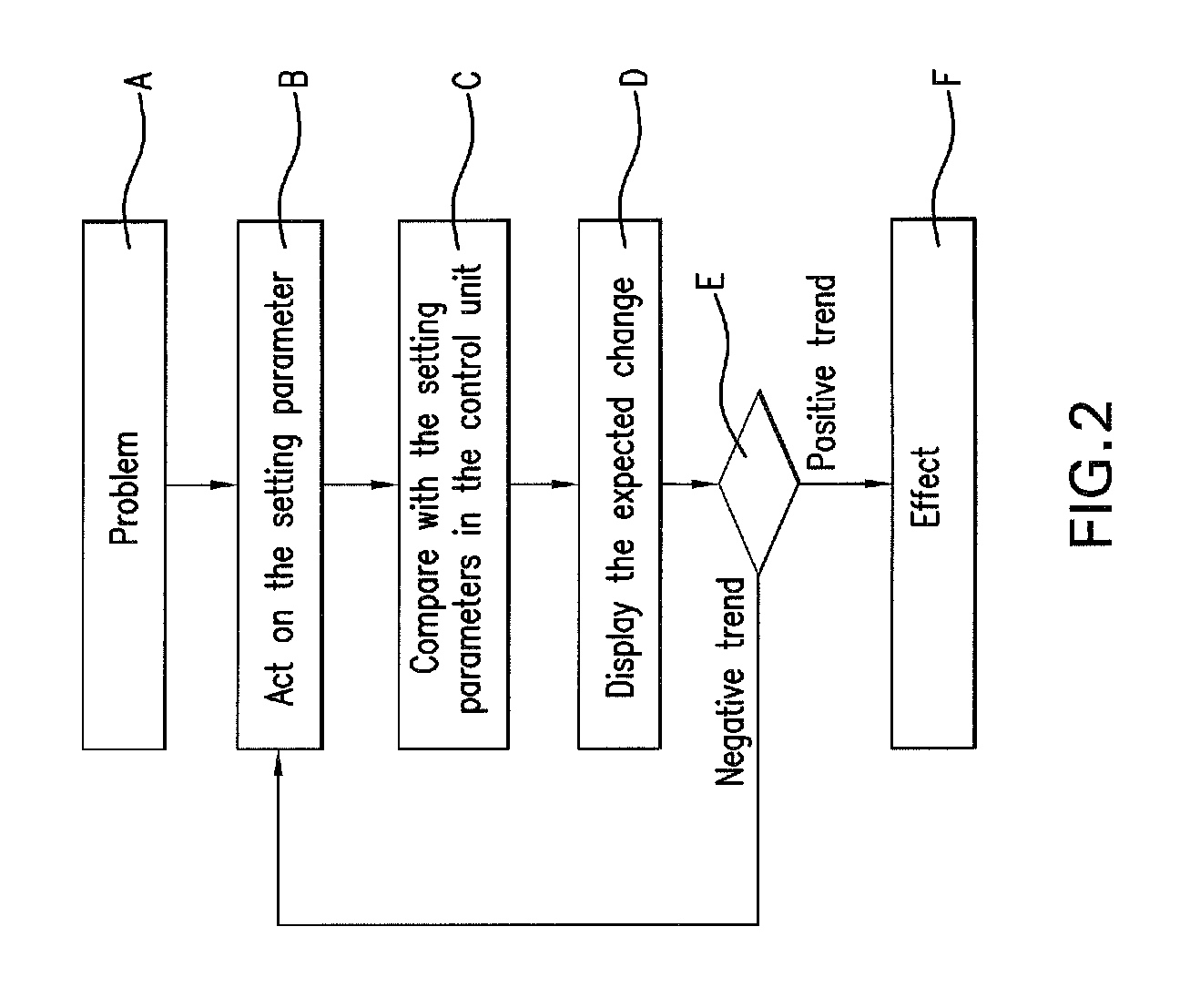
[0008]The depiction of the expected change in the function and / or the working result of individual working assemblies or a plurality of working assemblies therefore also enables an inexperienced operator to directly and rapidly assess the effects of the change he made to the setting parameters of the working assemblies without these effects having been noticeable. What is basically involved here is not changes to the function and / or the working result that are exactly definable using numbers, but rather a visualization of the trend of the expected effects of the operator's actions. This direct and immediate depiction of the expected effects then prompts the operator to immediately influence the setting parameters—when the expected effects are negative—such that he may immediately attain a positive function and / or a positive working result of individual working assemblies or a plurality of working assemblies.
[0011]In an advantageous refinement of the present invention, in order to continually increase the database, and, therefore, to improve the quality of the statement regarding the expected change to the function and / or the working result, setting parameters and / or functions and / or working results that deviate from the setting parameters stored in the memory unit along with their influence on the function and / or the working result of individual working assemblies or a plurality of working assemblies are stored in the memory unit in a recallable manner.
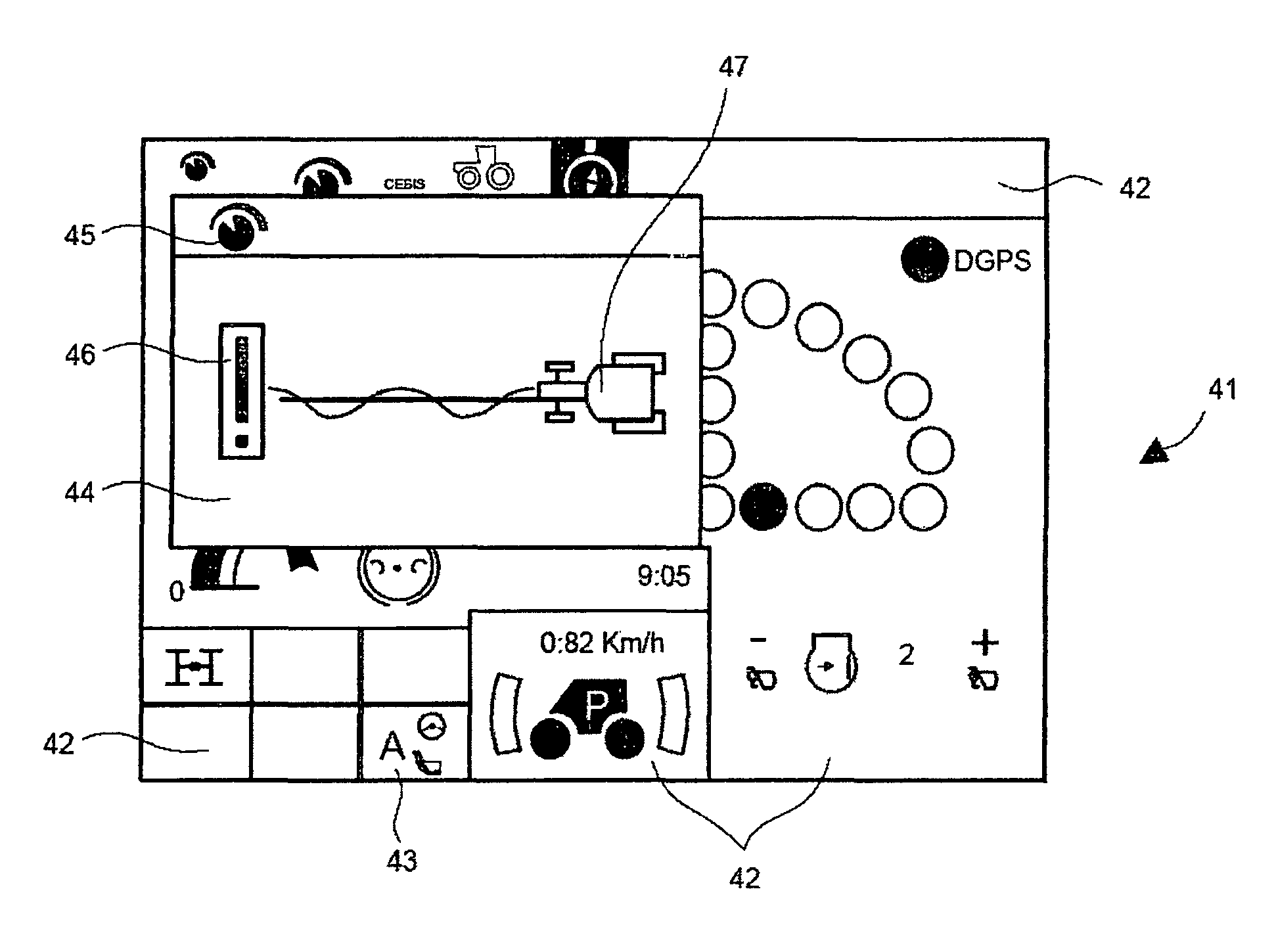
[0012]The expected changes are communicated in a visually rapid and simple manner to an untrained operator of the agricultural working vehicle in particular by depicting the expected change in the function and / or the working result of individual working assemblies or a plurality of working assemblies in the display unit in the form of various pictograms. It is particularly advantageous when the shape and / or color and / or size of the pictograms depicted in the display unit differ in a manner that depends on the expected change in the function and / or the working result of individual working assemblies or a plurality of working assemblies. Possible pictograms depend on the associated effect and include a large number of known forms, such as exclamation points, arrows, smiley faces, frowning faces, hand figures with the thumb pointing up or down, etc. It is also feasible to display the pictograms in color depending on the effect to be communicated, e.g., in red if the effects are expected to be negative, and green if the effects are expected to be positive.
[0013]In an advantageous refinement, in order to avoid overwhelming the operator with information and to be able to show him the actual effects of his influence on the setting parameters in the display unit as quickly as possible, an expected change to the function and / or the working result of individual working assemblies or a plurality of working assemblies is depicted in the display unit only for a certain period of time.
[0014]To make it even easier for an untrained operator, in particular, to identify the optimal setting parameters, an advantageous refinement of the present invention is designed such that a large number of setting parameters is stored in a recallable manner in the memory unit along with their influence on the function and / or the working result of individual working assemblies or a plurality of working assemblies, which are compared with the current setting parameters influenced by the operator, in order to depict an expected change in the function and / or working result in the display unit, and, if the change in the function and / or working result is expected to be negative, the operator is also shown setting parameters that are stored in the memory unit that would bring about a positive change in the function and / or working result. The operator is therefore shown not only the trend of the expected effects, but he is also shown an option for adjusting the setting parameters that would result in an optimal function and / or an optimal working result.


 Login to View More
  Login to View More