
Use of polyoxyalkylene nonionic surfactants with magnesium ion selective electrodes
a non-ionic surfactant and magnesium ion technology, applied in the field of ion selective electrodes, can solve the problems of significant drawbacks, shift in electromotive force bias, and difficulty in incorporating magnesium ises into clinical diagnostic instruments, and achieve the effect of reducing the shift in emf bias
- Summary
- Abstract
- Description
- Claims
- Application Information
AI Technical Summary
Benefits of technology
Problems solved by technology
Method used
Image

Examples
example 1
Experimental Setup
Reagents and Chemicals
[0029]Calibration reagents were prepared with deionized water and contained 150 mM NaCl, 1.0 mM CaCl2 and varying amounts of MgCl2 (0.1, 0.3, 0.5, 0.7, and 1.0 mM). BRIJ-700 (lot#4050-01) was added to the reagents at varying concentrations of 0.5, 0.25, 0.125, 0.05, 0.025 and 0.0125 g / L. A rinse solution of 0.05 mM MgCl2 (I=160 mM adjusted with NaCl) was used to rinse the Mg-ISE surface after each EMF measurement.
Mg-ISE Sensors
[0030]Magnesium ISE membranes were cast with 4 wt % (or 1 wt %) ionophore (ETH5506). Additional membrane components are: lipophilic borate salt (potassium tetrakis(4-chlorophenyl)borate, 150 mol % to ionophore ETH 5506), 62 wt % (or 66 wt %) plasticizer (2-nitrophenyl octyl ether) and 32 wt % PVC (plasticizer:PVC=2:1, weight) to form PVC membrane discs. The membrane thickness is about 150 μm. The discs were mounted onto Philips electrode bodies. The internal filling solution was 10 mM MgCl2 (I=160 mM adjusted with NaCl)....
example 2
Effect of Different BRIJ-700 Levels in Consistent Electrolyte Background
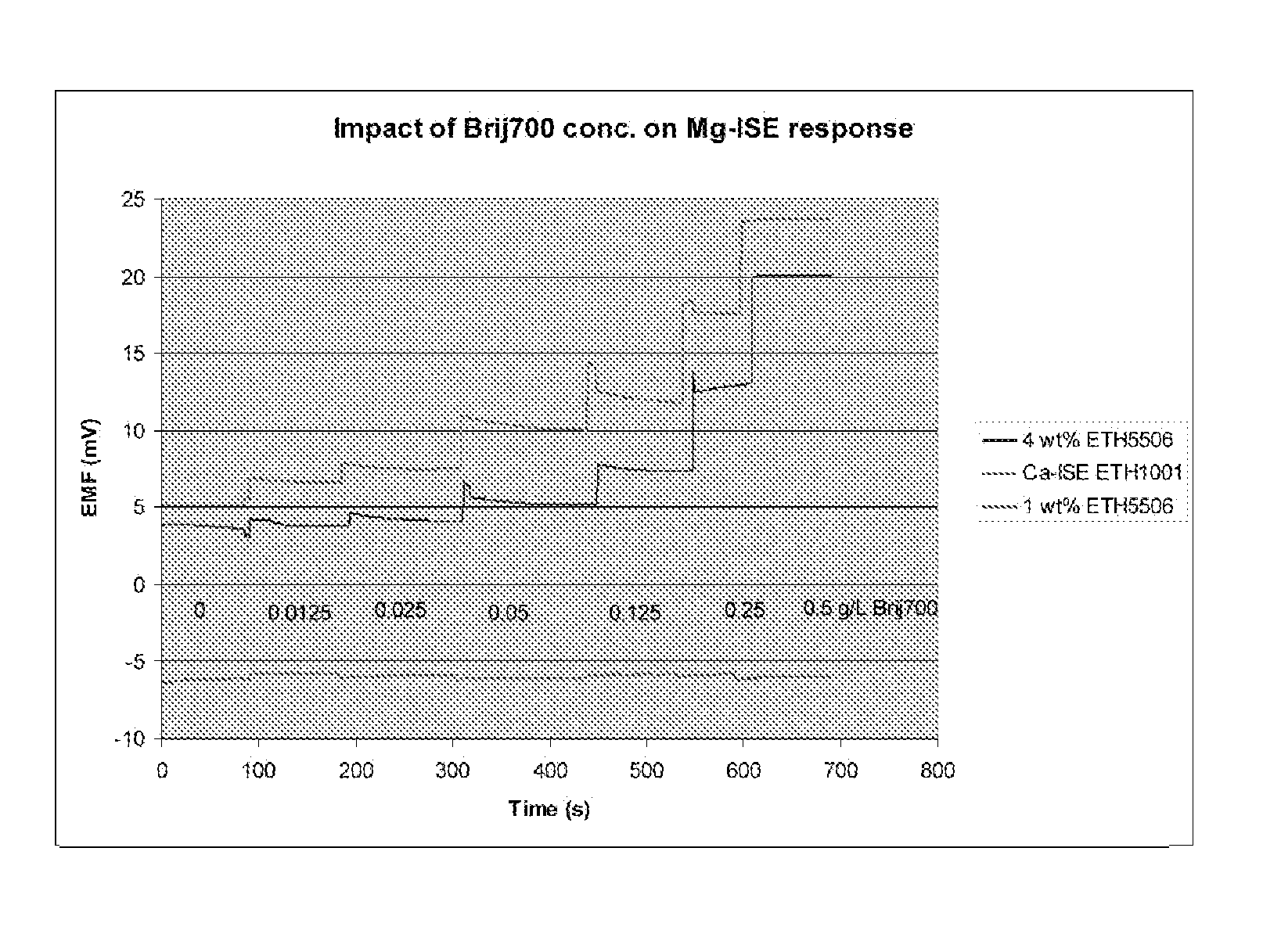
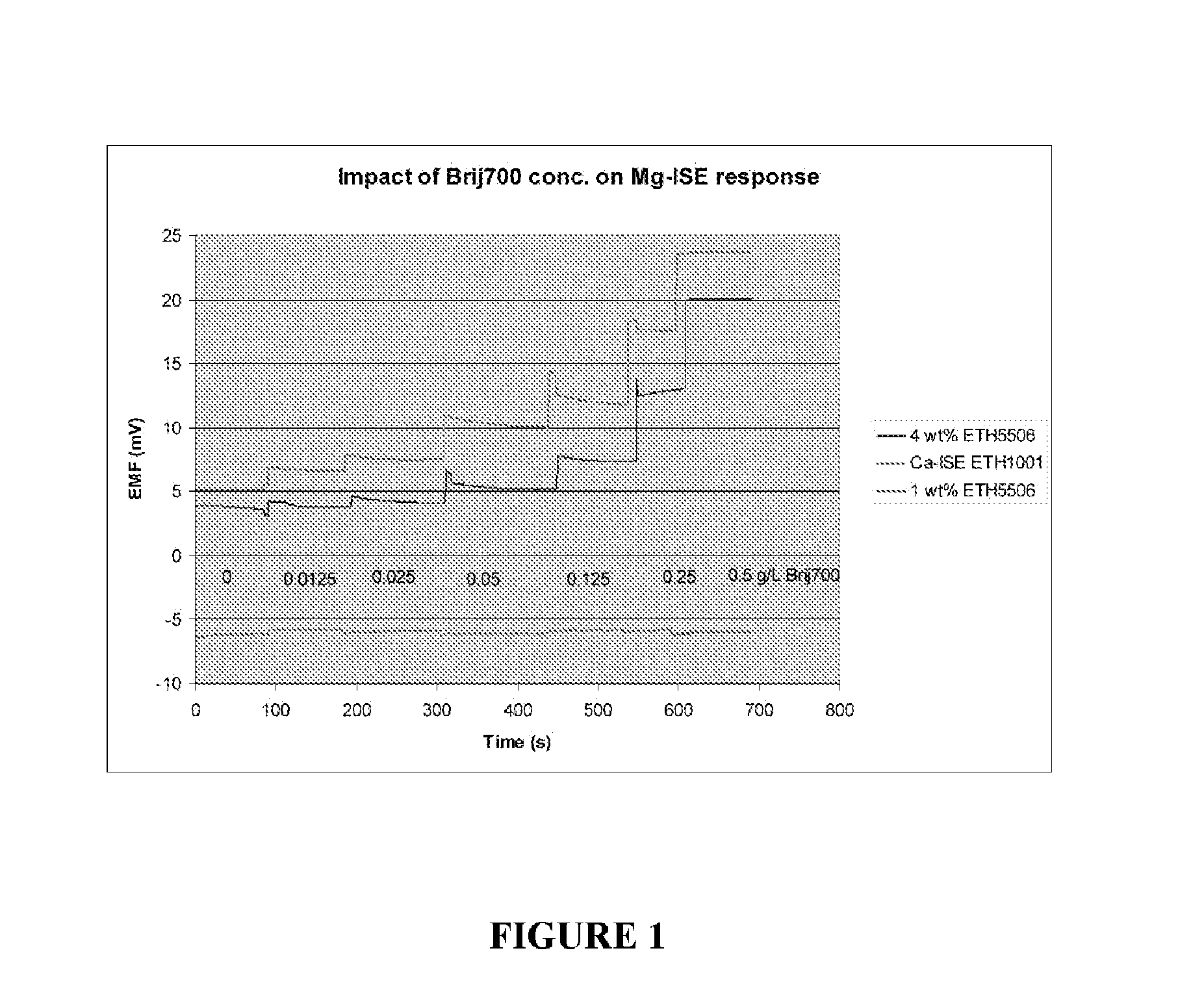
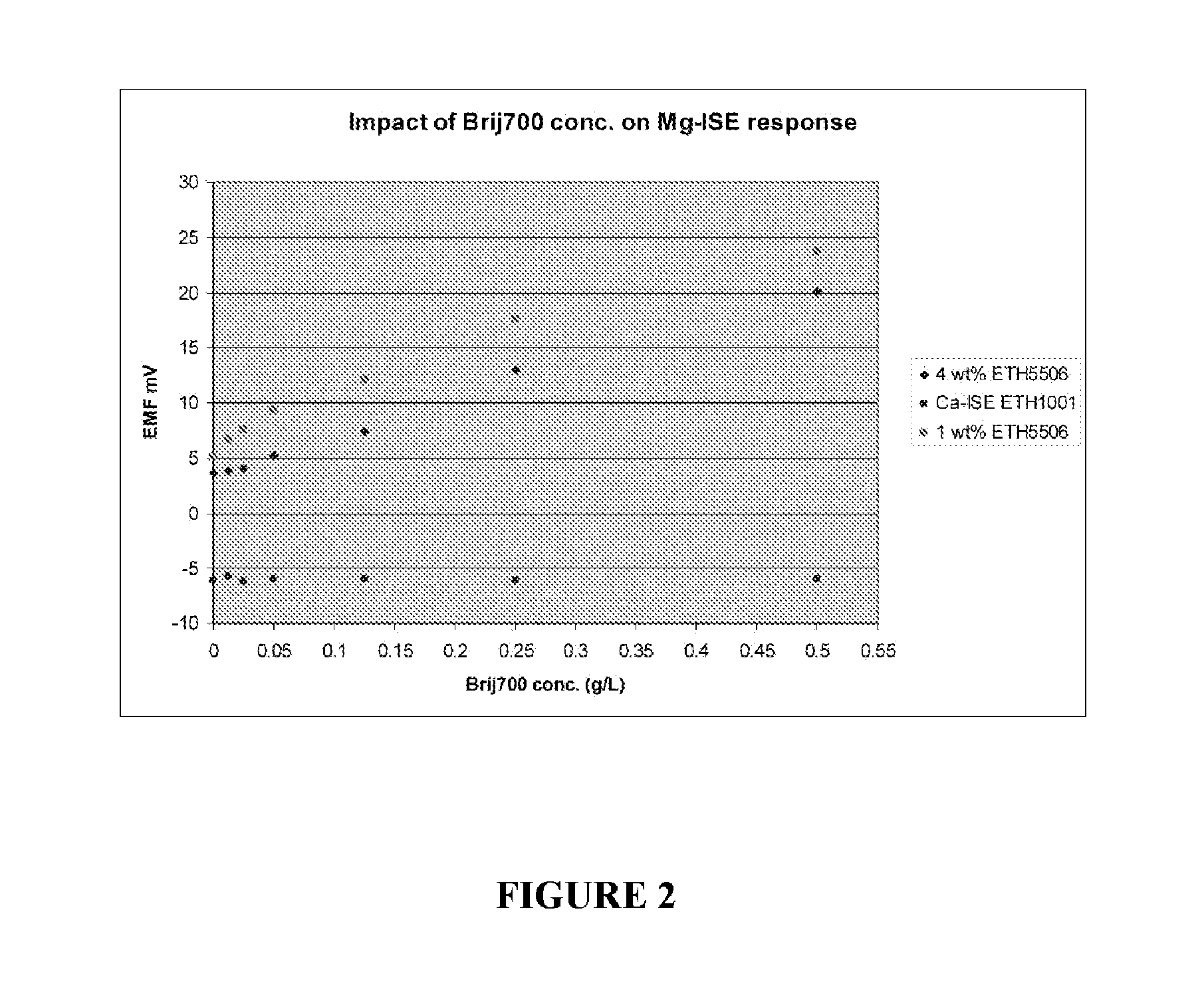
[0032]In a constant base solution (0.5 mM Mg2+, 150 mM Na+ and 1.0 mM Ca2+), different concentrations of BRIJ-700 as described in Example 1 were added. Mg-ISE response in these solutions was measured by comparing with a “blank” solution containing no polyoxyethylene(100) stearyl ether nonionic surfactant (sold under the tradename BRIJ-700®; CAS No. 9005-00-9). A Ca-ISE based on ETH1001 was simultaneously tested with two Mg-ISEs (1 wt % and 4 wt % ETH5506). The responses of both the Mg-ISEs and the Ca-ISE were measured. As shown in FIGS. 1 and 2, a quantitative relationship exists between the BRIJ-700 concentration and its impact on EMF off-set of Mg-ISEs. Unlike the Ca-ISE, the Mg-ISEs show significant sensitivity to the concentration of BRIJ-700. This may be the result of surfactant molecules penetrating into the PVC membrane and competing with ionophores in the PVC membrane regarding the binding affinity to th...
example 3
Measurements of Mg Ions in Biologically Relevant Concentrations
[0034]The impact of BRIJ-700 on Mg-ISE response to Mg2+ over a physiological normal range (0.3-0.7 mM) was studied. As shown in FIG. 3, 0.05% BRIJ-700 addition in reagents can lead to significant mV bias of Mg-ISE response (˜+4 mV). At the level of 0.025% BRIJ-700 in reagents (not shown), such mV bias shrinks to ˜+1 mV. In this range, the mV bias is parallel mV bias that can be mathematically corrected. FIG. 3 also shows that the mV bias of BRIJ-700 on Mg-ISEs can easily be removed when a fresh reagent without BRIJ-700 is used.
[0035]This is very different from the feature of BRIJ-35 with Mg-ISEs as reported in previous publications. BRIJ-35 and TRITON X-100 cause very high mV bias on Mg-ISE response (>100 mV in 0.1% surfactant) and such mV bias can only be removed over several hours or even days. This is one of the reasons that IFCC recommends using MEGA instead of BRIJ-35.
[0036]FIG. 4 shows EMF bias over an extended phy...
PUM
| Property | Measurement | Unit |
|---|---|---|
| EMF bias | aaaaa | aaaaa |
| concentration | aaaaa | aaaaa |
| concentration | aaaaa | aaaaa |
Abstract
Description
Claims
Application Information
 Login to View More