[0009]There were are two significant aspects of the invention in the parent application: (1) a kit for converting a compound bow into a left or right handed inline crossbow, and (2) a dedicated hybrid compound bow to use with the kit that eliminated some features of the traditional compound bow, and which can be used with the conversion kit equipment as an inline crossbow or a horizontal limb crossbow.
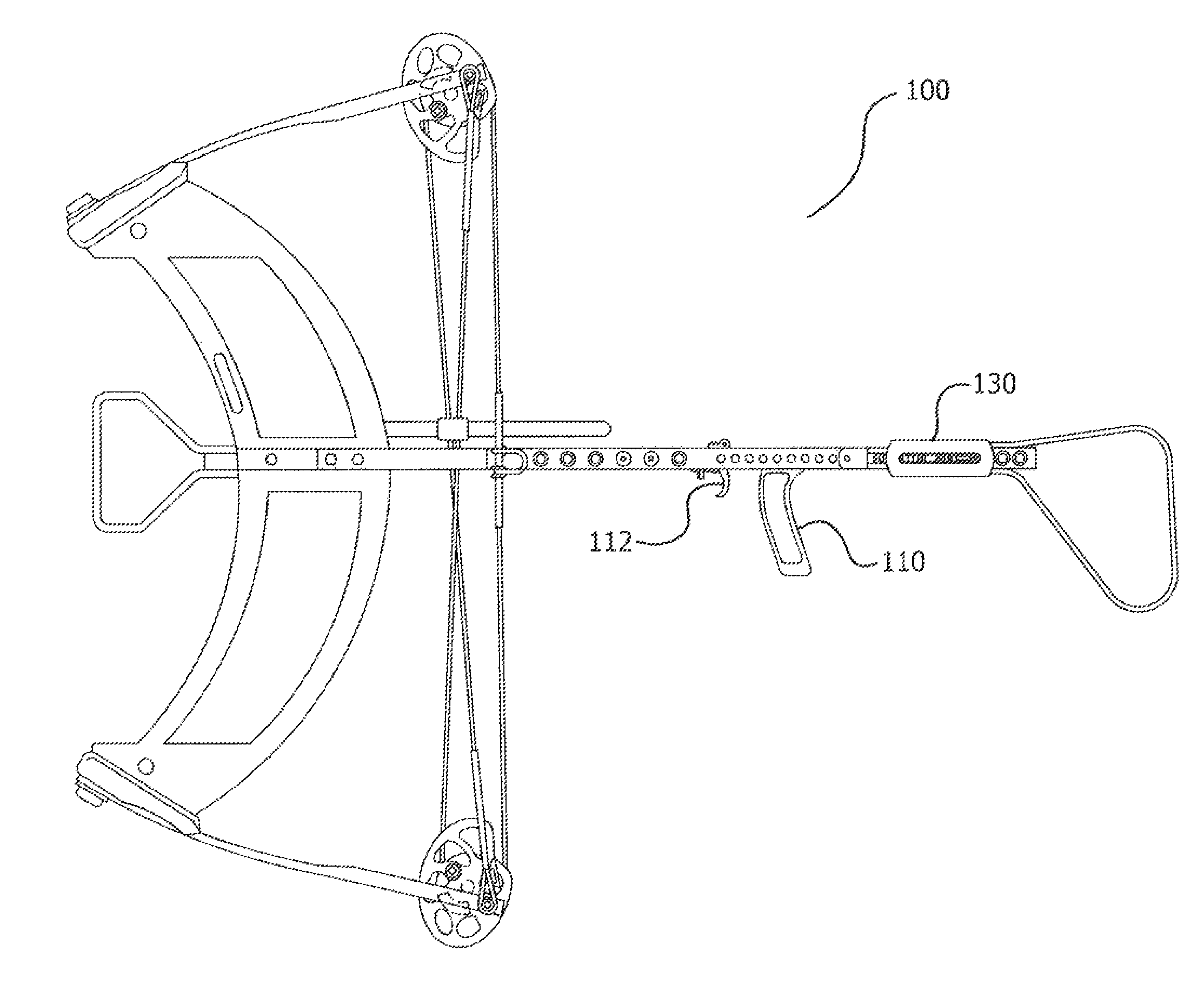
[0010]The present invention is directed to improvements in the trigger / string release assemblies and an improved butt stock. The parent application describes a draw-lock bar that simulates a forearm stock, with a pistol grip and a trigger-actuated string release at its butt end. The present invention provides an improvement wherein the trigger assembly is moved forward relative to the string latch / release assembly on opposite sides of the draw-lock bar. The trigger is connected to the string release by an actuator rod which may be inside of the draw-lock bar. In the preferred embodiment, the trigger and release assemblies can be attached to the draw-lock bar on either side, allowing for conversion between left or right handed configuration. The string latch has a sliding cover to allow the archer to put the release against his cheek without being stung by the string, and to protect the string from being pried off the latch by brush or other obstacles.
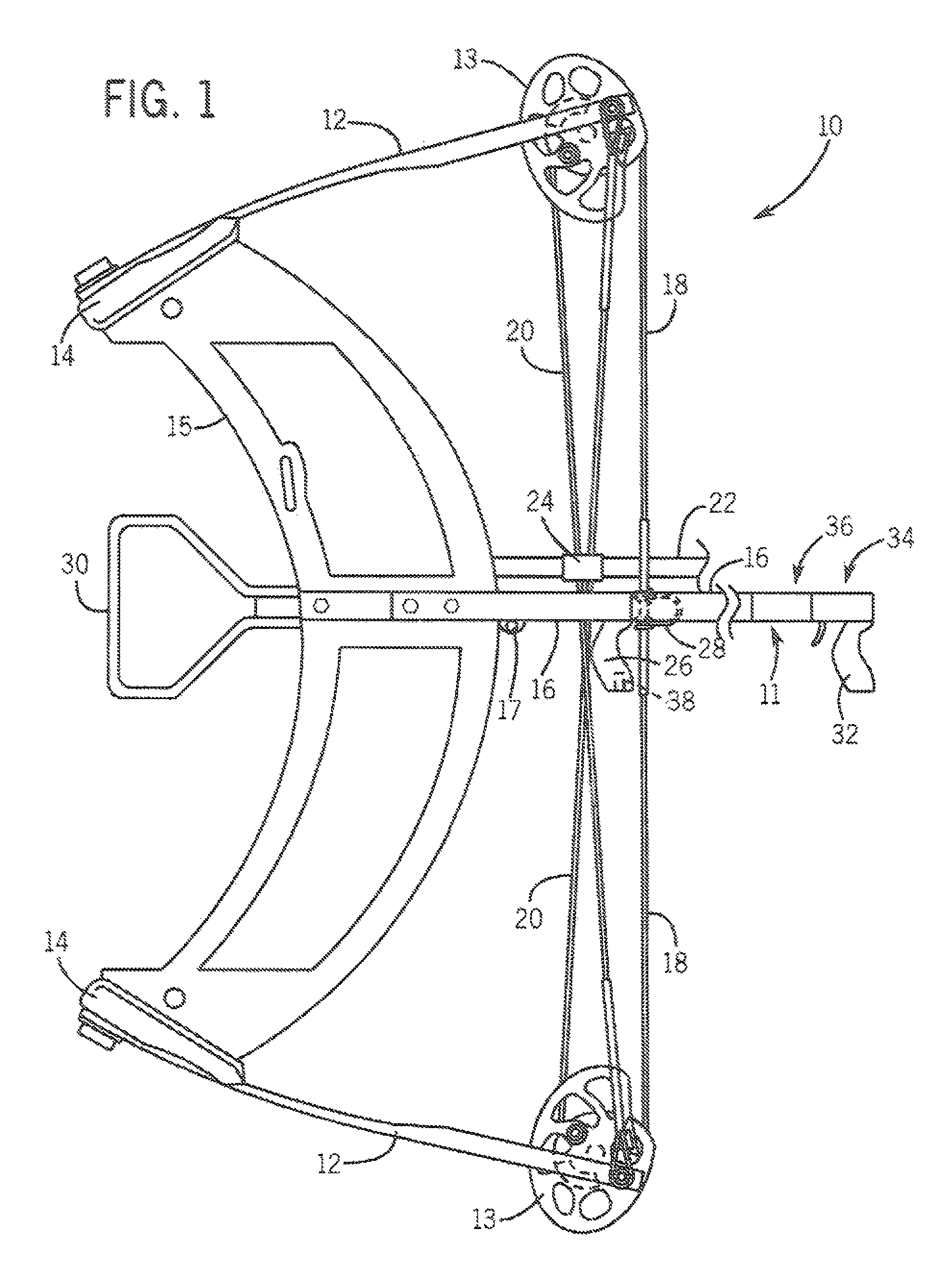
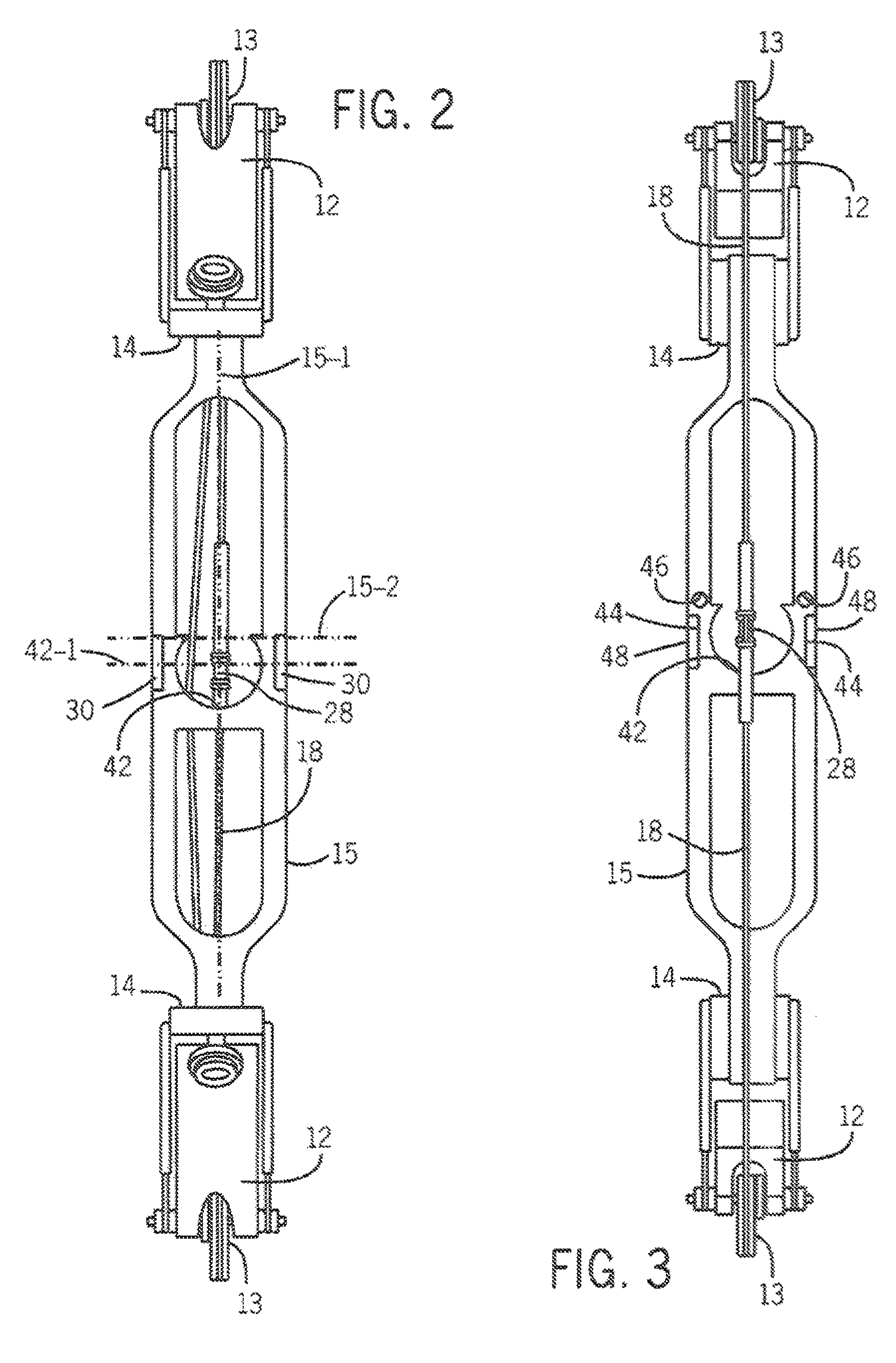
[0014]The hybrid compound bow of the invention is made specifically for use with the conversion kit. It has forward curving riser sections that locate the limb pockets well in front of the riser center point. The limbs extend backward from the pockets in an essentially parallel or slightly closing orientation, such that the axle to axle distance between the eccentric pulley wheels is very short, on the order of 18-19 inches. This provides a very compact compound bow with a power stroke that can be over 20 inches, depending of the draw bar length selected. With the aid of the cocking stirrup, even a 75-80 lb draw weight is easily handled by almost any adult. The hybrid bow does not itself have a handgrip, and thus is not a stand alone bow. The forward handle is provided by the vertical grip of the conversion kit. The lack of an integral handle, however, allows the bow to use a shoot-through riser with a contained arrow rest (such as a whisker biscuit) that locates the arrow exactly on vertical and horizontal center from the nocking point through the center cut-out in the biscuit. This exact centering improves accuracy by reducing arrow torque and string vibration, and is the most efficient location (the center) of the string for top speed and performance.
[0015]An added embodiment moves the rear pistol grip and the trigger / safety assembly forward along one side of the draw-lock bar, while keeping the string release and anti-dryfire lever assembly on the other side of the bar back at a draw near the archer's lip. This allows the archer to shoulder mount the bow to a consistent “lock-in” position, using a set contact point with his lip or cheek as the anchor point, while at the same time it moves his trigger hand forward to a comfortable position in front of his eyes and nose. Conceptually, this new arrangement is similar to the “bullpup” configuration kit for many rifles, which moves the trigger forward of the action to shorten overall length. In the context of a crossbow, however, the reason for moving the trigger further ahead of the string release is not to shorten the weapon itself, but rather to preserve the long draw-length and anchor point while making the weapon easier to balance and sight align. A sliding cover provided for the string release allows the archer to press the anchor point against his lip or cheek without being stung when the string releases. The sliding cover also keeps the string loop from being accidently pried off of the release lever. The cover slides backward to draw and latch the string, then forward to cover the latch.
[0016]The butt stock is also improved over the minimalist rear flange shown in FIG. 8. The improved butt stock is a thin aluminum band shaped to a butt stock profile with its heel at a slight elevation above the draw bar and its toe located slightly below the bottom of the pistol grip. The ends of the band attach to the draw-lock bar by a pivot bolt that allows the stock to swivel in against the bar to shorten the assembly for travel and storage, and to protect the sliding cover for the string release.


 Login to View More
  Login to View More