
Stable emulsion formulations
a technology of emulsion and formulation, applied in the field of medicine, can solve the problems of drug precipitation drug is considered challenging, drug is considered difficult, etc., and achieve the effect of reducing, inhibiting or eliminating drug precipitation, pain, inflammation, or phlebitis
- Summary
- Abstract
- Description
- Claims
- Application Information
AI Technical Summary
Benefits of technology
Problems solved by technology
Method used
Image

Examples
example 1
[0191]This example summarizes the solubility data and illustrates the composition of the formulations of the invention.
[0192]The solubility measurements of the compounds were prepared by the addition of 1 g of drug substance to two milliliters of oil into a Wheaton 5 mL vial. The headspace was sparged with nitrogen, and enclosed with a West 4405 / 50 gray Teflon coated stopper and manually sealed by an aluminum overseal. The preparations were repeated again with the oils containing either purified egg or soy lecithin. All labeled vials were shaken at room temperature for eighteen hours on a platform shaker. After eighteen hours, the samples were diluted in mobile phase, and analyzed by the RP-HPLC method. Table 2 summarizes solubility results (expressed in mg / mL) of cinacalcet in various oil phases.
[0193]
TABLE 2Medium ChainStructuredLong ChainLecithinTriglyceridesTriglyceridesTriglycerides—>341>368>340Egg>349>339>362Soy>327>317>304
[0194]Table 3 summarizes solubility of other calcimime...
example 2
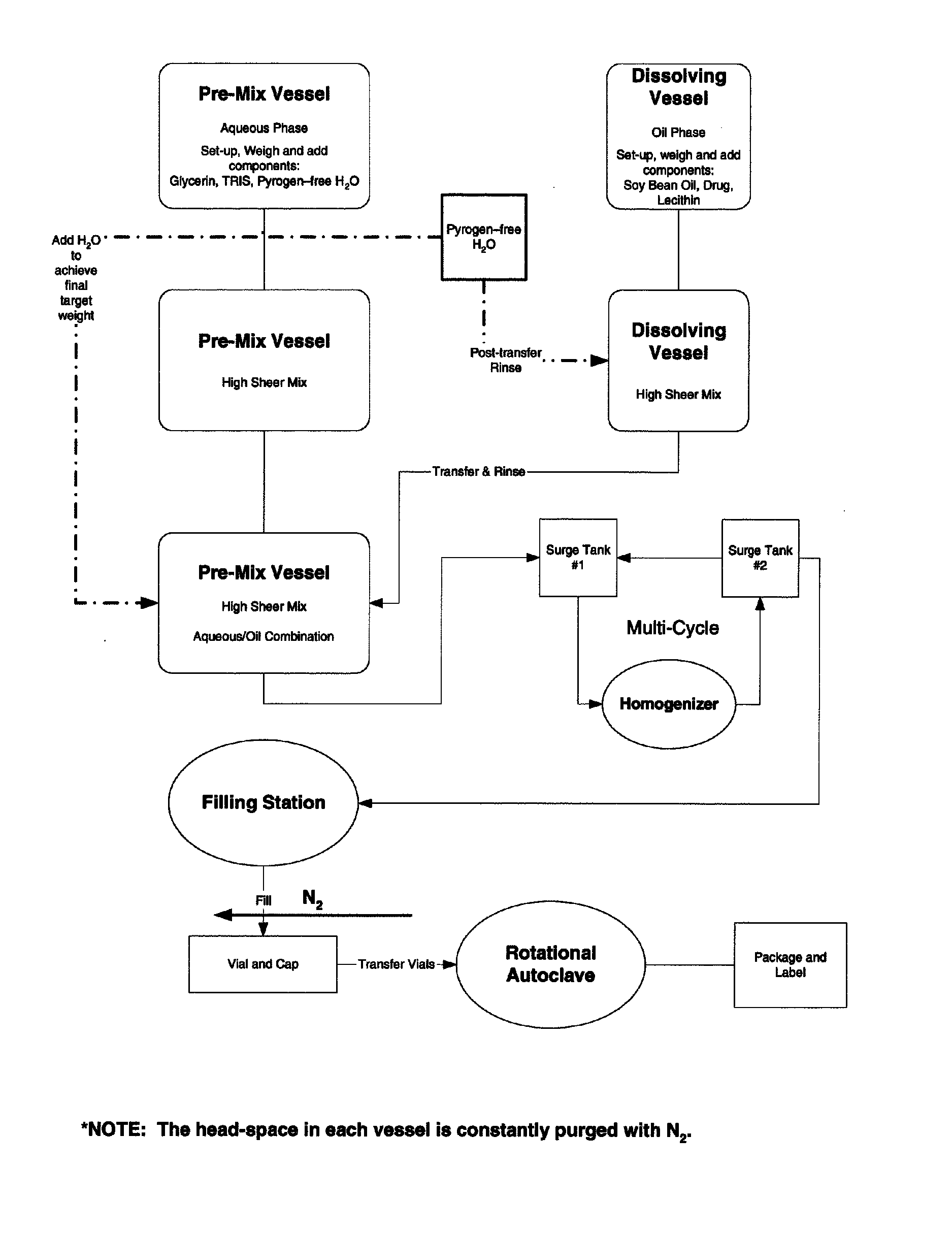
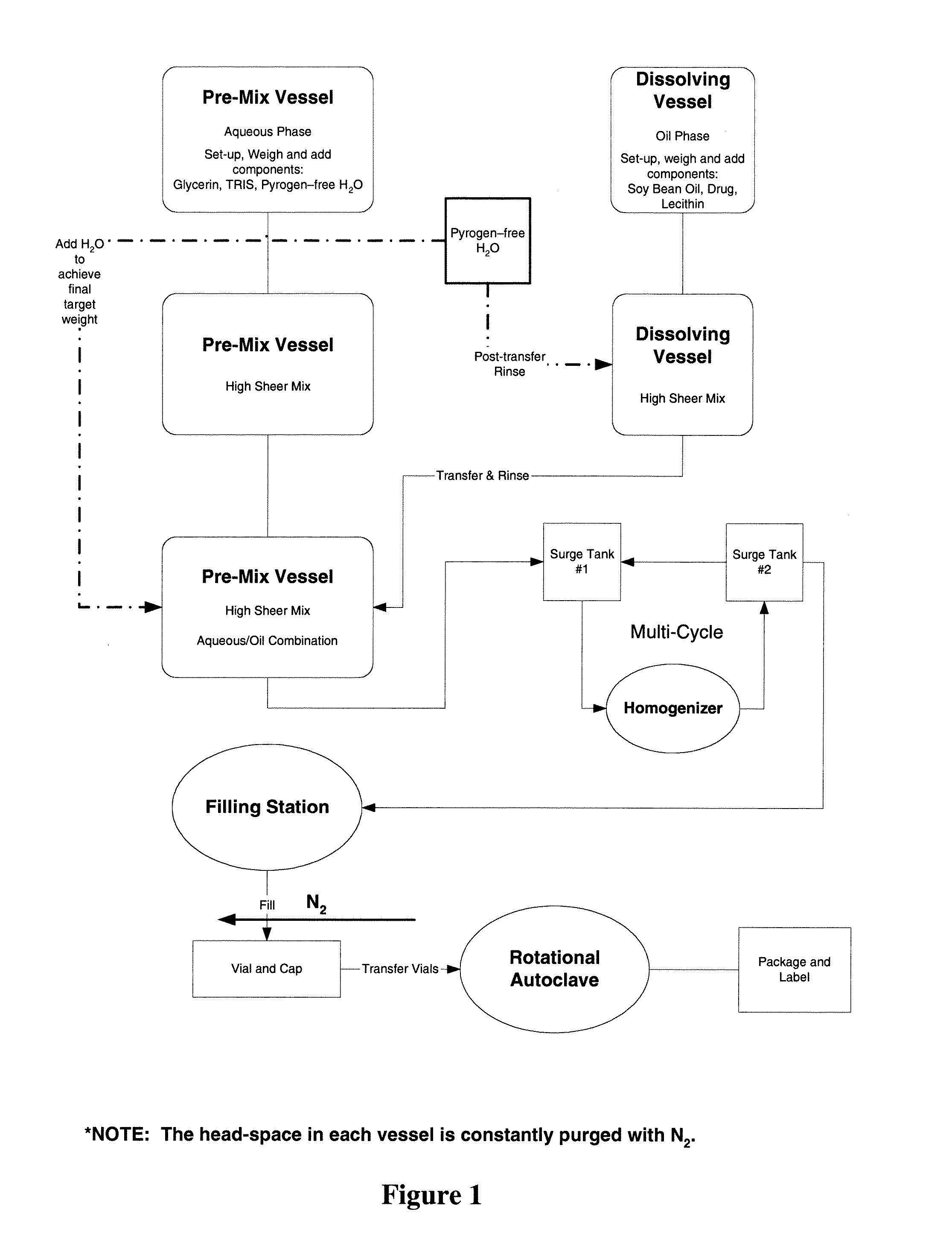
[0202]This example illustrates different routes of preparation of formulations of the invention.
[0203]Materials
[0204]Fresenius Kabi supplied the purified egg lecithin, structured triglycerides (STG) and soybean oil, or long chain triglycerides (LCT). Miglyol 810N, or medium chain triglycerides (MCT), was purchased from Condea Chemie (formerly Huls). American Lecithin supplied the soy lecithin. Other common lab chemicals such as sodium hydroxide, Hydrochloric acid, glycerin, isopropyl alcohol, TRIS, diethanolamine etc. were obtained from JT Baker, Sigma chemicals or other suitable vendors.
[0205]Coarse prototype emulsion formulations were prepared at a batch size of 10 mLs by an Ultraturrax T25 S1 Janke and Kunkel blade homogenizer equipped with a 10 mm rotostator, followed by sonication from a Vibracell Ultrasonicator with a titanium microtip probe. Batches at a 40 mL size were prepared in a similar manner, with the exception of the ultrasonicator having a ¾″ titanium probe tip.
[0206...
example 3
[0231]This Example illustrates the effect of pH and buffer type on the stability of the formulations of the invention as measured by the size and charge of the droplets.
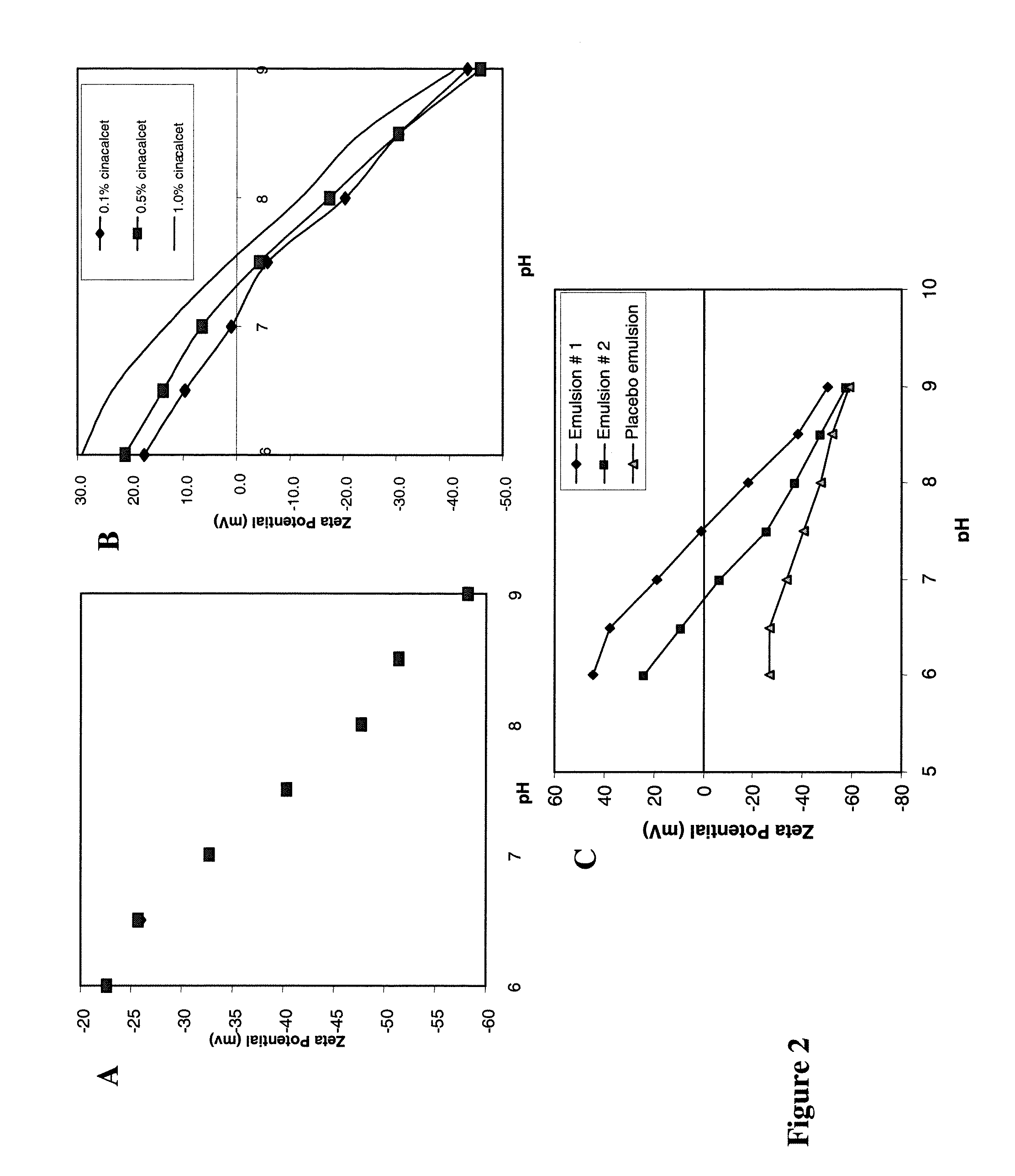
[0232]The results of these studies are depicted in FIG. 2 which demonstrates the effect of pH and the presence of a calcimimetic compound on the droplet charge. Panel A, titration results of 1% EYP / 10% SBO in 1 mM dibasic phosphate. Panel B, titration results of cinacalcet / 1% EYP / 10% SBO in 1 mM dibasic phosphate. Other components of the emulsions include 10% soybean oil, 1% egg lecithin, 2.25% glycerin and water. Panel C, titration results for Compound A. Emulsion composition: SBO 10%, Lecithin 2% at pH 7. Concentration of Compound A was 5 mg / mL for formulation #1 and 1 mg / mL for formulation #2. The emulsion with higher Compound A concentration reaches neutral charge at a higher pH than that with a lower concentration.
[0233]The zeta potential measurements were made on a Malvern Zetasizer 4 laser-scattering particle ...
PUM
| Property | Measurement | Unit |
|---|---|---|
| temperatures | aaaaa | aaaaa |
| concentration | aaaaa | aaaaa |
| concentration | aaaaa | aaaaa |
Abstract
Description
Claims
Application Information
 Login to View More