Image processing apparatus, image processing method, program, and recording medium for learning from moving images
a technology for moving images and processing methods, applied in image analysis, image enhancement, instruments, etc., can solve the problems of large amount of calculation, difficulty in learning, and large amount of suppositions, and achieve the effect of fewer suppositions and small amount of calculation
- Summary
- Abstract
- Description
- Claims
- Application Information
AI Technical Summary
Benefits of technology
Problems solved by technology
Method used
Image



Examples
first specific example
[0295]In a first specific example, a region where a foreground image is present is recognized by inputting and learning a moving image in which a foreground image shown in FIG. 17 is moving against a background image shown in FIG. 18.
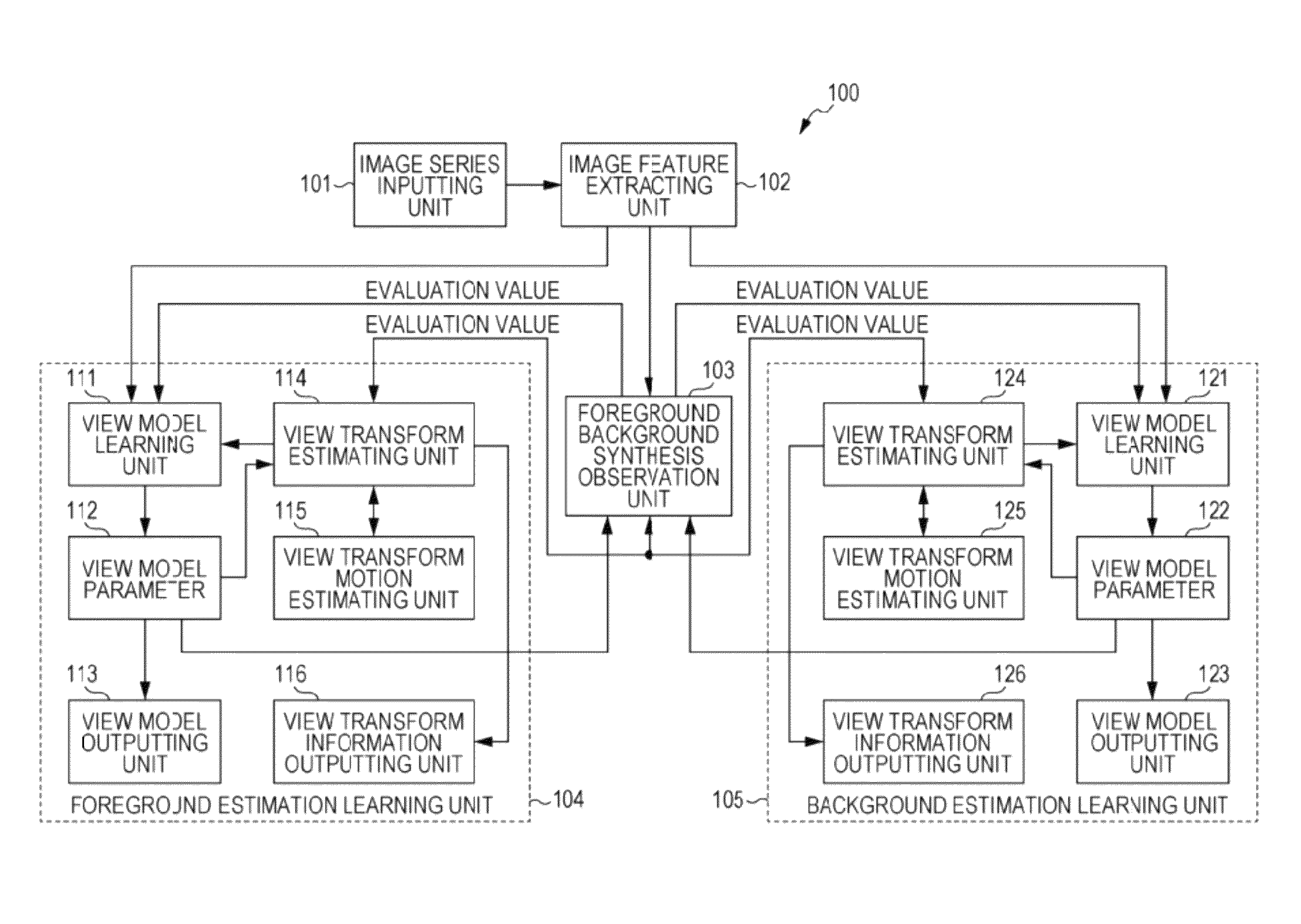
[0296]In this case, the view model learning apparatus 100 in FIG. 3 learns a foreground as a single view model and also learns a background as a single view model, and then recognizes the foreground image using the view model which is the learning result.
[0297]When the image is recognized after the learning of the view model, the view transform is also estimated or the view transition is also estimated, as in the view model learning. However, when the image is recognized, only one candidate of the view transform or the view transform is generally output.
[0298]The foreground image shown in FIG. 17 is an image which is formed by a rectangular region of 5 by 5 pixels and has a predetermined pattern in which the respective pixels are white and black.
[0299]T...
second specific example
[0341]In a second specific example, the configuration of the background estimation learning unit of the view model learning apparatus 200 in FIG. 4 is used, which is configured to be the same as the configuration of the background estimation learning unit 105 in FIG. 3. It is assumed that the view model learning apparatus 200 learns a foreground as the multi-view model and learns a background as the single view model, and then recognizes the foreground image using the view model which is the learning result.
[0342]When the image is recognized after the learning of the view model, the view transform is estimated or the view transition is estimated, as in the case where the view model is learned. However, when the image is recognized, only one candidate of the view transform or the view transform is generally output.
[0343]In the second specific example, HMM is used in the view transition estimation of the foreground, a particle filter is used in the view transform estimation of the for...
third specific example
[0416]In a third specific example, the view model learning apparatus 100 in FIG. 3 learns a foreground as a single view model and also learns a background as a single view model, and then recognizes the foreground image using the view model which is the learning result.
[0417]When the image is recognized after the learning of the view model, the view transform is also estimated, as in the view model learning. However, when the image is recognized, only one candidate of the view transform or the view transform is generally output.
[0418]In the third specific example, a local feature (Harris corner) is used as a view model and a particle filter is used for the view transform estimation.
[0419]FIG. 25 is a diagram illustrating examples of images as a series of input images in the third specific example. As shown in FIG. 25, the series of input images is obtained by manually fixing the posture of a doll (stuffed toy) on a desk, moving the doll front, rear, right, and left, and photographin...
PUM
 Login to View More
 Abstract
Description
Claims
Application Information
 Login to View More