

Inhibitors of filovirus entry into host cells
a technology of host cells and inhibitors, which is applied in the direction of immunological disorders, drug compositions, peptides, etc., can solve the problems of no approved therapeutic intervention for ebov infections, and no single organ shows sufficient damage to account for the onset of severe shock and bleeding
- Summary
- Abstract
- Description
- Claims
- Application Information
AI Technical Summary
Problems solved by technology
Method used
Image

Examples
example 1
Preparation of Pseudotype Viruses for Infection Inhibition Assays
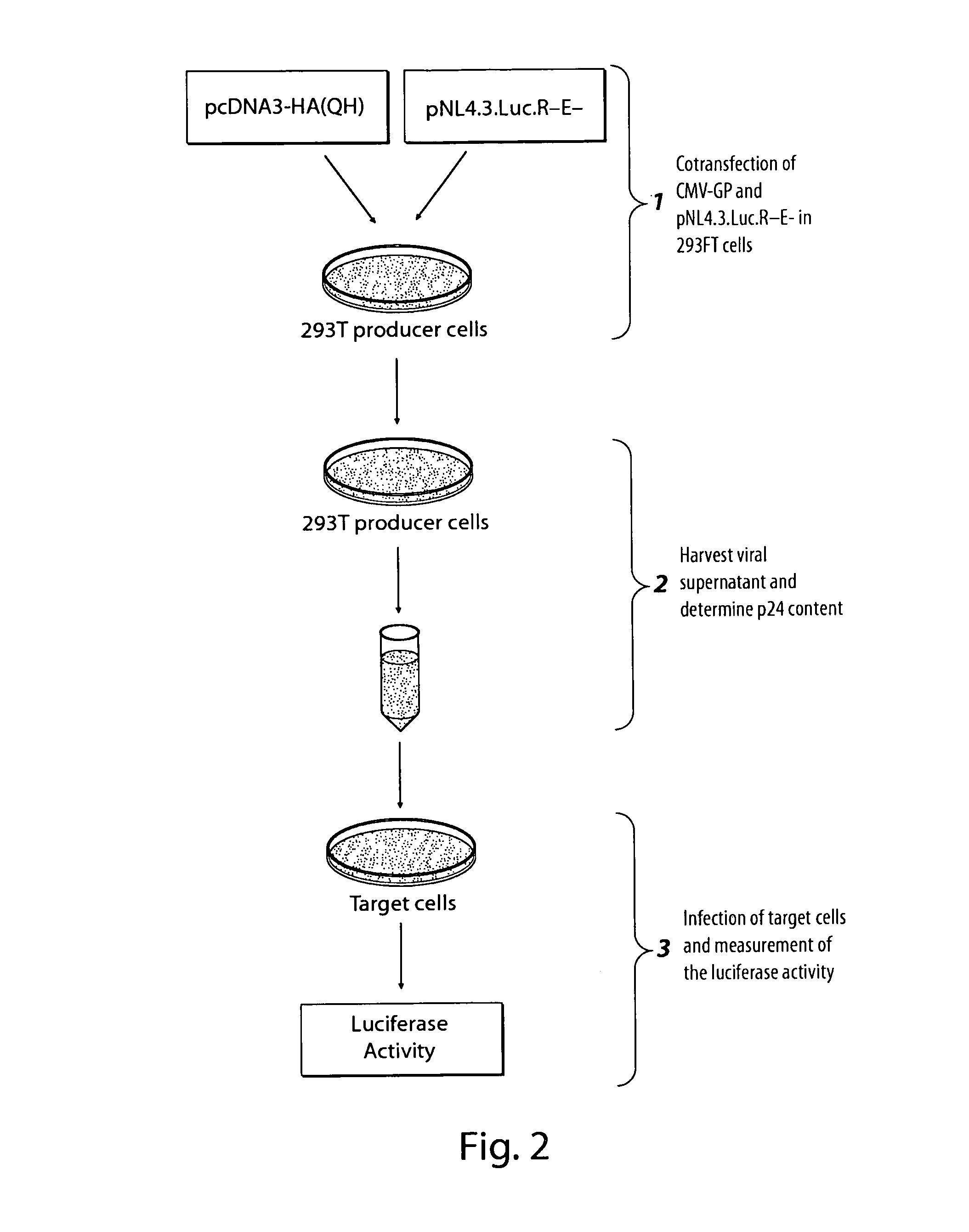
[0163]Because of the biosafety concerns for EBOV and MARV, several efficient pseudotyping systems have been established to study EBOV and MARV entry in a BSL-2 laboratory. The EBOV pseudotype system typically utilizes either a recombinant vesicular stomatitis virus (VSV) or a retrovirus (HIV 1 or MuLV) core (Manicassamy, B., et al., J. Virol., 79:4793-4805 (2005); Becker, S., et al., J. Gen. Virol., 76:393-399 (1995); Chan, S. Y., et al., Cell, 106:117-126 (2001); Chandran, K., et al., op. cit.). Described herein is the generation of EBOV-GP (Zaire strain) pseudotyped viruses having either a HIV backbone with the luciferase reporter gene (HIV / EBOV-GP) or a VSV backbone (VSV / EBOV-GP) to mimic the EBOV-GP mediated entry process.
[0164]Briefly, HIV / EBOV-GP pseudotype viruses were generated by co-transfecting 293T cells with HIV vector envelope-defective proviral genome (pNL4.3.Luc.R-E-) containing a luciferase reporter (Mu...
example 2
Selection of Virus and Cells for High Throughput Screening (HTS)
[0170]The HIV / EBOV-GP and the VSV / EBOV-GP pseudotype viruses engineered in Example 1 were evaluated for HTS suitability. The HIV / EBOV-GP pseudotype virus with the luciferase reporter gene was chosen for the final HTS screen because of its sensitivity and reproducibility in a 96 well plate format (data not shown).
[0171]To further develop the HTS assay, the infectivity of the HIV / EBOV-GP pseudotype virus was investigated in different cell lines. Vero, 293T, HeLa, HepG2 and BHK cells were chosen as suitable HIV / EBOV-GP target cell lines (Wool-Lewis, R. J., et al., op. cit.; Watanabe, S., et al., op. cit.; Manicassamy, B., et al. op. cit.; Becker, S., et al. op. cit.; Chan, S. Y., et al., op. cit.; Chandran, K., et al., id.; Schornberg, K., et al., op. cit.). As shown in FIG. 3, the maximum activity to background ratio was obtained with 293T cells. Precision statistical parameters including signal to background ratio (S / B),...
example 3
Screening a Diverse Compound Library to Identify / Confirm Selective EBOV Inhibitors
[0173]The HIV / EBOV-GP pseudotype virus HTS was performed in human 239T cells at a compound concentration of 25 μM. A workflow diagram describing criteria for isolation of inhibitors from the HTS screen is shown in FIG. 4. An inhibition of >90% (IC90) of luciferase activity was designated as a “primary hit”. Controls were included on each plate: 2 blank wells for background correction, 8 wells for 0% inhibition (DMSO only, no test compound=negative control) and 6 wells with no infection. A chemical library of 52,500 diverse small molecular weight compounds was screened. Compounds were in the molecular weight range of 200-500 Da, and obtained from several vendors: Chembridge (San Diego, Calif.), Timtec (Newark, Del.), and ChemDiv (San Diego, Calif.). The compounds in the libraries were pre-selected using numerous “drug-like” chemical filters, including Lipinski's ‘Rule of 5’ (Lipinski, C. A., et al., Adv...
PUM
| Property | Measurement | Unit |
|---|---|---|
| pore-size | aaaaa | aaaaa |
| molecular weight | aaaaa | aaaaa |
| pH | aaaaa | aaaaa |
Abstract
Description
Claims
Application Information
 Login to View More