Unlock instant, AI-driven research and patent intelligence for your innovation.
Ni-based alloy, and gas turbine rotor blade and stator blade each using same
What is Al technical title?
Al technical title is built by PatSnap Al team. It summarizes the technical point description of the patent document.
a technology of ni-based alloys and stator blades, which is applied in the field of ni-based alloys, can solve the problems of sigma phases, hard and fragile harmful phases, and material tissue stability deterioration, and achieve the effect of inhibiting cracking and well-balanced manner
Active Publication Date: 2016-05-31
MITSUBISHI POWER LTD
View PDF15 Cites 1 Cited by
Summary
Abstract
Description
Claims
Application Information
AI Technical Summary
This helps you quickly interpret patents by identifying the three key elements:
Problems solved by technology
Method used
Benefits of technology
Benefits of technology
[0023]The present invention provides Ni-based alloys, which are provided with properties such as strength at high temperatures, corrosion resistivity, oxidation resistivity, and other properties in a well-balanced manner, compared with existing materials. Such alloys are particularly optimal for standard casting. Further, the Ni-based alloys of the present invention comprise C and B, which are effective for strengthening the crystal grain boundary, and Hf, which is effective for inhibiting cracking at the crystal grain boundary at the time of casting. Thus, such alloys have compositions that are suitable for unidirectionally solidified alloy materials.
Problems solved by technology
Meanwhile, there is a tendency to use low-quality fuels containing large quantities of impurities causing corrosion as land-based gas turbine fuels due to elevated fuel prices.
As alloy element content increases, however, the tissue stability of materials deteriorates, and hard and fragile harmful phases (e.g., sigma phases) are disadvantageously precipitated after prolonged use.
In the past, specifically, it has been difficult to develop alloy materials excellent in creep strength at high temperatures, corrosion resistivity, and oxidation resistivity.
Method used
the structure of the environmentally friendly knitted fabric provided by the present invention; figure 2 Flow chart of the yarn wrapping machine for environmentally friendly knitted fabrics and storage devices; image 3 Is the parameter map of the yarn covering machine
View more
Image
Smart Image Click on the blue labels to locate them in the text.
Viewing Examples
Smart Image
Click on the blue label to locate the original text in one second.
Reading with bidirectional positioning of images and text.
Smart Image
Examples
Experimental program
Comparison scheme
Effect test
examples
[0057]Hereafter, the present invention is described in greater detail with reference to examples and comparative examples, although the present invention is not limited thereto.
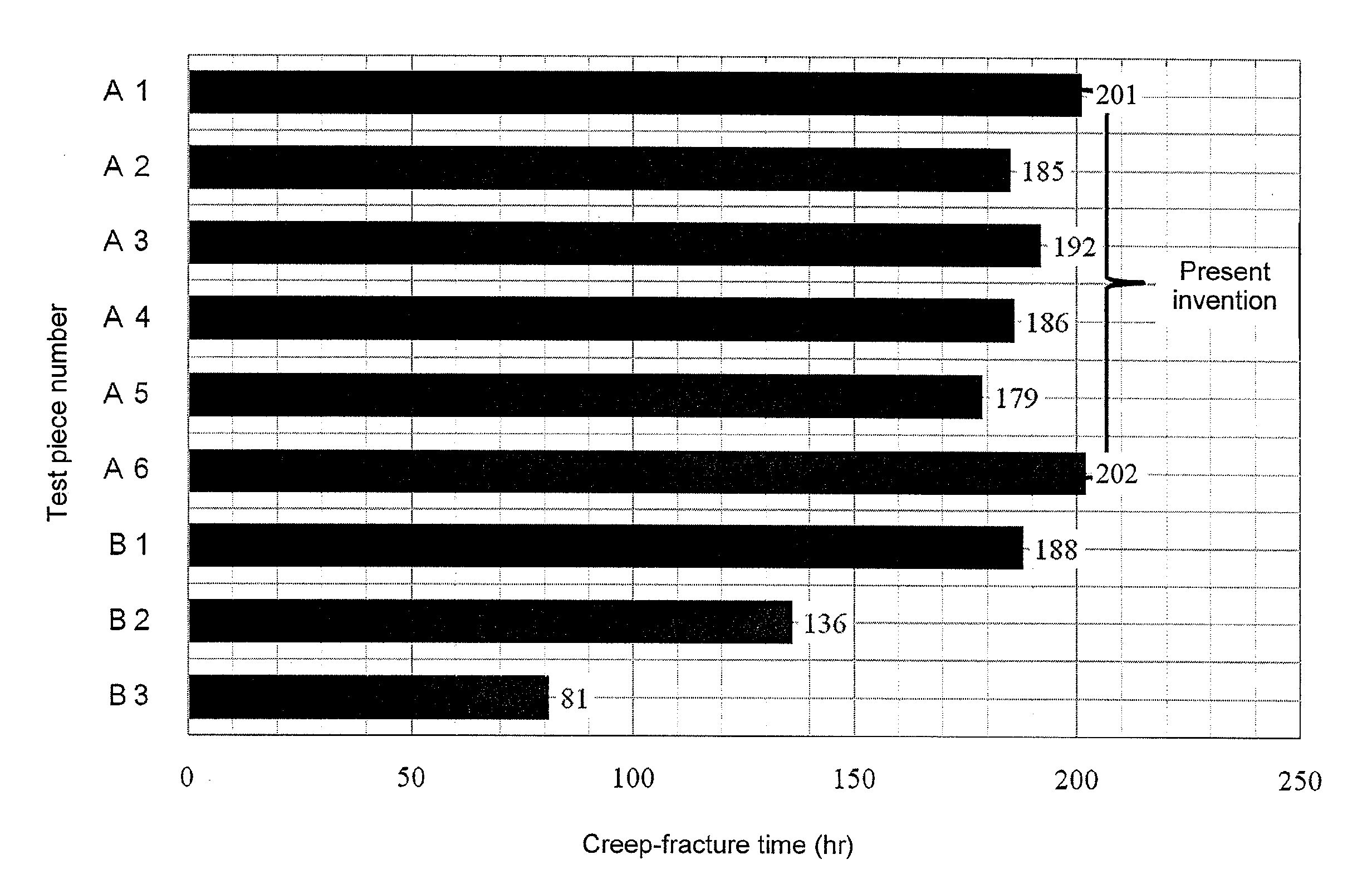
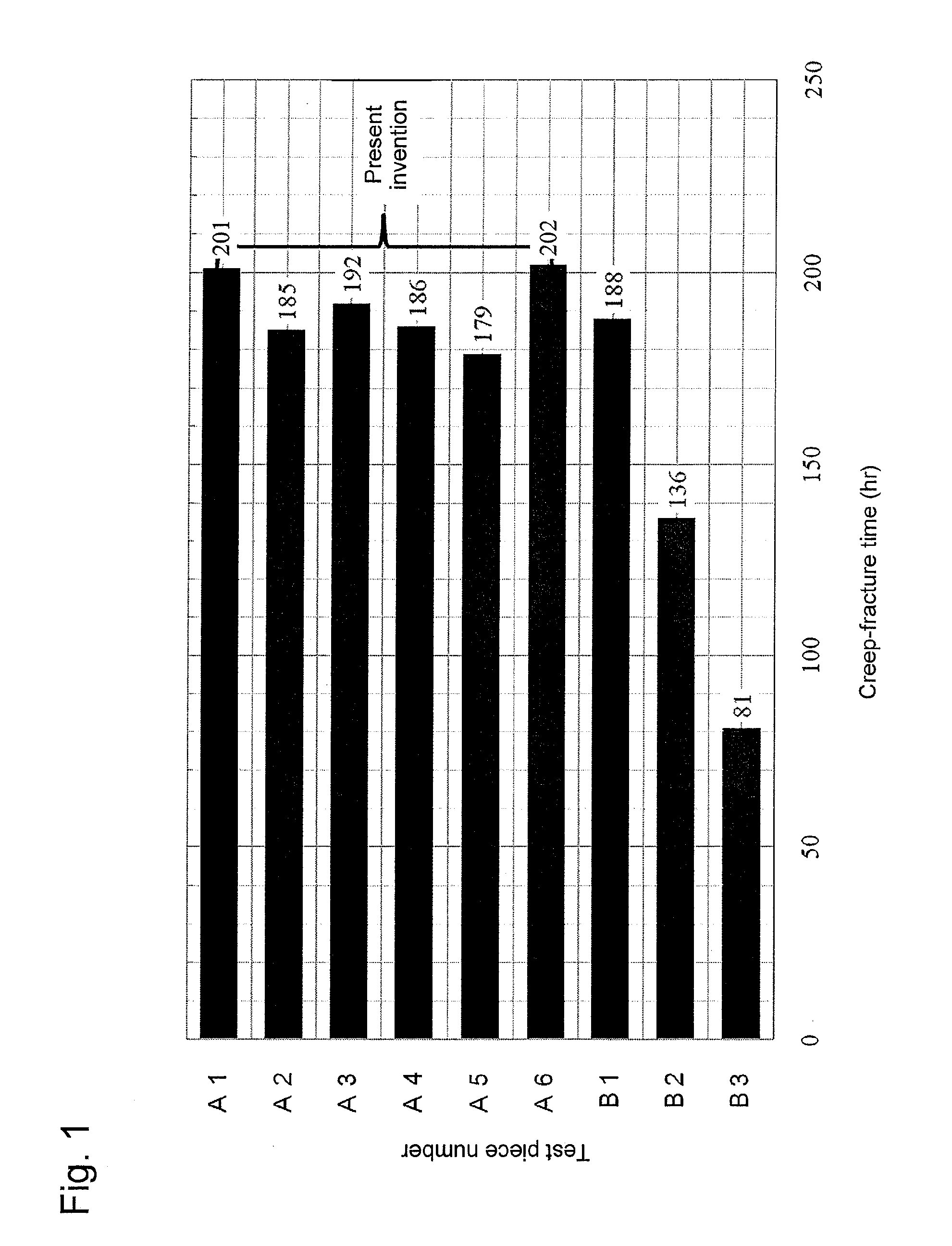
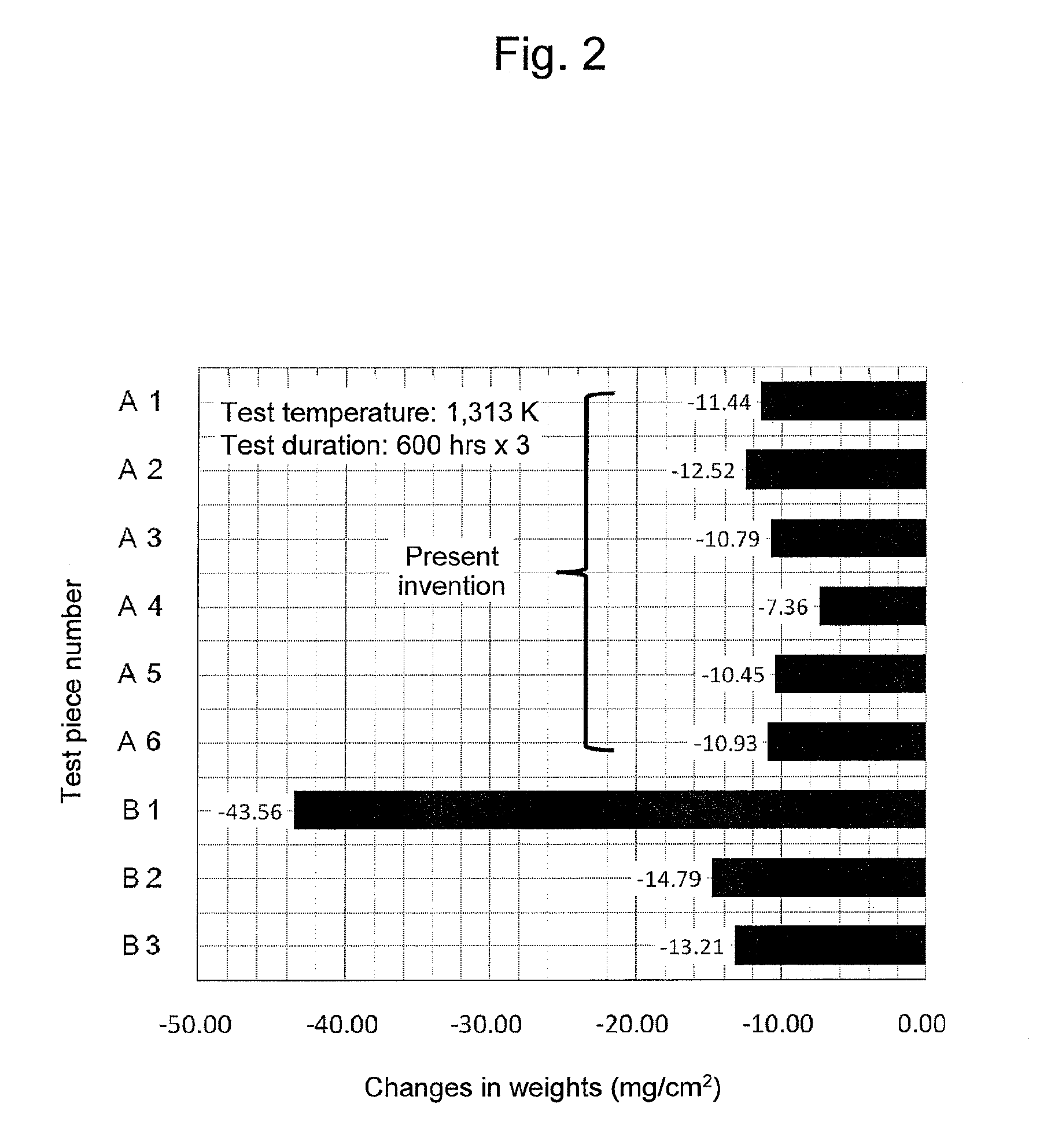
[0058]Table 1 shows the compositions (% by mass) of Ni-based alloys subjected to testing. In Table 1, Test pieces A1 to A6 are examples of the present invention and Test pieces B1 to B3 are existing alloys (comparative examples). Test pieces were prepared by melting master ingots and weighed alloy elements in alumina crucibles and casting the resultants into flat plates each with a thickness of 14 mm. The casting temperature was 1,373 K, the pour point was 1,713 K, and an alumina ceramic cast was used. After casting, the test pieces were subjected to solution heat-treatment and aging heat-treatment under the conditions shown in Table 2. Test pieces A1 to A6 were first subjected to solution heat-treatment at 1,480 K for 2 hours in order to homogenize the alloy compositions. After the solution heat-treatment, t...
the structure of the environmentally friendly knitted fabric provided by the present invention; figure 2 Flow chart of the yarn wrapping machine for environmentally friendly knitted fabrics and storage devices; image 3 Is the parameter map of the yarn covering machine
Login to View More
PUM
Property
Measurement
Unit
length
aaaaa
aaaaa
length
aaaaa
aaaaa
thickness
aaaaa
aaaaa
Login to View More
Abstract
This invention provides an Ni-based alloy, which is particularly used for standard casting and is provided with properties such as strength at high temperatures, corrosion resistivity, and oxidation resistivity in a more balanced manner, compared with existing materials. The Ni-based alloy comprises Cr, Co, Al, Ti, Ta, W, Mo, Nb, C, B, and unavoidable impurities, with the balance consisting of Ni. Composition of the alloy is represented by mass: 13.1% to 15.0% Cr, 1.0% to 15.0% Co, 2.3% to 3.3% Al, 4.55% to 6.0% Ti, 3.05% to 4.0% Ta, 4.35% to 4.9% W, 0.1% to 2.0% Mo, 0.05% to 0.5% Nb, less than 0.05% Zr, 0.05% to 0.2% C, and 0.01% to 0.03% B.
Description
TECHNICAL FIELD[0001]The present invention relates to Ni-based alloys, which are provided with properties such as creep strength at high temperatures, oxidation resistivity, and corrosion resistivity in a well-balanced manner. More particularly, the present invention relates to Ni-based alloys used for gas turbine rotor blades, stator blades, and the like.BACKGROUND ART[0002]In recent years, internal combustion engines have been expected to work with improved thermal efficiency because of increasing environmental awareness regarding, for example, reduction of fossil fuel use, reduction of carbon dioxide emissions, and prevention of global warming. Heat engines such as gas turbines or jet engines are known to maximize thermal efficiency by operating with a high-temperature Carnot cycle at higher temperatures. As temperature rises at the turbine inlet, the importance of development and modification of materials used for gas turbine hot parts (i.e., combustors, turbine rotor blades, an...
Claims
the structure of the environmentally friendly knitted fabric provided by the present invention; figure 2 Flow chart of the yarn wrapping machine for environmentally friendly knitted fabrics and storage devices; image 3 Is the parameter map of the yarn covering machine
Login to View More
Application Information
Patent Timeline
Application Date:The date an application was filed.
Publication Date:The date a patent or application was officially published.
First Publication Date:The earliest publication date of a patent with the same application number.
Issue Date:Publication date of the patent grant document.
PCT Entry Date:The Entry date of PCT National Phase.
Estimated Expiry Date:The statutory expiry date of a patent right according to the Patent Law, and it is the longest term of protection that the patent right can achieve without the termination of the patent right due to other reasons(Term extension factor has been taken into account ).
Invalid Date:Actual expiry date is based on effective date or publication date of legal transaction data of invalid patent.



 Login to View More