Reflector with resistant surface

a technology of reflective surfaces and reflective coatings, applied in the field of reflective coatings, can solve the problems of loss of energy, high purity, and increased precautions with increasing thickness of oxide coatings,

USRE39790E1Inactive Publication Date: 2007-08-21CONSTELLIUM SWITZERLAND
9 Cites 51 Cited by

Patent Information

Authority / Receiving Office
US · United States
Patent Type
Patents(United States)
Current Assignee / Owner
Publication Date
2007-08-21
Estimated Expiration
Not applicable · inactive patent

Smart Images

  • Figure 1
    Figure 1
  • Figure 2
    Figure 2
Patent Text Reader

Abstract

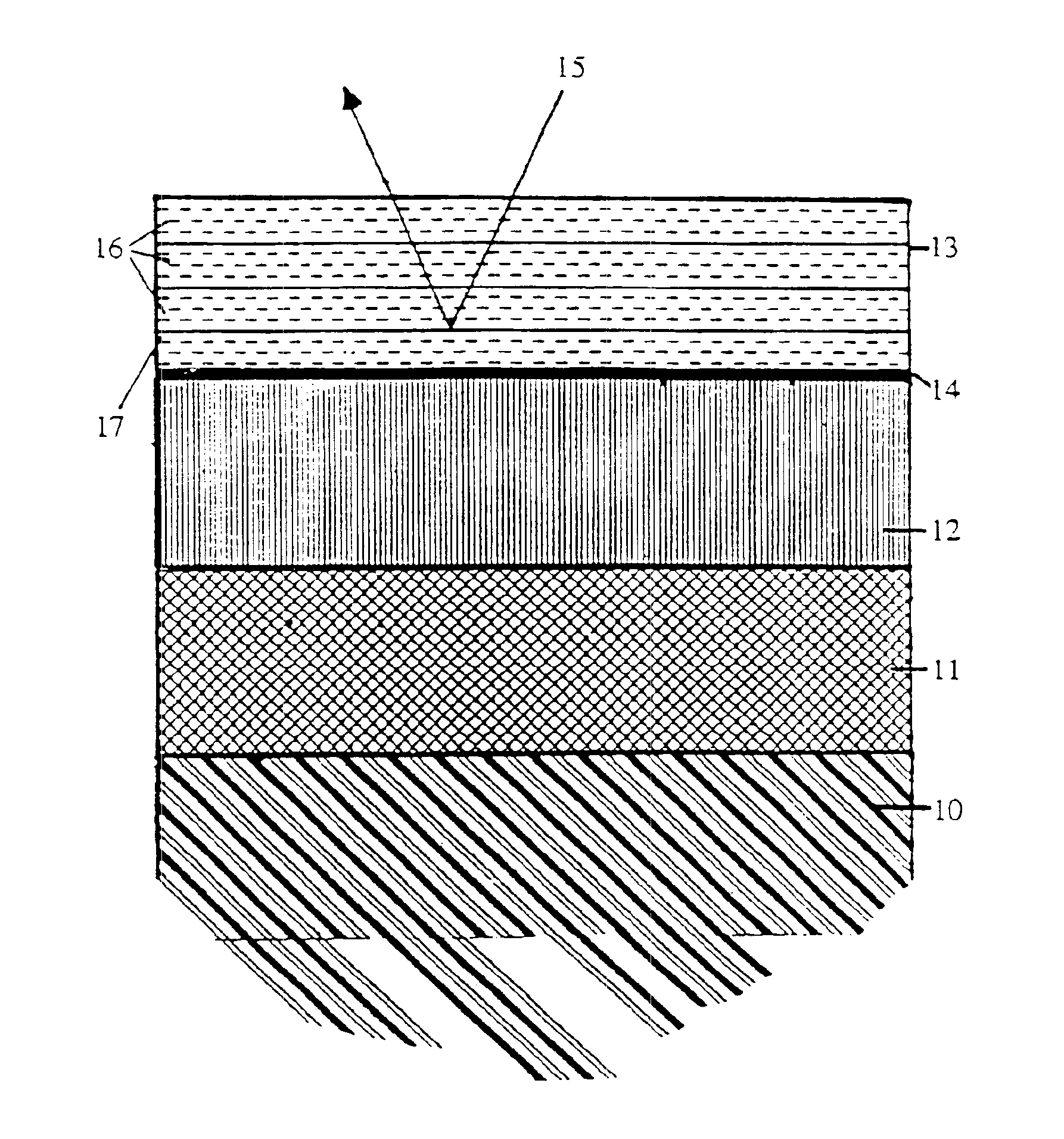
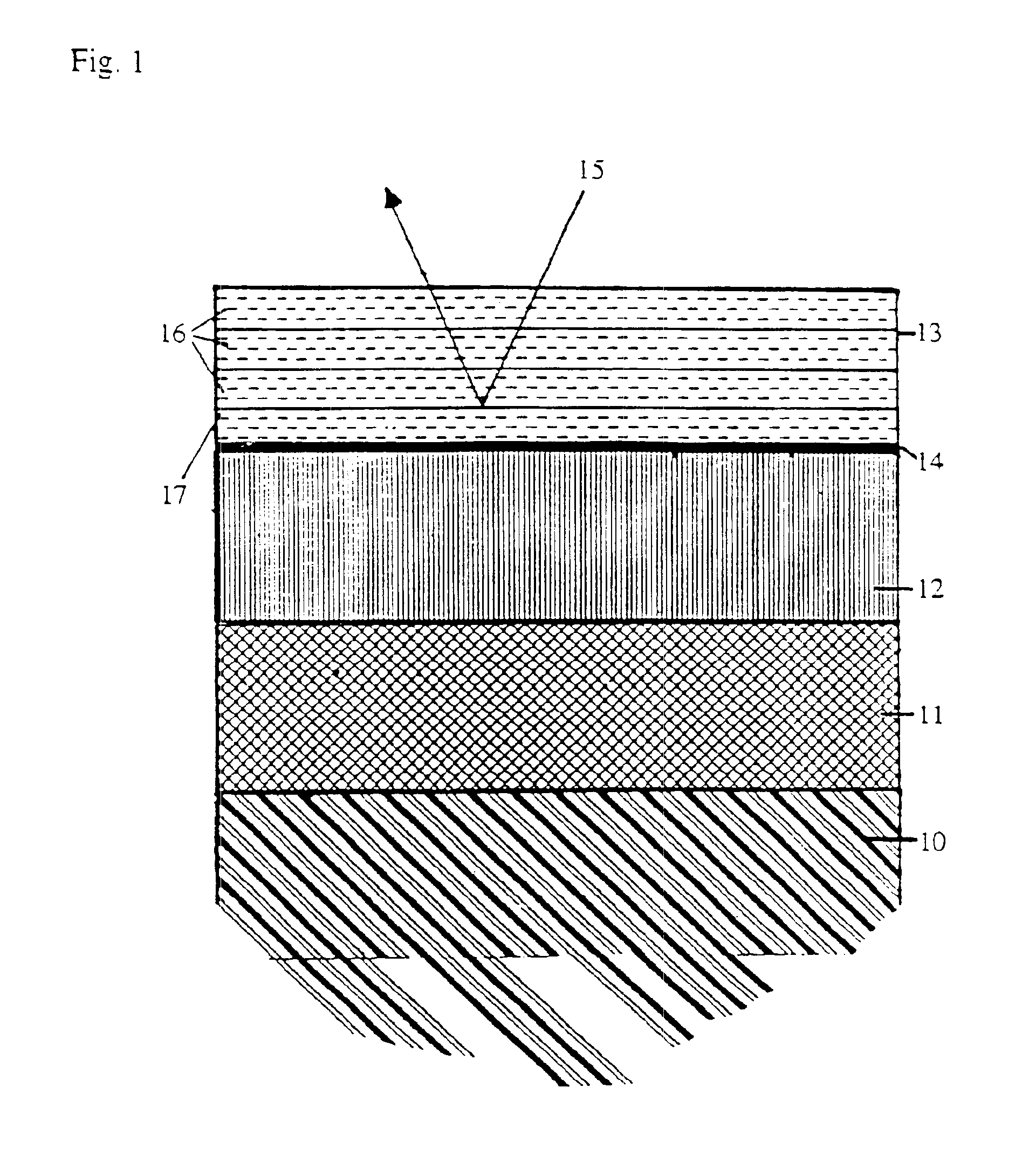
Reflectors, for example, for lamps used for technical lighting purposes, having a surface which is resistant to mechanical and chemical attack and has high total reflectivity. The body (10) of the reflector, which is, for example, a rolled aluminum product such as a foil, a strip of a sheet, has a surface layer in the form of a layer system containing (a) a pretreatment layer (11), onto which is deposited (b) a functional layer (12) with silanes, having organo-functional groups, of a metal compound, and onto which is deposited (c) a metal-containing reflective layer (13). Layer (a) is deposited on the reflector body and increases the strength of bonding to the above lying layers (a) and (b). Layer (b) effects a flattening and increase in the mechanical strength of the above lying layer (c). The pretreatment layer can be a layer produced by anodic oxidation. The functional layer (b) can be a sol-gel layer. The reflective layer (c) can be a metallic reflective layer, in some cases with one or more protective layers, which are deposited, e.g., by vacuum thin layer deposition process.
Need to check novelty before this filing date? Find Prior Art

Description

BACKGROUND OF THE INVENTION

[0001] 1. Field of the Invention

[0002] The present invention relates to a reflector having, on a reflector body, a surface which is resistant to mechanical and chemical attack and exhibits high total reflectivity. The invention relates also to a process for its manufacture and the use of such reflectors with a resistant surface layer.

[0003] 2. Background Art

[0004] Known is the production of bright finish strips e.g. of high purity aluminium or AlMg alloys based on aluminium having a purity of 99.8% and higher, such as e.g. 99.9%, and roll surfaces that produce diffuse or directionally reflected light depending on the application. To increase the directional reflectivity (degree of brightness) of such strips, it is also known to brighten the strips chemically or electrolytically, then to create a e.g. 1.5 μm thick protective layer by anodic oxidation.

[0005] Anodising processes are chemical treatments which suffer the disadvantage of requiring considerable precau...

Examples

example

[0071]1. A pre-treatment layer is deposited on an aluminium strip in a continuous process. For that purpose an aluminium strip (Al 99.8, Ra 0.08 μm), 500 mm wide and 0.3 mm thick is continuously anodised at 40 m / min. In that process the strip is exposed to the following treatments:[0072]a) Degreasing at pH 9-9.5, at approx. 50° C. and bonder V6150 / 01,[0073]b) rinsing with tap water (room temperature),[0074]c) anodising in 20% H2SO4 at 85° C. and 20V,[0075]d) rinsing in tap water at 50° C. and[0076]e) rinsing in deionised water at approx. 85° C.

[0077]The strip bearing the pre-treatment layer, in the present example the pre-anodised strip, is coated with the functional layer at 40 m / min in a coil coating process and counter-flowing immersion and deposition rolls and dried in a continuous oven at an oven temperature of 200 to 250° C. for approx. 10 to 15 sec. The temperature of the metal (measured using thermoelements on the non-coated substrate) was between 195 and 216° C.

[0078]The ri...