Method for operating internal combustion engine

A technology for internal combustion engines and fuels, applied in mechanical equipment, engine control, machines/engines, etc., can solve the problems of reducing the proportion of fresh air, increasing fuel consumption, and deteriorating thermal characteristics of fuel-air mixture, so as to reduce fuel consumption and optimize fuel consumption The effects of simplification and reduction of the remaining gas fraction

CN101210523AInactive Publication Date: 2008-07-02ROBERT BOSCH GMBH
0 Cites 2 Cited by

Patent Information

Authority / Receiving Office
CN · China
Patent Type
Applications(China)
Current Assignee / Owner
Publication Date
2008-07-02
Estimated Expiration
Not applicable · inactive patent

Smart Images

  • Figure 1
    Figure 1
  • Figure 2
    Figure 2
Patent Text Reader

Abstract

A method for operating an internal combustion engine working according to the Otto principle, in which fuel, particularly gasoline, is injected directly into a combustion chamber and is inflamed by self-ignition. A characteristic quantity characterizing the stability of combustion of an air / fuel mixture located in the combustion chamber is ascertained, and, as a function of the characteristic quantity, a residual gas proportion in the cylinder associated with the combustion chamber is set, in particular minimized, the residual gas proportion being reduced, preferably iteratively, as long as the characteristic quantity does not fall below a specifiable stability boundary.
Need to check novelty before this filing date? Find Prior Art

Description

technical field

[0001] The invention relates to a method for operating an internal combustion engine according to the preamble of claim 1 . Furthermore, the invention relates to a computer program and a control device for an internal combustion engine. Background technique

[0002] Internal combustion engines are known which have the mode of operation known as HCCI (Homogeneous Charge Compression Ignition) in which fuel is injected directly into the combustion chamber and - comparable to the diesel principle - self-ignites. In other internal combustion engines operating with external ignition, this method of HCCI combustion is used especially due to its potential to reduce fuel consumption and reduce emissions. Because the HCCI combustion method is generally sensitive to changed boundary conditions, such as ambient temperature, changes in the valve system of the internal combustion engine, ambient pressure, aging of components of the internal combustion engine, etc., the co...

Examples

Embodiment Construction

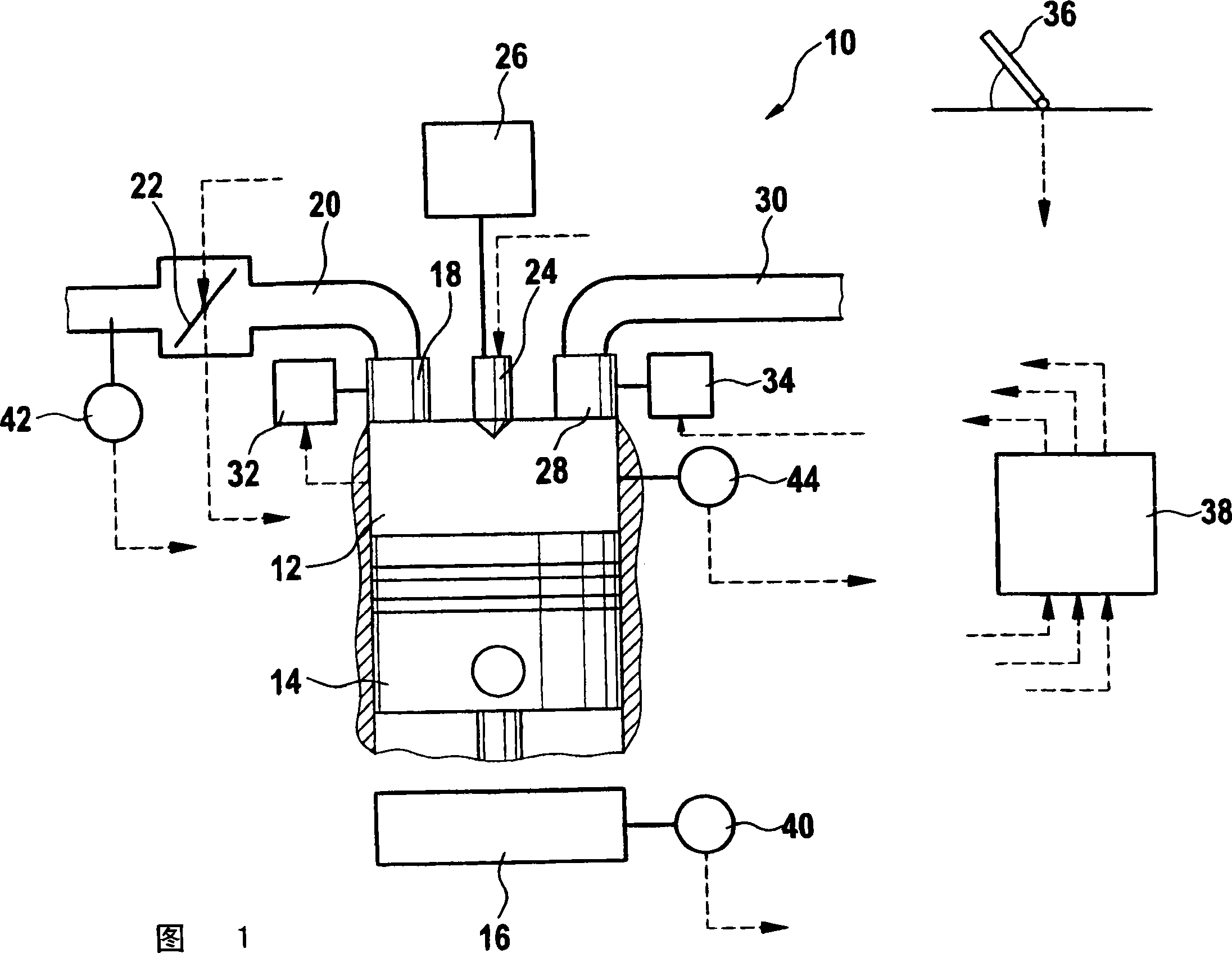
[0023] In FIG. 1 , the entire internal combustion engine is indicated by reference numeral 10 . This internal combustion engine is preferably used to drive a motor vehicle (not shown). Internal combustion engine 10 includes a plurality of cylinders, a cylinder with a combustion chamber 12 and a piston 14 being shown as an example in FIG. 1 . Piston 14 is connected to crankshaft 16 . Combustion air passes through intake valve 18 and intake passage 20 to combustion chamber 12 . The intake duct 20 has a throttle valve 22 for regulating the mass flow of fresh air. This fresh air mass flow is delivered to combustion chamber 12 via intake duct 20 .

[0024] Fuel is injected directly into combustion chamber 12 through injector 24 . The injector is fueled on its side by a high pressure fuel system 26 . The direct injection of fuel into combustion chamber 12 enables a more targeted influence of the HCCI-based operating mode of internal combustion engine 10 than a port injection. ...