
A kind of ash-removing and coking-removing agent formula for municipal solid waste incinerators
A technology for municipal solid waste and incinerators, applied in incinerators, combustion methods, combustion types, etc., to achieve the effects of improving ash and slagging conditions, improving boiler efficiency, and prolonging the safe operation period of boilers
- Summary
- Abstract
- Description
- Claims
- Application Information
AI Technical Summary
Problems solved by technology
Method used
Image

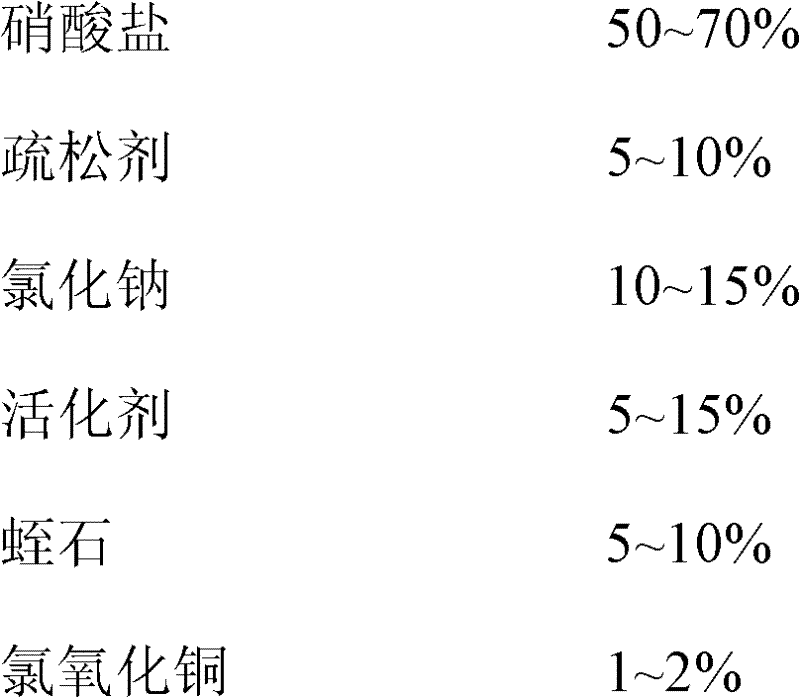
Examples
Embodiment 1
[0069] First, take 58Kg of nitrate (copper nitrate and sodium nitrate), 10Kg of borax, 10Kg of sodium chloride, 3Kg of ammonium nitrate, 4Kg of carbon powder, 3Kg of sulfur powder, 10Kg of vermiculite, and 2Kg of copper oxychloride, mix them and crush them to 50-40 mesh Fine particles account for more than 80%; then put the crushed mixture into the mixer and stir evenly; dry the stirred mixture at a drying temperature of 100°C to 150°C and a drying time of 10 to 20 minutes; finally, it is inspected and packaged Warehouse for finished products.
Embodiment 2
[0071] First, take 60Kg of nitrate (copper nitrate and sodium nitrate), 10Kg of borax, 10Kg of sodium chloride, 5Kg of ammonium nitrate, 5Kg of carbon powder, 3Kg of sulfur powder, 5Kg of vermiculite, and 2Kg of copper oxychloride, mix and crush to 50-40 mesh Fine particles account for more than 80%; then put the crushed mixture into the mixer and stir evenly; dry the stirred mixture at a drying temperature of 100°C to 150°C and a drying time of 10 to 20 minutes; finally, it is inspected and packaged Warehouse for finished products.
Embodiment 3
[0073] First, take 65Kg of nitrate (copper nitrate and sodium nitrate), 10Kg of borax, 10Kg of sodium chloride, 3Kg of ammonium nitrate, 2Kg of carbon powder, 3Kg of sulfur powder, 5Kg of vermiculite, and 2Kg of copper oxychloride, mix them and crush them to 50-40 mesh Fine particles account for more than 80%; then add the crushed mixture into the mixer-stir evenly; dry the stirred mixture at a drying temperature of 100°C to 150°C and a drying time of 10 to 20 minutes; finally, it is inspected Packaging is finished product storage.
PUM
 Login to View More
 Abstract
Description
Claims
Application Information
 Login to View More