Peanut paste with reasonable fatty acid proportion
Active Publication Date: 2011-10-26
SHANGHAI LIANGYOU GRP +1
View PDF4 Cites 0 Cited by
Summary
Abstract
Description
Claims
Application Information
AI Technical Summary
This helps you quickly interpret patents by identifying the three key elements:
Problems solved by technology
Method used
Benefits of technology
Problems solved by technology
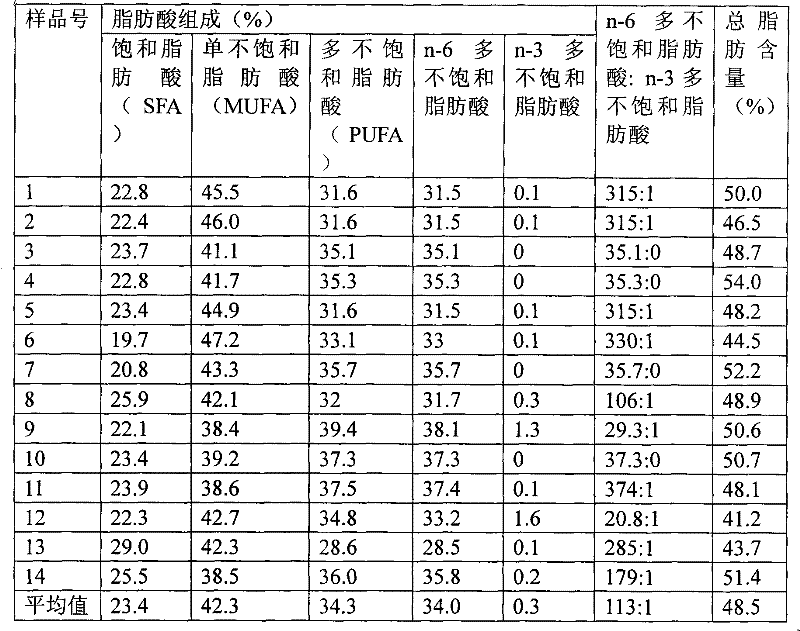
[0015] The purpose of the present invention is to solve the problem of unbalanced proportion of fatty acid composition of peanut butter on the market, to provide a brand-new peanut butter, which can provide consumers with a peanut butter with a reasonable proportion of fatty acids, and improve the nutritional value of peanut butter
Method used
the structure of the environmentally friendly knitted fabric provided by the present invention; figure 2 Flow chart of the yarn wrapping machine for environmentally friendly knitted fabrics and storage devices; image 3 Is the parameter map of the yarn covering machine
View more
Image
Smart Image Click on the blue labels to locate them in the text.
Viewing Examples
Smart Image
Click on the blue label to locate the original text in one second.
Reading with bidirectional positioning of images and text.
Smart Image
Examples
Experimental program
Comparison scheme
Effect test
Embodiment 1
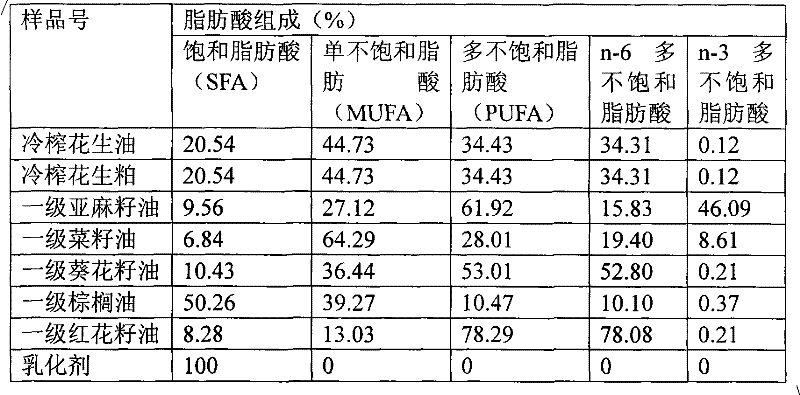
[0027] 100kg of peanut kernels are roasted at 140°C for about 25 minutes, with a suitable degree of burnt aroma. The roasted peanuts are immediately cooled to room temperature, and the broken red coat is blown away by the wind. And select the peanut kernels that have been removed from the burnt and red coat. Then, the peanut kernels are cold-pressed by a cold-pressing machine to obtain 39.3 kg of cold-pressed peanut oil and 60.7 kg of cold-pressed peanut meal. After testing, the fat content of cold-pressed peanut meal was 15.3%, and the fatty acid composition of cold-pressed peanut meal and cold-pressed peanut oil was shown in Table 3. The cold-pressed peanut meal and cold-pressed peanut oil prepared in this example were used as raw materials for the following examples.
[0028] The following examples selected vegetable oil and emulsifier as raw materials, and the emulsifier was monoglyceride. The selected raw material fatty acid composition test results are shown in Table 3...
Embodiment 2
[0032] The selected raw materials are 589.1g of cold-pressed peanut meal, 7.1g of cold-pressed peanut oil, 250.5g of first-grade rapeseed oil, 128.2g of first-grade safflower oil, and 25.1g of first-grade linseed oil.
[0033] After crushing the cold-pressed peanut meal in a mixer, add other materials, mix evenly, and then finely grind the mixture with a colloid mill to make the material fully mixed and stable, and put it into a bottle to obtain the finished peanut butter.
Embodiment 3
[0035] The raw materials selected are 596.2g of cold-pressed peanut meal, 52.3g of cold-pressed peanut oil, 22.0g of first-grade rapeseed oil, 176.4g of first-grade safflower oil, 74.3g of first-grade linseed oil, 68.8g of first-grade palm oil, and emulsifier. 10.0g.
[0036] After crushing the cold-pressed peanut meal in a mixer, add other materials, mix evenly, and then finely grind the mixture with a colloid mill to make the material fully mixed and stable, and put it into a bottle to obtain the finished peanut butter.
the structure of the environmentally friendly knitted fabric provided by the present invention; figure 2 Flow chart of the yarn wrapping machine for environmentally friendly knitted fabrics and storage devices; image 3 Is the parameter map of the yarn covering machine
Login to View More
PUM
Login to View More
Abstract
The invention discloses a peanut butter with reasonable fatty acid proportions. based on the total fatty acid weight in the peanut butter, the weight percentage composition of the fatty acids is: saturated fatty acid 10%-30%, single unsaturated fatty acid 30%-50%, and polyunsaturated fatty acid 30%-50%; in the polyunsaturated fatty acid, the ratio of the contents of n-6 polyunsaturated fatty acidand n-3 polyunsaturated fatty acid is 4:1-6:1. The peanut butter of the present invention has reasonable proportion in fatty acid composition, achieves high nutritive value and is helpful for consumer to intake balanced fatty acid nutrients.
Description
technical field [0001] The present invention relates to food, in particular to peanut butter. Background technique [0002] Peanut butter is a high-fat and high-protein nutritious food with special flavor and good taste. It is convenient to eat and can be eaten in various ways. It is a delicious meal or seasoning food. There are also a variety of peanut butter products in the Chinese market. As people are increasingly producing and developing food from a health perspective, peanut butter is no exception, but at present, people have developed many technologies mainly focusing on reducing the energy of peanut butter, and there are many invention patent applications in this area, and peanut butter is no exception. It is true that there are no products and related reports to improve and optimize the nutrition of peanut butter from a more reasonable perspective of the fatty acid composition of the fat contained in it. [0003] Lipids are one of the important nutrients that the ...
Claims
the structure of the environmentally friendly knitted fabric provided by the present invention; figure 2 Flow chart of the yarn wrapping machine for environmentally friendly knitted fabrics and storage devices; image 3 Is the parameter map of the yarn covering machine
Login to View More
Application Information
Patent Timeline
Application Date:The date an application was filed.
Publication Date:The date a patent or application was officially published.
First Publication Date:The earliest publication date of a patent with the same application number.
Issue Date:Publication date of the patent grant document.
PCT Entry Date:The Entry date of PCT National Phase.
Estimated Expiry Date:The statutory expiry date of a patent right according to the Patent Law, and it is the longest term of protection that the patent right can achieve without the termination of the patent right due to other reasons(Term extension factor has been taken into account ).
Invalid Date:Actual expiry date is based on effective date or publication date of legal transaction data of invalid patent.



 Login to View More
  Login to View More