AI technical title is built by Patsnap AI team. It summarizes the technical point description of the patent document.
A technology of transmit diversity and diversity coding, applied in the field of communication, can solve the problems that the diversity gain cannot be obtained, and the available diversity effect is not fully utilized.
Inactive Publication Date: 2009-07-22
ZTE CORP
View PDF3 Cites 5 Cited by
Summary
Abstract
Description
Claims
Application Information
AI Technical Summary
This helps you quickly interpret patents by identifying the three key elements:
Problems solved by technology
Method used
Benefits of technology
Problems solved by technology
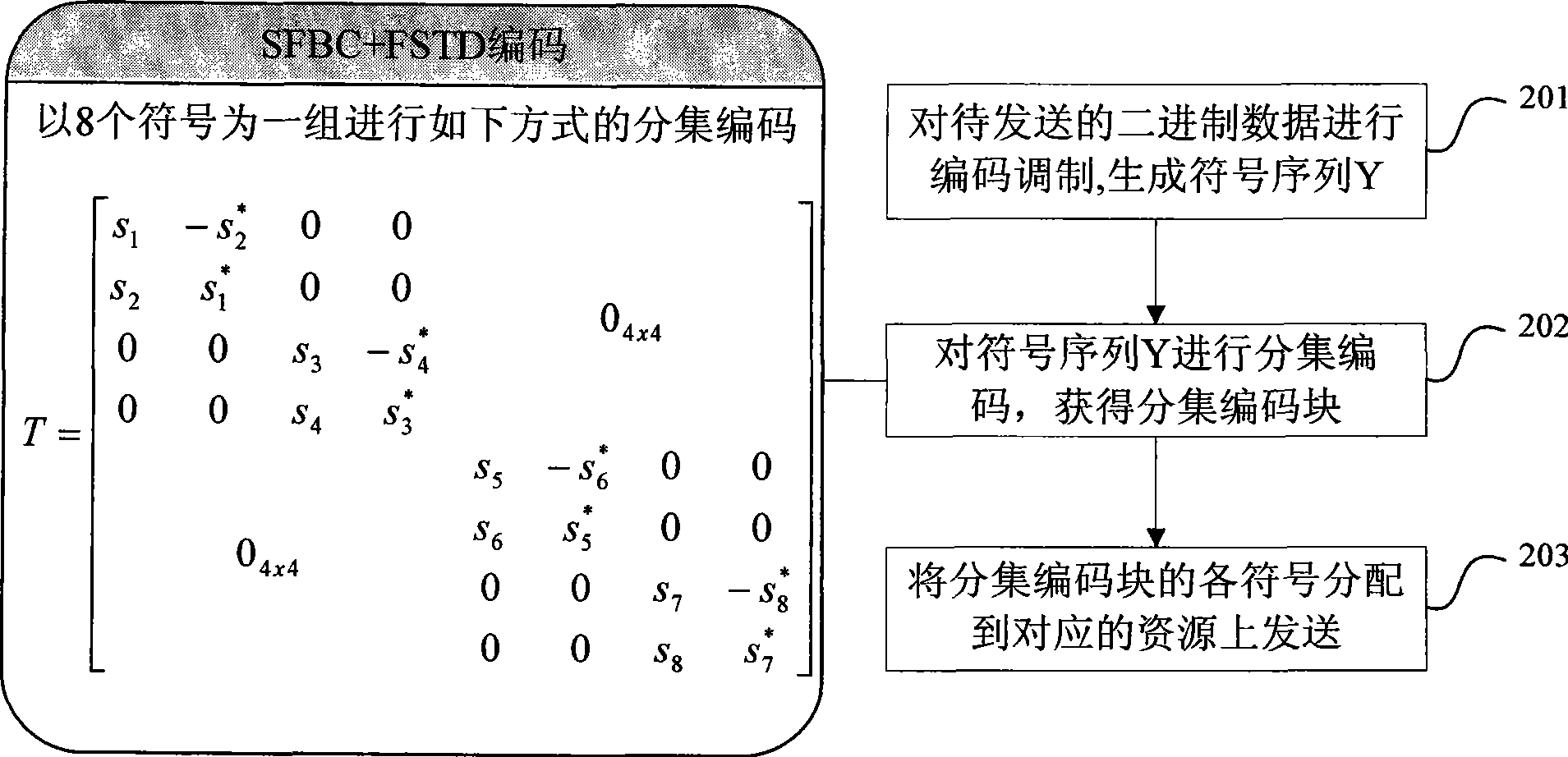
This scheme has the following disadvantages: each symbol transmitted can only obtain the diversity gain of transmitting on 2 antennas and switching between 4 groups of antennas, but cannot obtain the diversity gain of transmitting on 8 antennas and switching between 4 groups of antennas, let alone Gain diversity gain over more than 8 antennas transmitting over more channels
In the case of using more antennas, the disadvantages of the transmit diversity scheme in the prior art will be more obvious because there are more available diversity effects that are not fully utilized
Method used
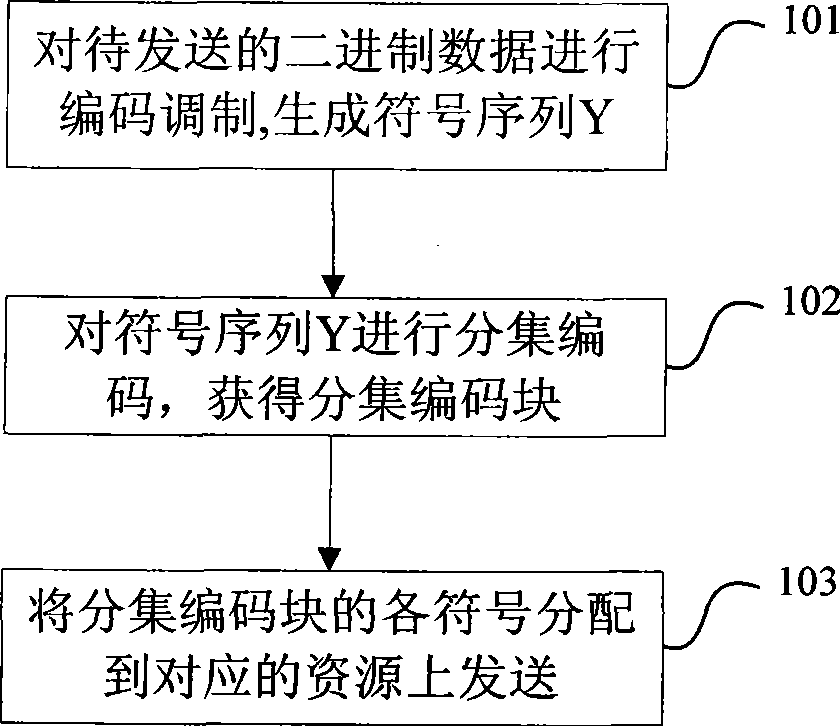
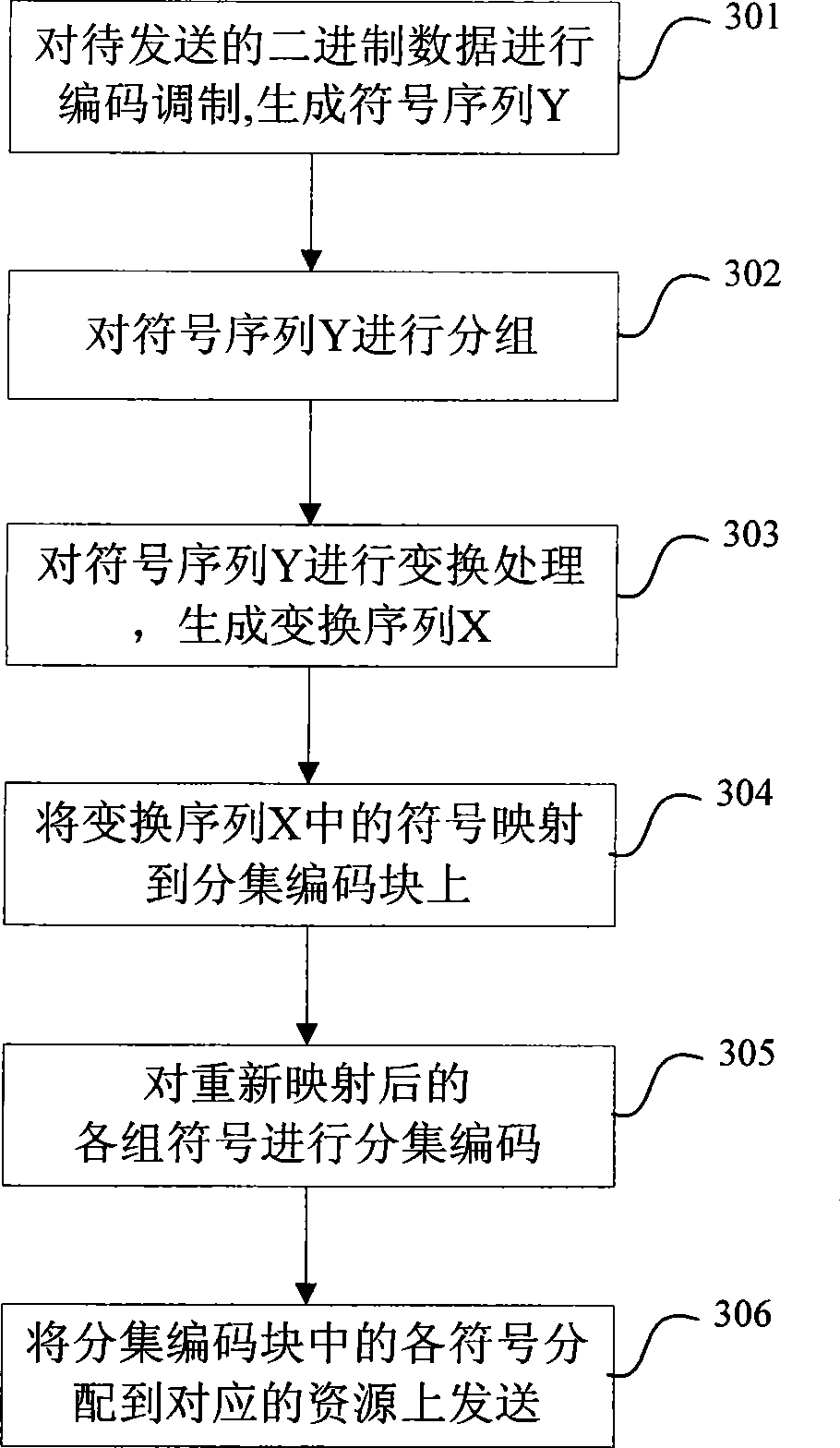
the structure of the environmentally friendly knitted fabric provided by the present invention; figure 2 Flow chart of the yarn wrapping machine for environmentally friendly knitted fabrics and storage devices; image 3 Is the parameter map of the yarn covering machine
View more
Image
Smart Image Click on the blue labels to locate them in the text.
Viewing Examples
Smart Image
Click on the blue label to locate the original text in one second.
Reading with bidirectional positioning of images and text.
Smart Image
Examples
Experimental program
Comparison scheme
Effect test
example 1
[0115] Example 1: A diversity coding block requires 4 transmission symbols, and the number of symbols in the new group needs to correspond to the number of symbols required by the diversity coding block, so the new group contains 4 symbols; it can be generated by crossing the transformed 2 groups, such as [X 1 , X 2 ] T with [X 3 , X 4 ] T Form a new group: [X 1 , X 3 , X 2 , X 4 ] T or [X 3 , X 2 , X 1 , X 4 ] T , [X 2 , X 3 , X 1 , X 4 ] T Wait.
example 2
[0116] Example 2: A diversity coding block requires 8 transmission symbols, which can be represented by [X 1 , X 2 , X 3 , X 4 ] T and [X 5 , X 6 , X 7 , X 8 ] T Form a new group [X 1 , X 6 , X 3 , X 8 , X 5 , X 2 , X 7 , X 4 ] T , or [X 5 , X 2 , X 7 , X 4 , X 1 , X 6 , X 3 , X 8 ] T Wait;
[0117] It can also be composed of 4 groups, [X 1 , X 2 ] T , [X 3 , X 4 ] T , [X 5 , X 6 ] T , [X 7 , X 8 ] T Cross combinations generate new groups.
[0118] 4.1.1.2. Multi-group cross exchange or cross-recombination into multiple groups
[0119] After the grouping in step 302, multiple groups are recombined into multiple groups and then mapped to multiple diversity coded blocks for transmission. Cross-combining can be performed during merging to enhance the diversity effect.
example 3
[0120] Example 3: Each diversity coding block requires 4 symbols, which can be composed of the original 2 groups:
[0121] [X 1 , X 2 , X 3 , X 4 ] T , [X 5 , X 6 , X 7 , X 8 ] T Crossover to form new 2 groups:
[0122] [X 1 , X 6 , X 3 , X 8 ] T and [X 5 , X 2 , X 7 , X 4 ] T ,or:
[0123] [X 1 , X 5 , X 3 , X 7 ] T and [X 2 , X 6 , X 4 , X 8 ] T , or other similar combinations.
the structure of the environmentally friendly knitted fabric provided by the present invention; figure 2 Flow chart of the yarn wrapping machine for environmentally friendly knitted fabrics and storage devices; image 3 Is the parameter map of the yarn covering machine
Login to View More
PUM
Login to View More
Abstract
A transmission diversity method comprises: transforming modulating symbol sequence Y to be transmitted with N symbols as one set to generate a transforming sequence X with N symbols as one set, wherein, the transformation enables the any one symbolic information in the modulating symbol sequence Y to be included by a plurality of symbols in the transforming sequence X, and one symbol in the transforming sequence X includes a plurality of symbol information in the modulating symbol sequence Y; mapping the symbols generated by the same transformation in the transforming sequence X into different space-frequency block code SFBC blocks in a diversity coding matrix, diversity coding and transmitting the mapped symbols by using the diversity encoding mode based on SFBC; or mapping the symbols generated by the same transformation in the transforming sequence X into different space time block code STBC blocks, and diversity coding and transmitting the mapped symbols by using the diversity encoding mode based on STBC.
Description
technical field [0001] The present invention relates to the communication field, in particular to a transmission diversity method. Background technique [0002] In the process of wireless communication, the signal received by the receiving end is a decaying signal with noise, and its signal-to-noise ratio (Signal To Noise Ratio) affects the transmission performance. When the SNR is low, the transmission performance is poor and the channel link becomes unreliable. In the case of multi-antenna diversity transmission, the channel becomes complicated, and the receiving end can receive the same signal (or a signal containing the same information) through multiple transmissions, and the signal-to-noise ratio becomes lower after the signal arrives at the receiving end. The single-channel signal transmitted by a single antenna should be small, thereby improving the reliability of the link, that is, obtaining diversity gain. [0003] Due to the complexity of the multi-antenna wirel...
Claims
the structure of the environmentally friendly knitted fabric provided by the present invention; figure 2 Flow chart of the yarn wrapping machine for environmentally friendly knitted fabrics and storage devices; image 3 Is the parameter map of the yarn covering machine
Login to View More
Application Information
Patent Timeline
Application Date:The date an application was filed.
Publication Date:The date a patent or application was officially published.
First Publication Date:The earliest publication date of a patent with the same application number.
Issue Date:Publication date of the patent grant document.
PCT Entry Date:The Entry date of PCT National Phase.
Estimated Expiry Date:The statutory expiry date of a patent right according to the Patent Law, and it is the longest term of protection that the patent right can achieve without the termination of the patent right due to other reasons(Term extension factor has been taken into account ).
Invalid Date:Actual expiry date is based on effective date or publication date of legal transaction data of invalid patent.


 Login to View More
  Login to View More