
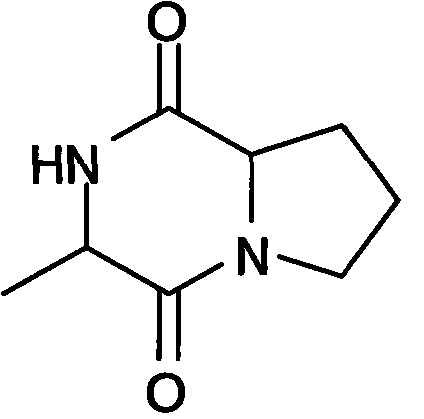
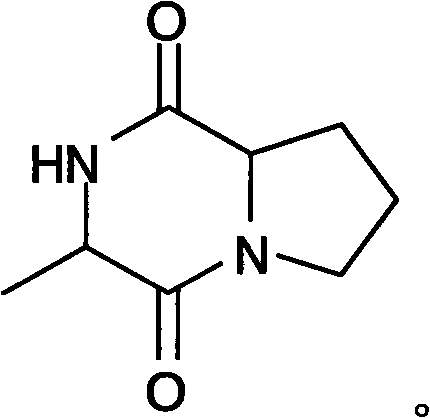
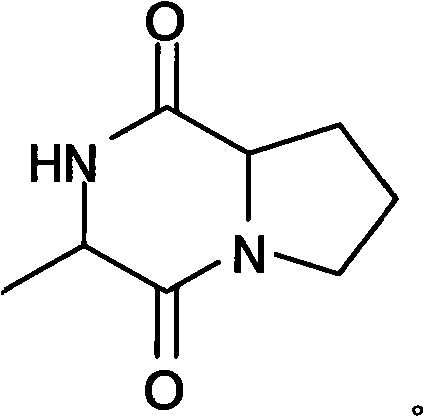
Application of cycle (proline-alanine) in preventing and removing marine fouling organism
A biological control and marine fouling technology, applied in the field of marine antifouling coatings, has achieved good application prospects, easy access, and great potential for popularization and application
- Summary
- Abstract
- Description
- Claims
- Application Information
AI Technical Summary
Problems solved by technology
Method used
Image

Examples
Embodiment 1
[0027] Experimental group I: the ring (proline-alanine) was dissolved in methanol to prepare a solution with a concentration of 28.26 μg / ml. Add 1 ml of this solution to a petri dish with a diameter of 6 cm, and make it evenly cover the bottom of the petri dish. After the solvent is completely evaporated, the content of the ring (proline-alanine) coated on the bottom of the petri dish is 1 μg / cm 2 . Add 10ml of seawater.
[0028] Experimental group II: the ring (proline-alanine) was dissolved in methanol to prepare a solution with a concentration of 98.91 μg / ml. Add 1 ml of this solution to a petri dish with a diameter of 6 cm, and make it evenly cover the bottom of the petri dish. After the solvent is completely evaporated, the content of the ring (proline-alanine) coated on the bottom of the petri dish is 3.5 μg / cm 2 . Add 10ml of seawater.
[0029] Control group: Add 1ml of methanol to distribute the solution evenly on the bottom of the petri dish, and then add 10ml of ...
Embodiment 2
[0036] Experimental group: the ring (proline-alanine) was dissolved in methanol to prepare a solution with a concentration of 282.6 μg / ml. Add 1 ml of this solution to a petri dish with a diameter of 6 cm, and make it evenly cover the bottom of the petri dish. After the solvent is completely evaporated, the content of the ring (proline-alanine) coated on the bottom of the petri dish is 10 μg / cm 2 . Add 10ml of seawater.
[0037] Control group: Add 1ml of methanol to distribute the solution evenly on the bottom of the petri dish, and then add 10ml of seawater after the solvent has evaporated completely.
[0038] Blank group: add 10ml of seawater.
[0039] Determination of the number of larvae: Take the water body containing the larvae of Pinctada martensii from the nursery pond and concentrate it with a sieve. Take 50ml each for three times, add 1-2 drops of formalin solution to kill the larvae, and then count them under a microscope. The average value obtained is the densi...
PUM
 Login to View More
 Abstract
Description
Claims
Application Information
 Login to View More